
What are beliefs? I am currently confronted with this question quite often. No wonder, since word has gotten around that our inner beliefs have a direct influence on our thoughts, our Decisions and our behavior. One of the most important skills in the area of personal development is therefore being able to dissolve negative beliefs. This is mainly due to the fact that our behavior is a direct result of our conscious and unconscious beliefs. These inner beliefs can influence us both positively (activating) and negatively (limiting) and therefore play a decisive role in how happy, satisfied and successful we are in life.
In this article, I would therefore like to take an in-depth look at the question “What are beliefs?” and, of course, answer it as comprehensively as possible. After we have looked at how they arise in the first place, what role they play and what examples there are, I will also give you a tried and tested guide at the end that will enable you to dissolve negative beliefs and transform them into positive ones.
Definition of beliefs
Let's start with the definition: “Beliefs are views deeply rooted in the subconscious that we develop in the course of our lives and of which we are deeply and firmly convinced. These beliefs serve as the basis for our thoughts, actions and decisions. Beliefs come from various sources, such as our experiences, upbringing, culture, media or the social environment in which we grew up. They form the filters through which we view the world, influence our perception and interpretation of situations and thus the results of our behavior.”
7 characteristics of beliefs
After this brief definition of beliefs, let's now look at seven fundamental characteristics that all beliefs have in common.
1) Beliefs always come from outside
No baby is born a racist, cynic or optimist. People only develop all beliefs in the course of childhood and adolescence, especially from important caregivers such as parents, relatives, teachers or people with whom they have an emotional relationship.
2) Beliefs work unconsciously
Our beliefs are deeply rooted in our subconscious and serve us faithfully in autopilot mode. More on why this is both good and dangerous later.
3) Beliefs determine our behavior
Beliefs act as a perception filter and therefore determine both our thinking and, above all, our decisions. You behave differently depending on how you see the world.
4) Beliefs are reinforced over time
The more convinced you are of something, the more evidence you will find of it in everyday life. And the more evidence you find that your conviction is correct, the more it becomes firmly established. More details on this later.
5) Beliefs can be beneficial
Positive beliefs have an activating effect, direct your focus towards opportunities in life and ensure that you are able to develop your full potential.
6) Beliefs can be limiting
Negative beliefs have a limiting effect, focus on problems in life and (unconsciously) ensure that you sabotage yourself and do not achieve the success that you (consciously) want so much.
7) Beliefs can be changed
This is perhaps the most important quality of all. Because even if beliefs always work unconsciously, they can still be changed. I will tell you exactly how this works at the end of the article.
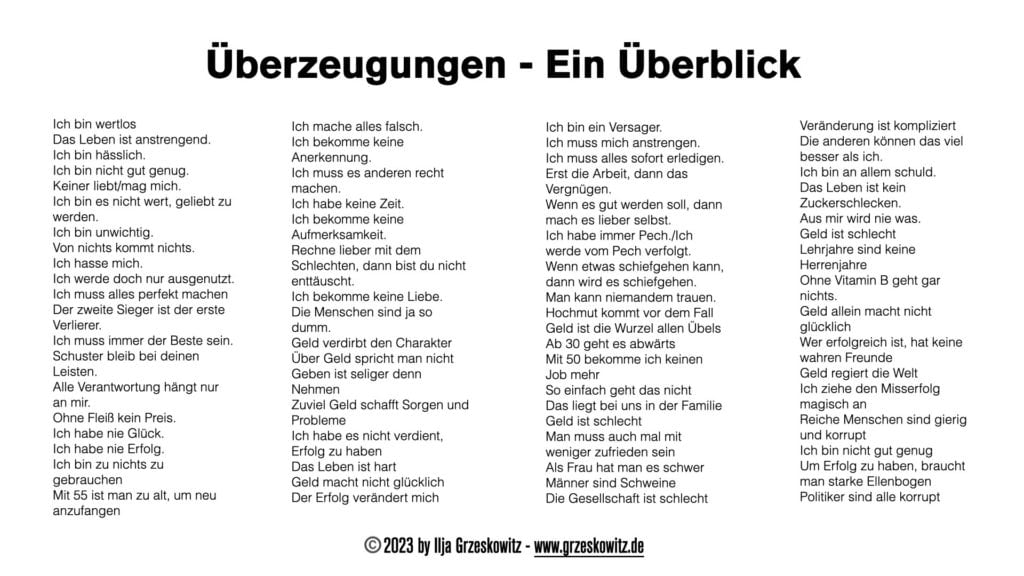
Negative beliefs examples
Negative beliefs can manifest themselves in different areas of our lives. Here are some examples of negative beliefs:
- „I'm not good enough.“
- „I don't deserve happiness.“
- „I am not worthy of being loved.“
- „Money is hard to earn.“
- „I can never change.“
A comprehensive (but by no means complete) overview can be found in the following graphic.
Positive beliefs examples
Positive beliefs, on the other hand, can help us to develop our full potential and lead a fulfilled life. Here are some examples of positive beliefs:
- „I have the ability to achieve anything I set my mind to.“
- „I am worthy of love and success.“
- „I am unique and valuable.“
- „I am financially successful and have enough for my needs.“
- „I have the power to change and grow myself.“
These positive beliefs can strengthen us, guide us towards our goals and create a positive Self-image build up.
How do beliefs arise?
But how do convictions arise in the first place? By no means by chance. Instead, they are the direct result of a wide variety of influences from your environment. They develop from the influences you are constantly exposed to. The information you consume, the people you surround yourself with and the places you move around in. To put it simply, you can imagine it like this: You pick up a belief in the form of an opinion, an idea or a prejudice and adopt it uncritically.
And off you go. Suddenly you find „evidence“ everywhere in your everyday life that confirms your new conviction. And the more „evidence“ you find, the deeper the belief becomes embedded in your subconscious. Our core beliefs are mainly formed in childhood and adolescence, but even in adulthood this process follows exactly the same pattern. And before you know it, you believe deeply and firmly that Success is hard, money corrupts your character and other people are just waiting to rip you off. The firmer your conviction, the more you will notice these things in everyday life. And as a result, the conviction becomes stronger again. A classic spiral that you can either Targets or ensure that you permanently sabotage yourself.
To help you harness the full power of your own beliefs, let's take a critical look at the information, ideas and opinions you surround yourself with throughout the day. It is always the same programming that leads to people having a low self-image and ultimately not believing they can succeed at all. It is the same messages of failure that you have been exposed to since your earliest childhood and that have become a little more entrenched every day through regular repetition.
Recognize beliefs
Negative beliefs lurk everywhere in everyday life and are reflected in the following patterns and behaviors:
- Excuses
- Emotional reactions
- Negative thoughts
- Negative thought patterns
- Assumptions
- Doubts
- Recurring patterns
- Cultural myths
- Urge for perfectionism
- Justifications
- Worries
- Self-deception
- Stereotypes
- Self-optimization mania
- Inner critic
- All the stories we tell ourselves every day
Lurking in all these behaviors and patterns are deep-seated beliefs that, by filtering reality, decide what you actually do and how you react to certain things.
Sources of beliefs
Do you think it makes a difference whether you are reading a novel by Thomas Mann or Wife swap watch on RTL II? Do you spend your afternoon in a bookstore or in the arcade? Whether you attend a seminar for personal development or spend the weekend in front of the television? Destructive suggestions lurk everywhere in everyday life. In addition to your family, teachers and other important people, it is mainly politicians, the radio and, of course, television that bombard you with regular messages of failure and lack. The more often you are exposed to this programming, the more quickly limiting core beliefs such as „Money is the root of all evil“, „There are more important things than success“, „There is not enough for everyone“, „If you fly high, you will fall low“, „Nothing happens without moss“, or „Money spoils your character“ are formed over time. Ever heard that? Ever said it? It's worth taking a particularly critical approach here. Because if you hear these messages every day, you will soon be conditioned to believe them deeply and firmly. Your identity is consolidated.
This is where the name Richard Brodie comes into play. What, you've never heard of him? First of all, you should be more or less grateful to him. In his former life, Brodie was a software programmer at Microsoft and, in this capacity, the developer of the Word writing program. At some point, however, he decided to follow his calling and became a speaker and author (funny, that sounds kind of familiar). In his new role, he devoted himself to studying how external programming influences internal beliefs. As a result of his research, he wrote a book that I can warmly recommend to you. It bears the exciting title Virus of the Mind - The New Science of the Meme.
Based on research into the „selfish gene“ by Richard Dawkins, Brodie describes how ideas settle in the brain and spread there in the same way as a flu virus does, for example. Two factors determine how strongly the information he calls „mind viruses“ take root in the brain. The first is regular repetition. Of course, the more often you have an idea in your head, the more familiar and real it becomes at some point. Then there is the emotional intensity. If an idea is presented in connection with love, sex, fear, children or food, the effect of the suggestion is multiplied many times over. To check this out, all you have to do is go to the nearest newsstand and buy the latest issue of Bild. It is full of examples of both of these phenomena. The combination of intensity and repetition then ensures that a thought virus spreads just as quickly as a typical flu epidemic does. The worst thing about it is that most ideas and opinions are now adopted and passed on without a single spark of personal thought. Newspapers copy each other. Friends tell each other about the latest discovery that came on TV, and modern chain letters are shared and spread indiscriminately on Facebook. And once an opinion or prejudice is in our heads, it doesn't want to get out any time soon.
Critical thinking as protection against negative suggestions
It has therefore never been more important to critical thinker to become. Otherwise, you are helplessly at the mercy of the external programming of advertising experts, television producers and radio presenters. I'm sure you've often heard the following suggestion: „Success corrupts your character and is only possible with elbow grease.“ You no longer really notice it because you have heard it so often. Nevertheless, the message works. A little more with every repetition. The only protection is to critically question the impact of such a message. But you are not always programmed directly. Often it is simply stereotypical but highly emotional images. Imagine you open the newspaper and see a harmless-looking cartoon in which a poor woman is being ripped off by a fat, greedy captain of industry. What message is unconsciously conveyed there? Right, the rich are fat, greedy and exploit poor (and of course honest) people at every opportunity.
The more often you accept such messages uncritically, the stronger their effect and the more they develop into core beliefs on which your view of the world and, above all, of yourself is based. These beliefs sit deep in your subconscious and spread there like the famous thought virus from the movie Inception with Leonardo DiCaprio, in which it is possible to infiltrate other people's dreams and place ideas there. The formerly external idea has become your internal reality. The sum of the core beliefs then inevitably leads to your unconscious autopilot not being geared towards success and abundance, but towards lack and mediocrity. And then you can still be convinced on a conscious level that you want to be successful. If your autopilot is programmed for the exact opposite, you will not achieve your goal. Einstein already knew that when the logical mind and the subconscious are in conflict, the subconscious mind always prevails. And please don't use this statement to follow the lead of the masses and completely abandon the mind. The ability to think critically, to make conscious decisions and to use the gigantic capacity of the brain is the greatest gift that nature has endowed you with.
Dissolve negative beliefs
But it's the unconscious that really gets to work. So it's time to reprogram your inner autopilot and set it up for abundance and success. Just as there is a self-reinforcing negative spiral, you can also start a success domino rally. Start by making a conscious decision for your own personal success. Be ready to receive it. And then implement the following eight steps to dissolve limiting restrictions and deficiency thinking and instead activate your huge potential that is just waiting to be awakened and used by you.
Dissolve limiting beliefs in 7 steps
- Identify a negative belief and ask yourself the following question: “How exactly do I know this?”
- Analyze as consciously as possible how exactly the belief makes itself felt in your everyday life. When does it appear, what triggers it and what behaviors are typical consequences?
- Ask yourself: “What would happen if I kept this belief?”
- When analyzing persuasion, use the following idea as a guide: “Only argue for the limitations that you want to keep.”
- Formulate a positive alternative to replace the negative belief.
- Consciously and consistently integrate the new, positive belief into your everyday life.
- Give yourself at least 66 days and make a Habit out of it.
These seven steps follow a recurring pattern of change:
- Bringing unconscious behavior to the surface
- Change there
- Use it consciously until it becomes a new unconscious habit
What are beliefs? A conclusion
Beliefs act unconsciously as a perception filter of reality and influence our thinking, our behavior and generally our quality of life in a decisive way. It is therefore worthwhile regularly checking your own beliefs and making appropriate changes. Changes to do. Of course, belief system work requires time, patience and commitment, but the positive effects are more than worth it.
I wish you every success in recognizing and dissolving your own personal beliefs. I very much hope that the ideas and impulses in this article will be a loyal companion to you.
 German
 English