

Changes in life are like Robin to Batman, the Spree to Berlin or Asterix to Obelix. Because they ensure that you grow as a person and develop personally. And this leads to greater satisfaction, happiness and fulfillment in the long term, both at work and in everyday life. But if changes in life are essential, why do so many people find them so incredibly difficult? Because they often start in the wrong place. But that doesn't have to be the case. If you have understood and internalized the background to sustainable change. And this is what we want to focus on now.
How do I change my life?
To understand the answer to precisely this question, I would like to introduce you to a model that, in my view, perfectly explains the psychological background to changes in life. It illustrates why some people seem to always succeed in change without much effort, while others fail at the slightest challenge. It is based on the idea of levels of change, which was developed by the social scientist Gregory Bateson and the therapist Robert Dilts were developed.
Over the years, I have continued to refine, supplement and expand my work with this model. The result is my Change Diamond, which can also make a decisive difference for you if you want to use your personality as the most important success factor of the future.
Changes in life with the change diamond model
The following diagram shows an overview of the change model and thus describes how sustainable change works. Or not.
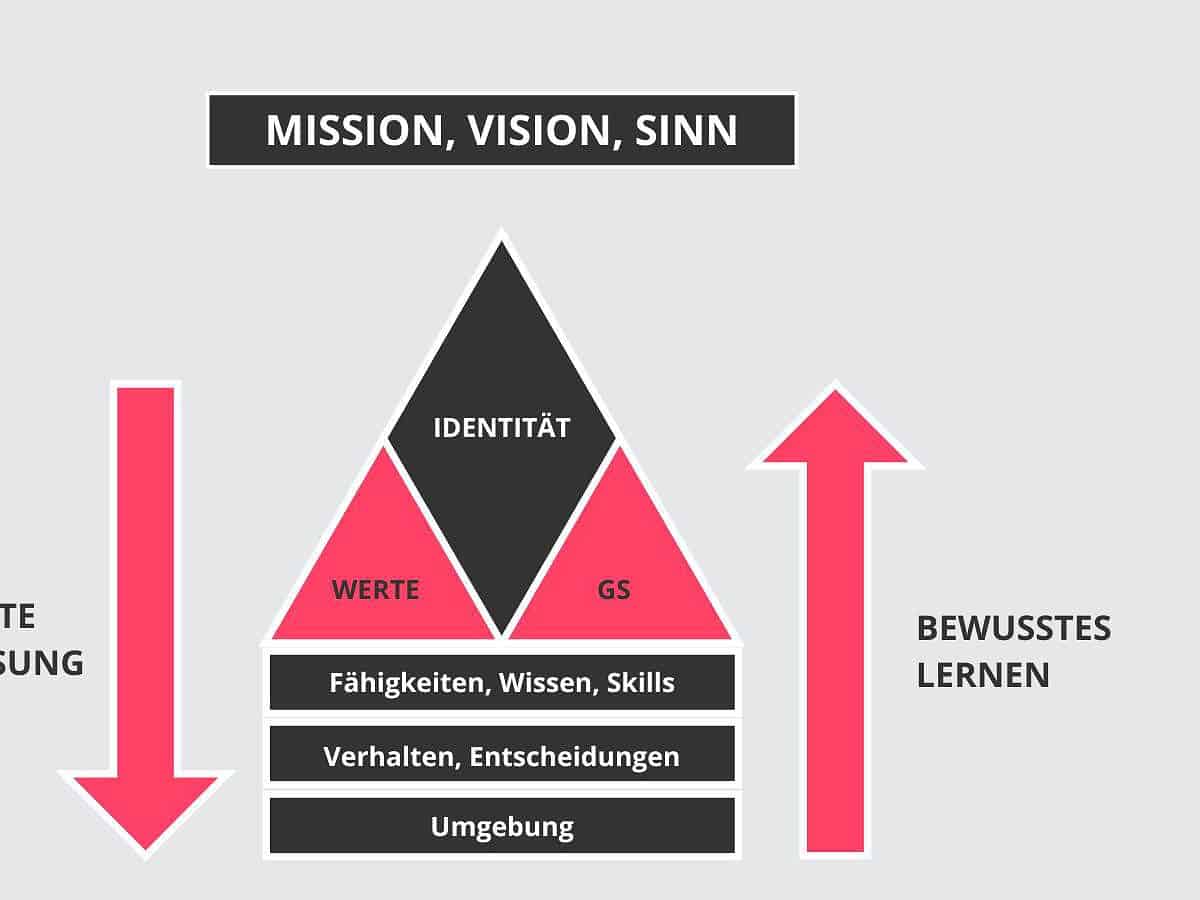
The idea behind the model is quickly explained. There are different psychological levels on which Changes can be brought about, and which influence each other. The top three levels are closely interlinked and the central element is identity, which takes the form of a diamond. We will see in a moment why this symbol fits perfectly. But first, let's take a look at the individual levels.
Surroundings: Our spatial environment, the people we interact with and all other external conditions.
Behavior and decisions: Our concrete actions, i.e. everything we do, make and decide.
Abilities, knowledge and skills: The sum of our knowledge, our skills and our experiences, which then lead to inner processes, strategies and programs.
Beliefs: What we are deeply and firmly convinced is true. Beliefs work on an unconscious level, always come from outside and become stronger over time. They can be both beneficial and limiting.
Values: The moral principles of our being and, as it were, the compass of our actions. Values develop more and more firmly over the course of our lives and also have an effect on an unconscious level. There are so-called motivational values (towards) and aversion values (away from).
Identity: Imagine that you would use all your knowledge, skills, talents, experience and dreams, Values, Your personality, beliefs, strengths, weaknesses and all other aspects of your unique personality into a large funnel. This large mass then goes through a special process and only a single drop comes out at the bottom, which contains the concentrate of what makes you an individual: Your self-image.
Vision, mission and purpose: The vision that drives us personally and the mission that goes beyond our own personality and strives for a higher purpose (for other people). In combination with purpose, they ensure a life with meaning.
Life changes and how they work psychologically
So far, so good. There is now the following connection between the individual levels. Whenever there is a change at one level, this automatically results in changes at the levels below. Top-down, this is therefore an actual connection. Bottom-up changes may or may not occur at the levels above.
This is an optional connection. If we change our values, for example, this automatically results in changes at the levels of skills, behavior and environment. If, on the other hand, we change our behavior, this can lead to a change at the higher levels, but everything can also remain the same. The ellipse with any existing vision and mission then hovers above the complete model.
These factors give our lives real meaning and therefore have a direct impact on the underlying levels of change.
Shaping positive changes in life
I very much hope that this model has given you a significant increase in clarity and that you now understand a little better why change sometimes works and so often does not. In the change diamond model, there is always a "should" relationship from top to bottom and a "can" relationship from bottom to top. And the most important fixed point is identity.
This interacts very closely with our values and beliefs, and defines our personality, our behavior and therefore our results in life. „But wait a minute, Ilya, that would mean that changes at the environmental, behavioral and knowledge level often don't help at all?“ That's exactly the case. Of course, regularly repeating a behavior will eventually lead to a change in identity, but this is rarely the case. Normally, the change diamond will always be the dominant factor.
Why changes in life so often fail
A good example of this are the popular TV series on Vox or RTL2. The pattern here is almost always the same. A dissatisfied and unsuccessful person decides to go to Mallorca or Gran Canaria to make a new start. So they change their environment and usually also their behavior. But these people forget one important thing: they take themselves with them to their new adopted home. And as their identity and the values and beliefs associated with it remain the same, the results look the same after just a short time. same again out. They are frustrated, unsuccessful and turn their backs on the island they had just chosen as their paradise.
Another example is the smoker who tries to make changes in his life at the behavioral level. As long as they do not change anything about their identity („I am a smoker“) and the associated beliefs („It is difficult to stop smoking“ or „If I stop smoking, I will inevitably gain weight“), there may be short-term success, but in the long term such plans always end in relapse. Only when the change diamond is transformed („I am a happy and satisfied non-smoker“) will sustainable results be achieved.
So we can twist and turn it however we like. If we want to bring about deep and lasting change, we have to start at the core of our personality. I would therefore like to end this article with an important conclusion: „Every external change always begins with an internal transformation.“
And now I am interested in your opinion, or rather your experience with changes in life, but of course also with the individual components of the Change Diamond Model. Write me a comment and let's get into the discussion 🙂
Yours sincerely, Ilja Grzeskowitz
 German
  English