
Values are my absolute favorite topic. That's why we want to address an important question in this article: What are values? Why, you ask? Because powerful values and sustainable changes are mutually dependent. Because a conscious approach to values determines whether we are happy or unhappy. Because the focus on values determines our professional success.
I would therefore like to take a closer look at the topic of values in this article. Let's take a look at what exactly values are, why they are so extremely important and how exactly they can be defined and, if necessary, changed. Are you interested?
Why are values important?
Great, then let's get straight to it. With a few harmless-sounding questions that I would like to ask you right at the beginning.
- Why do you lead the life you lead?
- Why did you choose your profession?
- What is Your drive, when things are not going so well
The answer to all three questions is: They are your Values. Nothing has as great an influence on our decisions, behavior and results as our inner value system. They are the compass by which we align everything. The things we do, but also the things we don't do. But first an important note: in this article, I'm not talking about those fluffy, nice-sounding and trendy values that you write on a piece of paper (or print on posters and plaster on the walls of companies).
No, I'm talking about the values that are deeply rooted in our subconscious, our Personality and which we live every single day. To understand this better, let's first take a look at the definition of values.
Values Definition German
What exactly are values? The more you look into the subject, the more you will realize one thing: Pretty much everyone has a rough idea and thinks they already know everything about it. But this knowledge is merely superficial (I know what I'm talking about, I was once at this point too), because dealing with and defining your own values is a bit like Alice in Wonderland. Once they start, the depth of the rabbit hole knows no bounds. So what are values?
As always in such cases, we look at Wikipedia, which provides the following definition of values for us:
„Values are desirable or morally good characteristics or qualities that are attributed to objects, ideas, practical or moral ideals, facts, patterns of action and character traits.“
If you have already read a few of my articles or even Books then you know that I don't like complicated definitions at all, but that I prefer short, concise and, in particular, understandable formulations. My personal definition of values is therefore as follows:
„Values are desirable or unworthy characteristics that serve as a yardstick in decision-making situations.“
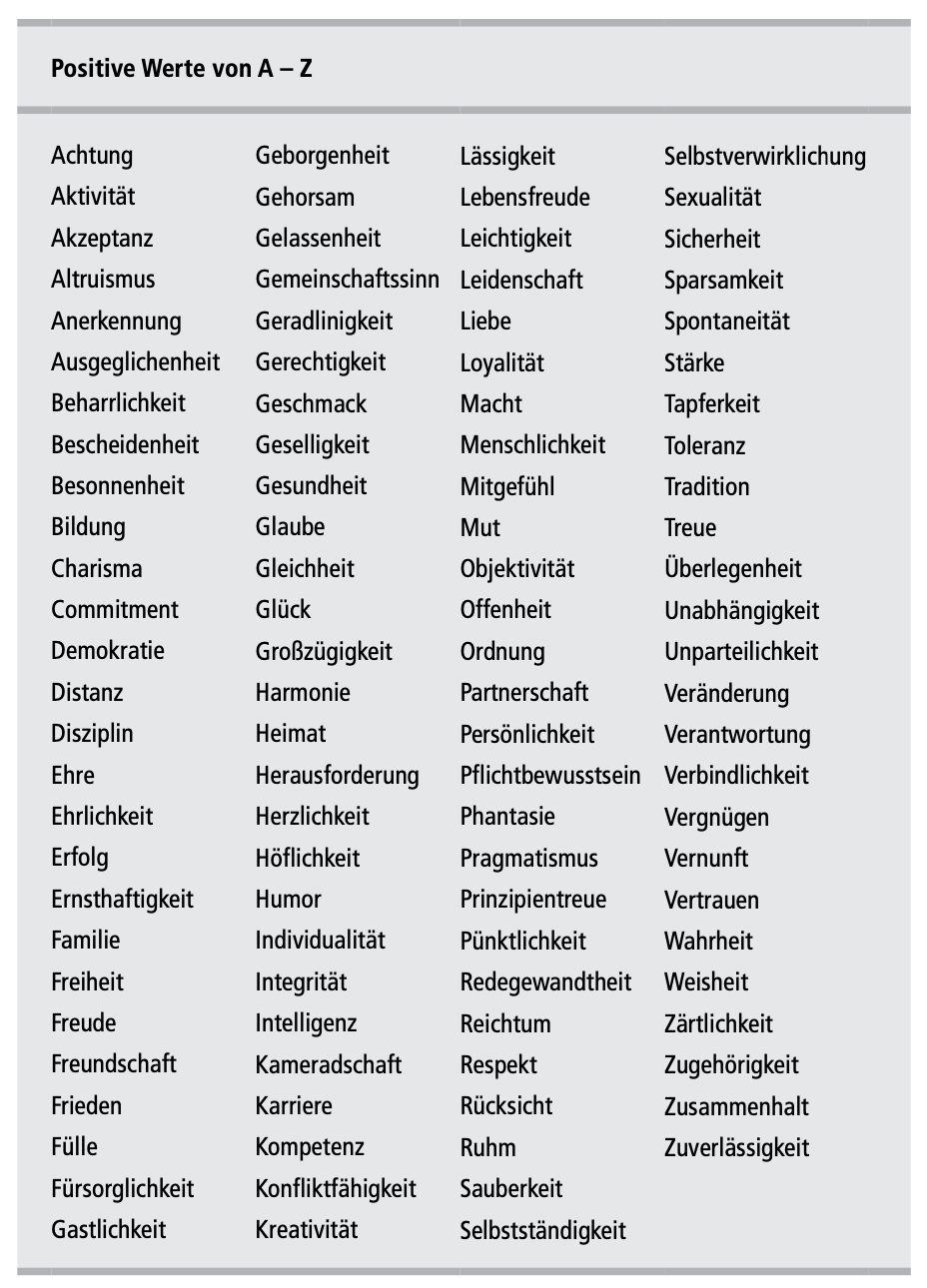
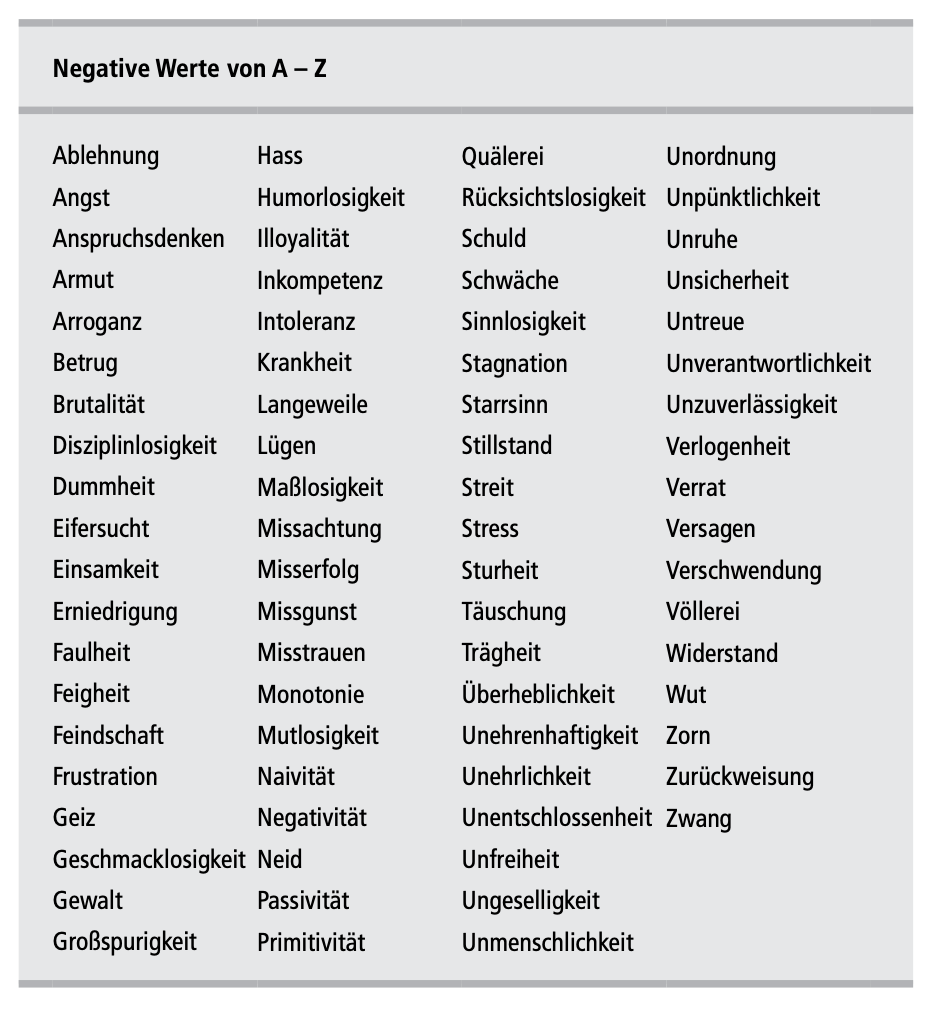
„Erm, Ilya, is that all?“ Yes. A single sentence that describes the entire core of values. To give you an even better understanding of this statement, I would like to present a short (and incomplete) selection of values. First, I will present a list of values that we strive for and that have positive connotations for us. This is immediately followed by an overview of values that we would like to avoid and that we regard as negative.
What are values Examples: Positive focus
What are values Examples: Negative focus
What are my values?
Have you let the two lists sink in for a while? Then I would now like to ask you two questions:
- What are your ten most important positive values?
- What are the ten values that you absolutely want to avoid in your life?
I highly recommend that you take enough time for this consideration. And please be more than careful about one thing. There is a huge difference between the values that we intellectually consider desirable and those that we actually live and act by.
You are welcome to put this to the test. If you ask 100 people about their most important values, you will find that in at least 90 % of all cases Honesty received in response. But already in the next best Conflict situation This is then no longer the case and people resort to white lies, conceal important information or do not dare to express their honest opinion for reasons of political correctness.
Personal values as a reflection of our behavior
Our actions are always a direct reflection of our values. If punctuality is important to us, we would never be late. If honesty is an important value, then we would rather accept negative consequences than lie. Or if we consider thriftiness to be desirable, then we would never throw money around indiscriminately. Generally speaking, you can use your values to identify exactly what is important to you and what you would rather avoid.
But back to the mirror. I've made the connection between our values and the appropriate behavior I learned this the hard way many years ago. You need to know that family has always been at the top of my list. It always seemed quite logical to me intellectually, because nothing was as important to me as my partner and my then still young daughter (who is now a wonderful teenager).
It was so important that I regularly told all my colleagues, employees and friends. And I still remember today how I was struck by the realization one evening when a colleague friend confronted me with the following statement: „Tell me, Ilya, if family is so important to you, why are you still sitting in the office at 9 p.m. for the fourth time this week?“
Rumms. That hit home. My first impulse was to explain my reasons, to argue why it was just an exception. But I quickly realized that anything I would say would only be an excuse in the end. Although a very logical and plausible-sounding one Excuse, but as much as I would have liked it to be different, it was and remained an excuse. And it took a lot of courage for me to admit to myself the real reason why that was the case: at the time, my career was simply more important to me than my family.
Values are more than just a few euphonious words on paper
I admit that I really struggled with this realization. Because in my mind, my family was actually the most important thing for me. But my behavior said something completely different. Or as the old saying goes: „Ich can't hear your words, your actions scream so loud!“
But I didn't want to resign myself to this situation and knew that I had to change something. Basically, I had two options. Either I changed my hierarchy of values and accepted that my career was my top priority for the moment. Or I adapted my behavior to my values. And that's exactly what I chose to do by shifting my focus from being in the office to efficiency and results. The result was that I was not only generally happier again, but also had more drive and fun at work.
Importance of values for human behavior
I hope that one thing has become very clear from this example. In theory, dealing with your own values sounds pretty easy and simple. You write down a few desirable concepts that you think are good and would like to have in your life. The problem is that it makes no difference what we write on a piece of paper. The decisive factor is always what values we act on. And these are not always identical to the ones we would like to have. This is due to a simple but often overlooked causality.
We always evaluate our own behavior, our ideas and values according to our intentions, but those of our fellow human beings exclusively according to their results.
If we were to apply the same standards to ourselves, many of us would see our entire world view collapse like a house of cards.
How do you decide when the going gets tough?
I would like to give you another example. Imagine that you had placed the two values of peace and integrity at the top of your list. You are firmly convinced of this and would of course never act against your pacifist convictions.
But one day you find yourself in an emergency situation. You have lost your job, have to pay off several loans and have four hungry children at home who look at you hopefully every evening with hungry stomachs. Unfortunately, it's not so easy to find a new job and your debts are slowly threatening to grow over your head.
Until one day you receive a phenomenal job offer. A managing director position with a company car, a generous pension plan and a salary that far exceeds your wildest expectations. You know that all you have to do is say yes and all your problems will be solved. You would have a great, challenging job.
Your debts would disappear in one fell swoop and your family would have enough to eat again. But unfortunately there is a catch. The job offer comes from an arms company that supplies weapons to various crisis areas around the world. How do you decide under these circumstances? Are your values so important to you that you would forego your family's financial security without batting an eyelid, or were peace and integrity more of a theoretical wishful thinking?
We ALWAYS make decisions based on our value system
Even if this was only a hypothetical consideration, such a Decision Not so simple, is it? And yet we act according to precisely this principle every day. We make decisions based on our individual value system. On a small and large scale. At work, in our relationships and in our everyday lives.
The more solid your values are, the easier it will be for you to make a clear and irrevocable decision.
And as we will see later, every sustainable change starts with this. I would therefore like to inspire you to take an intensive and detailed look at your personal and deepest values. Because whenever values and behavior are in conflict with each other, we feel a certain dissatisfaction, have the feeling that we are treading water or are not getting the desired results. So here is my checklist for optimal alignment of your individual value system.
Ten steps to the optimal alignment of your individual value system
- Write down all the values that are important to you. Be creative. Brainstorm. And as always: it works best if you do the whole thing with a pen and your change journal.
- Select the ten most important values from your list.
- Place these values in a hierarchical order in which your most important value is in first place, the second most important in second place and so on.
- Repeat the whole process for the negative values that you want to avoid at all costs.
- Check both lists for values that conflict with each other (e.g. freedom and security or recognition and rejection). If you come across a conflict of values, replace the less important one with a motivating alternative.
- Check whether your daily behavior is in line with your most important values. If you come across a conflict, you have two options. Firstly, you can swap the value for a new one that matches your behavior. Second: You consciously adapt your behavior to the value.
- Adapt your lists until you have a total of 20 values that reflect your deepest desires, views and characteristics and fit in with your future (dream) life.
- Integrate your (new) values into your everyday life and make a conscious effort to act in accordance with your most important values when making as many decisions as possible.
- Do this until your consciously chosen value system has become an automatic and habitual basis for your decisions and behavior.
- Repeat this process every four months at the beginning, later once a year.
The most important values of all changemakers
The more you look at your own individual values, the more you will realize how important this piece of the puzzle is for the expression of your unique personality. The more you can draw on powerful and deeply rooted values, the more you will be perceived as a changemaker who is a role model for other people. And even if every single person in this world has a very individual value system, there are still some universal values that unite all changemakers. The most important of these are
Changemaker value #1: Personal responsibility
This word is probably the one I use most often in my books. And there's a good reason for that. Nothing is as important as the Responsibility for their own ideas, decisions and actions. Without exception. Without compromise. Without excuses.
Changemaker Value #2: Courage
Anyone who dares to leave the beaten track and implement changes without a title, money or permission inevitably needs a lot of Courage. Why? Quite simply, new ideas are often ridiculed at first and often even fought against.
Changemaker Value #3: Responsibility for others
True changemakers are always individual personalities, but they also take responsibility for their employees, colleagues, friends and family members without any discussion. Why? Because they know that success only works as a team!
Changemaker Value #4: Decision-making ability
Always make your decision promptly, clearly and unambiguously. Nothing gives your environment (and yourself) such clear orientation as the certainty that you are in a position to make a Decision to meet. And we'll take a closer look at exactly how this works best later on.
Changemaker value #5: Clarity
Don't pussyfoot around, but stand by your word, your decisions and your opinion. The more clearly you communicate, the more reliable you will be as a Boss, employee, friend or partner.
Changemaker Value #6: Discipline
Never be afraid to work hard and do everything you can to achieve your goals. Above all, this requires a lot Discipline. The Romanian sculptor Constantin Brancusi summed it up wonderfully: „Create like a god. Command like a king. Work like a slave.“ And this is once again one of those quotes that is worth thinking about a little longer.
What values drive you?
Have I been able to inspire you a little with this article on the subject of values? I am always amazed at how few people really take a close look at their innermost drive. I hope that I have succeeded in making it clear to you how much our daily actions are controlled by our value system.
Especially in a world that threatens to drift more and more into arbitrariness, powerful and unambiguous values are a rare exception that clearly differentiate companies, organizations and individuals from their environment. I therefore never tire of calling for a renaissance of values at every possible opportunity. It would be a great honor if you would heed my call.
Yours sincerely, Ilja Grzeskowitz
 German
  English