
RAUS AUS DER PERFEKTIONSFALLE – REIN IN DIE VERÄNDERUNG

Die Botschaft des Artikels ist einfach: Raus aus der Perfektionsfalle. Denn nichts verhindert den Erfolg von Veränderungen im Business und im Leben so sehr wie der Dran nach Perfektion. Der Anspruch, 100 Prozent erreichen zu müssen. Denn dieser Zustand wird niemals erreicht werden. Ich möchte Ihnen daher Mut machen, sich zu trauen, einfach mit dem Umsetzen Ihrer Ziele anzufangen. Auch wenn Sie von Perfektion noch weit entfernt sein sollten. Und dann auf dem Weg zu lernen, besser zu werden und sich als Persönlichkeit weiterzuentwickeln.

Raus aus der Perfektionsfalle: Der perfekte Moment wird NIEMALS kommen

So viele Menschen träumen vom eigenen Unternehmen, finanzieller Freiheit, einem durchtrainierten Körper, steilen Karrieren, erfüllten Beziehungen und generell einem glücklichen Leben. Doch statt die eigenen Träume in die Tat umzusetzen, zögern sie. Warten ab. Und scheitern schlussendlich am größten Erfolgsverhinderer, den ich kenne: Der Perfektionsfalle. Dem Anspruch, perfekt vorbereitet sein zu müssen. Dem Glauben, dass noch etwas fehlen könnte. Dem fatalen Irrtum, nicht gut genug zu sein. Kommt Ihnen das bekannt vor?

In der Praxis ist die Perfektionsfalle an einem eindeutigen Symptom erkennbar. Anstatt eine echte Decision (nicht zu verwechseln mit Absichtserklärungen, Wünschen oder vagen Behauptungen. Echte Entscheidungen beinhalten immer das Commitment, die volle Responsibility für sämtliche eventuelle Konsequenzen zu akzeptieren und zu übernehmen) zu treffen, ein klares Ziel zu formulieren und dann sämtliche Kraft in die Umsetzung zu stecken, verschwendet man die vorhandene Energie lieber für die Vorbereitung. Man plant und plant und plant.

Perfektionismus ablegen

Und während andere schon lange im Machen sind, plant man lieber noch ein wenig weiter. Man bereitet sich mental vor, kauft unzählige Bücher (die man dann doch niemals liest, man spricht dann auch von “Shelf-Help-Büchern”), besucht Weiterbildungen, redet sich ein, noch nicht so weit zu sein, nimmt sich vor, im nächsten Monat ganz bestimmt anzufangen und plant dann weiter. Man wartet so lange auf den perfekten Moment, dass man es verpasst, in die so wichtige Phase der Umsetzung zu kommen.

Doch ich will Ihnen das große Geheimnis der Shift verraten. Den wichtigsten Baustein, um vom Planungsweltmeister zum Macher zu werden. Sind Sie bereit? Okay, hier ist er. So etwas wie einen perfekten Moment zum Anfangen gibt es einfach nicht. Es wird immer etwas geben, was Sie nicht wissen, was Sie nicht können, oder das Sie nicht bedacht haben. Sobald Sie gestartet sind, werden Herausforderungen, Probleme und Ablenkungen auf Sie warten. Das Leben wird Sie prüfen, ob Sie es wirklich ernst meinen. 

Na und? Erfolg ist niemals eine gerade Linie, sondern immer eine emotionale Achterbahnfahrt mit vielen Höhen und Tiefen. Unsere Aufgabe ist es, auf diesem Weg zu lernen, zu wachsen und uns weiterzuentwickeln. 

Lieber unperfekt starten als perfekt zu zögern

Womit auch immer Sie persönlich oder beruflich unzufrieden sind, die notwendigen Changes werden Ihnen nur gelingen, wenn Sie sich aus der Perfektionsfalle befreien. Machen Sie sich immer wieder klar, dass Sie gut genug sind. Und irgendwann kommt der Zeitpunkt, an dem Sie einfach anfangen müssen. Die perfekte Faustformel lautet: Lieber unperfekt begonnen, als perfekt gezögert. Natürlich, auf dem Weg werden Sie viele Fehler machen, unvorhergesehene Probleme lösen und Hindernisse aus dem Weg räumen müssen.

Aber erstens ist das nun mal das Leben, und zweitens ist dies die einzige Möglichkeit, um zu lernen, zu wachsen und sich weiterzuentwickeln. Folgendes gilt es dabei immer zu beachten: Bereiten Sie sich so viel vor wie nötig, aber so wenig wie möglich. Und dann legen Sie los. Geben Sie sich mit achtzig Prozent zufrieden, denn hundert werden Sie sowieso niemals erreichen. Kommen Sie ins Handeln und lernen Sie auf dem Weg. Und je mehr Sie sich trauen, unperfekt anzufangen, desto erfolgreicher werden Sie sein. Das Motto lautet: Raus aus der Perfektionsfalle – Rein in die Umsetzung. Oder wie es der koreanische Künstler Nam June Paik einmal so treffend ausdrückte: „Wenn zu perfekt, lieber Gott böse!“

Freedom is the new security - 4 crucial questions

In times characterized by massive change, one thing is truer than ever: freedom is the new security. In this article, you will find out why this is the case, how best to deal with it and what specific steps are recommended. However, we want to start with an important realization. That the security that so many people strive for is actually only a supposed security.

Security is just an illusion

Humans are creatures of habit. They feel particularly comfortable when they are on safe ground and can fall back on familiar behaviors. For this reason, many people choose the same route to work every day, eat in the same restaurants over and over again, talk about the same topics and have been spending their vacation in the same hotel in Mallorca for fifteen years.

These familiar processes and environments simply give us a sense of security. We need this to feel good. But as is so often the case, the dose makes the poison. While it is highly advisable to adopt as many powerful and effective routines as possible, the bad and slowing ones Habits directly into the notorious comfort zone. This is characterized above all by comfort and, in its extreme form, even by phlegm and lethargy.

Giving up freedom for security

In addition, the price for the supposed security within the status quo can very quickly skyrocket. The more comfortably you settle in and the more often you do the same things over and over again, the less you learn and use the huge potential, that lies dormant within you.

If you only ever do what you have always done, always draw on the same skills and knowledge, and always think what you have always thought, then you will only ever achieve the same results that you have always achieved. And that also means that you will remain who you are today.

So let's not even talk about it. In the best-case scenario, this means standstill for you, but in most cases it means a step backwards. Or as Benjamin Franklin put it in a nutshell: „Those who give up freedom for security will end up losing both.“

Freedom versus security: an eternal struggle

To verify this statement, all you need to do is ask around a little. It's not for nothing that language is also known as the clothing of thought. Phrases such as »Where would we get there?«, »It won't work like this«, »I can't do it« or, of course, the infamous »Why should I change anything? I've always done it this way« form the perfect basis for a well-groomed »keep it up«, so as not to take the first step in the process. Shift to have to go.

As is so often the case, the Comfort zone The devil is in the detail. Habit and indifference do not appear in your life out of the blue with a bang, but gradually and almost unnoticed take up more and more space in your everyday life. It feels good, which is why you usually don't even notice that you are becoming more and more comfortable in your own comfort zone.

Freedom or security: which is more important to you?

By the time you realize it, it will be too late. It then takes a great deal of effort to break out of the lethargy of mediocrity and break new ground. Not exactly a particularly effective strategy, is it?

The reason why it is sometimes so hard to break through the mental barriers and outside of comfortable opinions, Decisions and behavioral patterns lies in another important factor of the Shift: Unconsciously, you are always weighing up two Values that are diametrically opposed to each other.

I'm talking about security on the one hand and freedom on the other. Because these two values cannot be reconciled, an unconscious process takes place that ultimately causes you to choose either security or freedom. And now we are back to the subject of the gray area, which unfortunately does not exist in this case. There is only black or white. You can either have security or freedom. You can't have both at the same time. A little bit of freedom with a large portion of security is unfortunately not possible.

Freedom is the new security: the famous comfort zone

A real dilemma. Security is one of the most important basic human needs. Or rather: the feeling of security. Because in reality, it is usually only a supposed feeling of security. But people unconsciously do everything they can to constantly have this feeling of security. And then they give in to an illusion that they feel deep down is just a shaky construct that will collapse at the first shock.

There is a relatively simple way of thinking behind this: You know what you have. You may not be one hundred percent satisfied, but you have come to terms with the circumstances. And then thoughts like: »Who knows if it won't get worse.« Now we're back to guarantees. Nobody knows what the future holds. Any project can fail.

Every castle in the air can dissolve into itself. And every dream can also burst. To avoid this possible failure, you prefer to stick with what you have. You opt for the feeling of security and against the possibilities of freedom. And it is precisely with this kind of thinking that you permanently settle into your comfort zone.

Freedom is the new security: if you dare

I would therefore like to invite you to look at these things from a completely different perspective. I am a Keynote Speaker and Business Coach I travel a lot and therefore often stay in hotels. And I use this time for one of my favorite pastimes: I lie stretched out on my bed and flick through the TV channels. There are a few programs that I particularly enjoy watching, for example “Rach, the restaurant tester”. In this award-winning format, star chef Christian Rach rescues ailing restaurants from the threat of bankruptcy by helping the owners to let go of mediocre concepts and change themselves.

He once worked near Berlin with a restaurant owner who was not doing particularly well, but not really badly either. The quality of food and service was mediocre, as were the number of customers and sales. And here's the curious thing: the man had a big dream in his head, but not the courage to put it into practice. His standard excuse was: »Who can tell me that it will really work?«

I was very impressed by Christian Rach's answer. He said: »Nobody gives you a guarantee and nobody knows whether you will be successful with the new concept in the end. But a dream can only come true if you have one. You have one. And that sets you apart from 99 percent of the people out there. Believe in yourself and do your best. You'll learn the rest along the way all by yourself.« This is the philosophy of „freedom is the new security“ in its purest form.

New paths require courageous decisions

Breaking new ground requires courage. All the inventions in history, the great ideas, the daring dreams and epoch-making developments lay outside the comfort zones of those who realized them. They were always the result of crazy plans, uncomfortable decisions and consistent implementation. You can admire the Eiffel Tower in Paris today because Gustave Eiffel had the courage to leave his comfort zone. Black people now have the same rights as white people because people like Martin Luther King or Rosa Parks had the courage to take uncomfortable actions. And the digital revolution is only taking place so rapidly today because Konrad Zuse (considered the inventor of the modern computer) seized the opportunity in 1941 to choose the freedom of his daring idea over the security of the familiar.

We should be grateful to people like him, because otherwise we would still be writing our letters with a pen today, traveling from Berlin to Frankfurt in two weeks by horse-drawn carriage or even preparing our food over an open fire. Any progress, any growth and any change can only ever take place outside our own comfortable comfort zone.

Personal freedom becomes the new security

Much greater than the risk of freedom is the blind trust in a security that never exists anyway. It only exists in your head. It is an illusion that can vanish into thin air at any time. Above all, however, it is dependent on external factors that you can never fully influence. The world is changing rapidly. The constants of the past are rapidly losing their validity. Job security has long since ceased to exist. The various currencies, the climate and the global economy are equally unstable. In this uncertain environment, there is only one constant. And that is you.

Take your fate into your own hands. The more you develop your own freedom, the more security you will feel. I would even argue that it will be your only chance to actively change and stay one step ahead of external circumstances. In the changes of the next few years, one thing will apply more than ever: freedom is the new security. And therefore the only constant you can rely on. But to achieve this, you first need to change your way of thinking and then leave your comfort zone.

Freedom is the new security: the 4 most important questions of the future

To make this easier for you, I would like to provide you with a simple early warning system that clearly shows you the potential risks of different courses of action. It consists of four short but effective questions:

  1. What happens when I change?
  2. What happens if I don't change?
  3. What doesn't happen when I change?
  4. What won't happen if I don't change?

These four questions will quickly give you clarity about the most important cornerstones of any change. You will become aware of the opportunities and possibilities without overlooking the risks. You will also get a quick overview of the effects of possible decisions on the various networks in your life. Above all, however, you will hold a mirror up to yourself, which will help you to leave your comfort zone and grow as a result. Because never forget one thing. In an ever faster pace of change, freedom is the new security.

What experiences have you had? I look forward to your comment.

Best regards

Yours, Ilya Grzeskovits

What are values - definition, meaning and importance

Values are my absolute favorite topic. That's why we want to address an important question in this article: What are values? Why, you ask? Because powerful values and sustainable changes are mutually dependent. Because a conscious approach to values determines whether we are happy or unhappy. Because the focus on values determines our professional success.

I would therefore like to take a closer look at the topic of values in this article. Let's take a look at what exactly values are, why they are so extremely important and how exactly they can be defined and, if necessary, changed. Are you interested?

Why are values important?

Great, then let's get straight to it. With a few harmless-sounding questions that I would like to ask you right at the beginning.

  • Why do you lead the life you lead?
  • Why did you choose your profession?
  • What is Your drive, when things are not going so well

The answer to all three questions is: They are your Values. Nothing has as great an influence on our decisions, behavior and results as our inner value system. They are the compass by which we align everything. The things we do, but also the things we don't do. But first an important note: in this article, I'm not talking about those fluffy, nice-sounding and trendy values that you write on a piece of paper (or print on posters and plaster on the walls of companies).

No, I'm talking about the values that are deeply rooted in our subconscious, our Personality and which we live every single day. To understand this better, let's first take a look at the definition of values.

Values Definition German

What exactly are values? The more you look into the subject, the more you will realize one thing: Pretty much everyone has a rough idea and thinks they already know everything about it. But this knowledge is merely superficial (I know what I'm talking about, I was once at this point too), because dealing with and defining your own values is a bit like Alice in Wonderland. Once they start, the depth of the rabbit hole knows no bounds. So what are values?

As always in such cases, we look at Wikipedia, which provides the following definition of values for us:

„Values are desirable or morally good characteristics or qualities that are attributed to objects, ideas, practical or moral ideals, facts, patterns of action and character traits.“

If you have already read a few of my articles or even Books then you know that I don't like complicated definitions at all, but that I prefer short, concise and, in particular, understandable formulations. My personal definition of values is therefore as follows:

„Values are desirable or unworthy characteristics that serve as a yardstick in decision-making situations.“

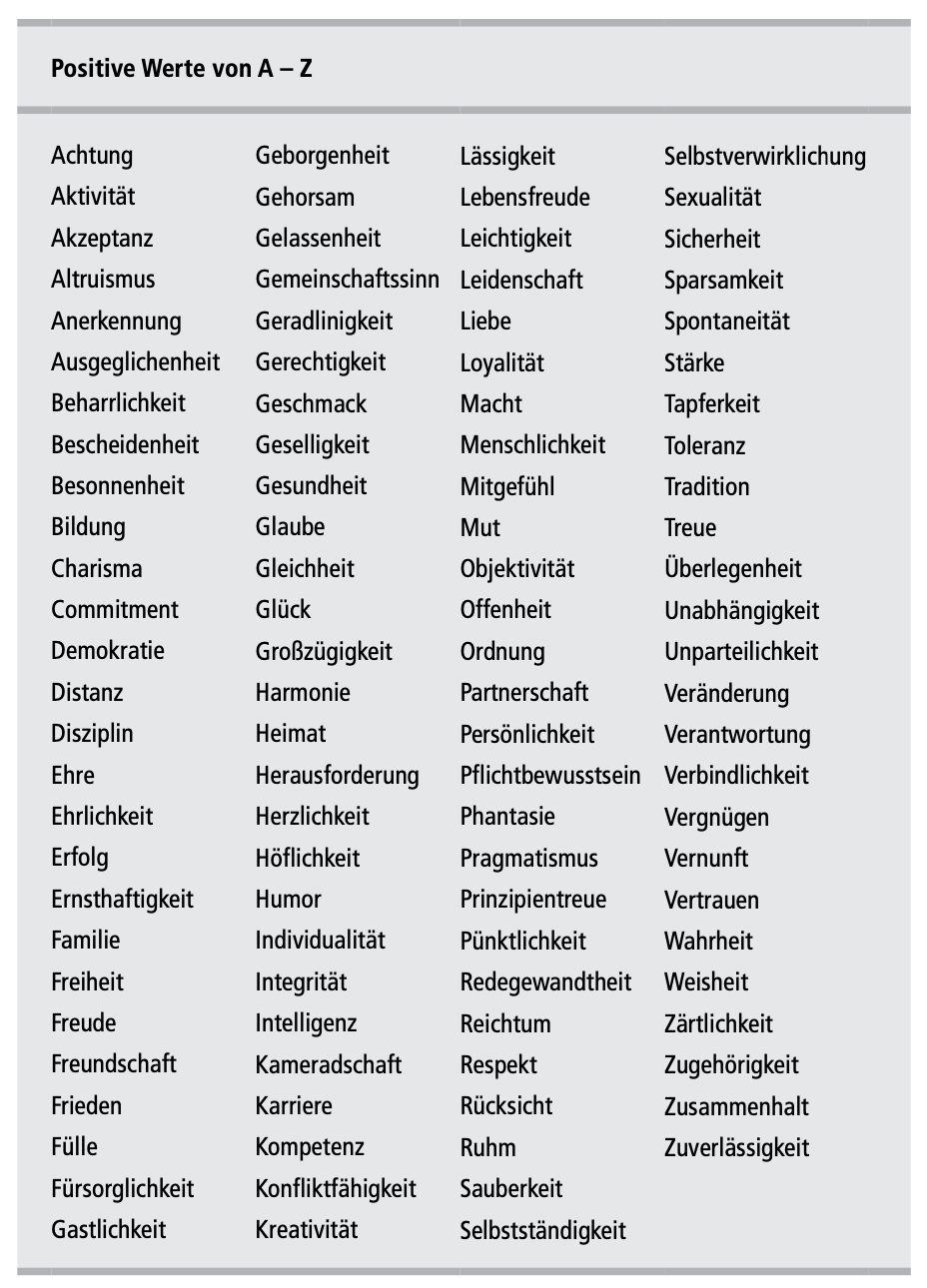
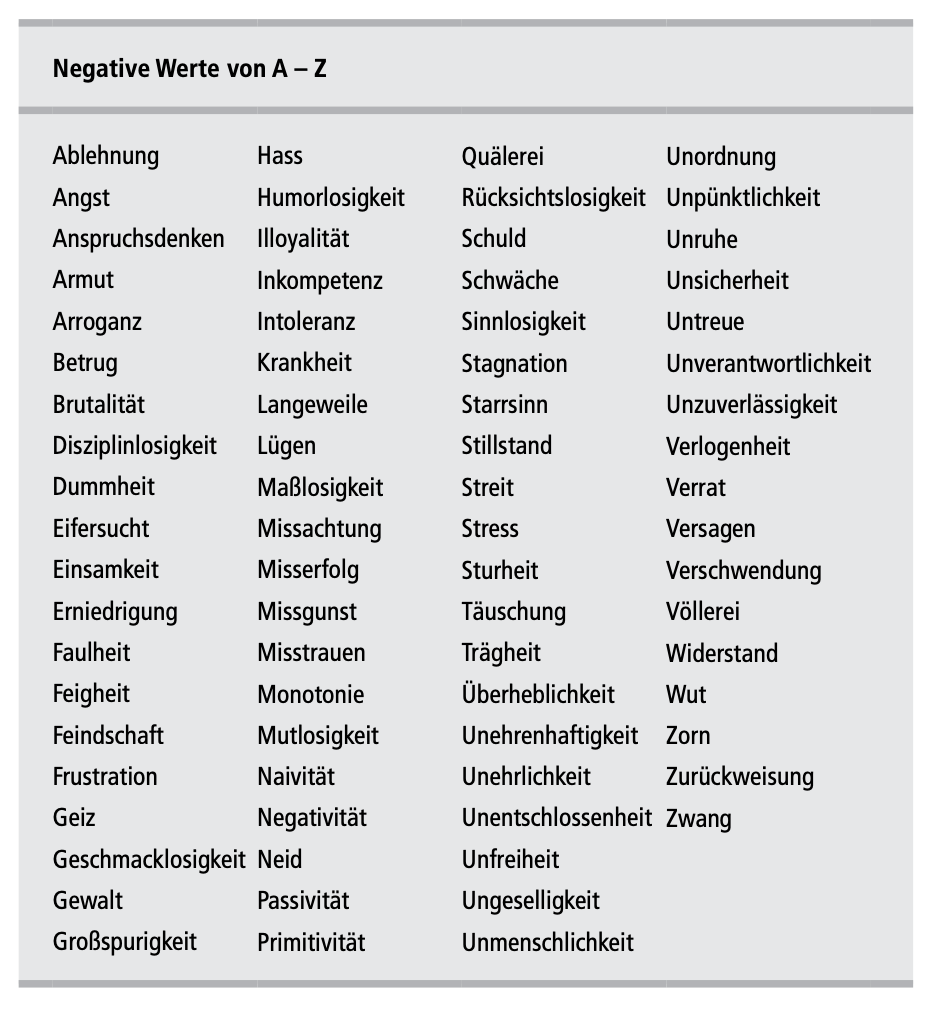
„Erm, Ilya, is that all?“ Yes. A single sentence that describes the entire core of values. To give you an even better understanding of this statement, I would like to present a short (and incomplete) selection of values. First, I will present a list of values that we strive for and that have positive connotations for us. This is immediately followed by an overview of values that we would like to avoid and that we regard as negative.

What are values Examples: Positive focus

Positive values

What are values Examples: Negative focus

Negative values

What are my values?

Have you let the two lists sink in for a while? Then I would now like to ask you two questions:

  1. What are your ten most important positive values?
  2. What are the ten values that you absolutely want to avoid in your life?

I highly recommend that you take enough time for this consideration. And please be more than careful about one thing. There is a huge difference between the values that we intellectually consider desirable and those that we actually live and act by.

You are welcome to put this to the test. If you ask 100 people about their most important values, you will find that in at least 90 % of all cases Honesty received in response. But already in the next best Conflict situation This is then no longer the case and people resort to white lies, conceal important information or do not dare to express their honest opinion for reasons of political correctness.

Personal values as a reflection of our behavior

Our actions are always a direct reflection of our values. If punctuality is important to us, we would never be late. If honesty is an important value, then we would rather accept negative consequences than lie. Or if we consider thriftiness to be desirable, then we would never throw money around indiscriminately. Generally speaking, you can use your values to identify exactly what is important to you and what you would rather avoid.

But back to the mirror. I've made the connection between our values and the appropriate behavior I learned this the hard way many years ago. You need to know that family has always been at the top of my list. It always seemed quite logical to me intellectually, because nothing was as important to me as my partner and my then still young daughter (who is now a wonderful teenager).

It was so important that I regularly told all my colleagues, employees and friends. And I still remember today how I was struck by the realization one evening when a colleague friend confronted me with the following statement: „Tell me, Ilya, if family is so important to you, why are you still sitting in the office at 9 p.m. for the fourth time this week?“

Rumms. That hit home. My first impulse was to explain my reasons, to argue why it was just an exception. But I quickly realized that anything I would say would only be an excuse in the end. Although a very logical and plausible-sounding one Excuse, but as much as I would have liked it to be different, it was and remained an excuse. And it took a lot of courage for me to admit to myself the real reason why that was the case: at the time, my career was simply more important to me than my family.

Values are more than just a few euphonious words on paper

I admit that I really struggled with this realization. Because in my mind, my family was actually the most important thing for me. But my behavior said something completely different. Or as the old saying goes: „Ich can't hear your words, your actions scream so loud!

But I didn't want to resign myself to this situation and knew that I had to change something. Basically, I had two options. Either I changed my hierarchy of values and accepted that my career was my top priority for the moment. Or I adapted my behavior to my values. And that's exactly what I chose to do by shifting my focus from being in the office to efficiency and results. The result was that I was not only generally happier again, but also had more drive and fun at work.

Importance of values for human behavior

I hope that one thing has become very clear from this example. In theory, dealing with your own values sounds pretty easy and simple. You write down a few desirable concepts that you think are good and would like to have in your life. The problem is that it makes no difference what we write on a piece of paper. The decisive factor is always what values we act on. And these are not always identical to the ones we would like to have. This is due to a simple but often overlooked causality.

We always evaluate our own behavior, our ideas and values according to our intentions, but those of our fellow human beings exclusively according to their results.

If we were to apply the same standards to ourselves, many of us would see our entire world view collapse like a house of cards.

How do you decide when the going gets tough?

I would like to give you another example. Imagine that you had placed the two values of peace and integrity at the top of your list. You are firmly convinced of this and would of course never act against your pacifist convictions.

But one day you find yourself in an emergency situation. You have lost your job, have to pay off several loans and have four hungry children at home who look at you hopefully every evening with hungry stomachs. Unfortunately, it's not so easy to find a new job and your debts are slowly threatening to grow over your head.

Until one day you receive a phenomenal job offer. A managing director position with a company car, a generous pension plan and a salary that far exceeds your wildest expectations. You know that all you have to do is say yes and all your problems will be solved. You would have a great, challenging job.

Your debts would disappear in one fell swoop and your family would have enough to eat again. But unfortunately there is a catch. The job offer comes from an arms company that supplies weapons to various crisis areas around the world. How do you decide under these circumstances? Are your values so important to you that you would forego your family's financial security without batting an eyelid, or were peace and integrity more of a theoretical wishful thinking?

We ALWAYS make decisions based on our value system

Even if this was only a hypothetical consideration, such a Decision Not so simple, is it? And yet we act according to precisely this principle every day. We make decisions based on our individual value system. On a small and large scale. At work, in our relationships and in our everyday lives.

The more solid your values are, the easier it will be for you to make a clear and irrevocable decision.

And as we will see later, every sustainable change starts with this. I would therefore like to inspire you to take an intensive and detailed look at your personal and deepest values. Because whenever values and behavior are in conflict with each other, we feel a certain dissatisfaction, have the feeling that we are treading water or are not getting the desired results. So here is my checklist for optimal alignment of your individual value system.

Ten steps to the optimal alignment of your individual value system

  1. Write down all the values that are important to you. Be creative. Brainstorm. And as always: it works best if you do the whole thing with a pen and your change journal.
  2. Select the ten most important values from your list.
  3. Place these values in a hierarchical order in which your most important value is in first place, the second most important in second place and so on.
  4. Repeat the whole process for the negative values that you want to avoid at all costs.
  5. Check both lists for values that conflict with each other (e.g. freedom and security or recognition and rejection). If you come across a conflict of values, replace the less important one with a motivating alternative.
  6. Check whether your daily behavior is in line with your most important values. If you come across a conflict, you have two options. Firstly, you can swap the value for a new one that matches your behavior. Second: You consciously adapt your behavior to the value.
  7. Adapt your lists until you have a total of 20 values that reflect your deepest desires, views and characteristics and fit in with your future (dream) life.
  8. Integrate your (new) values into your everyday life and make a conscious effort to act in accordance with your most important values when making as many decisions as possible.
  9. Do this until your consciously chosen value system has become an automatic and habitual basis for your decisions and behavior.
  10. Repeat this process every four months at the beginning, later once a year.

The most important values of all changemakers

The more you look at your own individual values, the more you will realize how important this piece of the puzzle is for the expression of your unique personality. The more you can draw on powerful and deeply rooted values, the more you will be perceived as a changemaker who is a role model for other people. And even if every single person in this world has a very individual value system, there are still some universal values that unite all changemakers. The most important of these are

Changemaker value #1: Personal responsibility

This word is probably the one I use most often in my books. And there's a good reason for that. Nothing is as important as the Responsibility for their own ideas, decisions and actions. Without exception. Without compromise. Without excuses.

Changemaker Value #2: Courage

Anyone who dares to leave the beaten track and implement changes without a title, money or permission inevitably needs a lot of Courage. Why? Quite simply, new ideas are often ridiculed at first and often even fought against.

Changemaker Value #3: Responsibility for others

True changemakers are always individual personalities, but they also take responsibility for their employees, colleagues, friends and family members without any discussion. Why? Because they know that success only works as a team!

Changemaker Value #4: Decision-making ability

Always make your decision promptly, clearly and unambiguously. Nothing gives your environment (and yourself) such clear orientation as the certainty that you are in a position to make a Decision to meet. And we'll take a closer look at exactly how this works best later on.

Changemaker value #5: Clarity

Don't pussyfoot around, but stand by your word, your decisions and your opinion. The more clearly you communicate, the more reliable you will be as a Boss, employee, friend or partner.

Changemaker Value #6: Discipline

Never be afraid to work hard and do everything you can to achieve your goals. Above all, this requires a lot Discipline. The Romanian sculptor Constantin Brancusi summed it up wonderfully: „Create like a god. Command like a king. Work like a slave.“ And this is once again one of those quotes that is worth thinking about a little longer.

What values drive you?

Have I been able to inspire you a little with this article on the subject of values? I am always amazed at how few people really take a close look at their innermost drive. I hope that I have succeeded in making it clear to you how much our daily actions are controlled by our value system.

Especially in a world that threatens to drift more and more into arbitrariness, powerful and unambiguous values are a rare exception that clearly differentiate companies, organizations and individuals from their environment. I therefore never tire of calling for a renaissance of values at every possible opportunity. It would be a great honor if you would heed my call.

Yours sincerely, Ilja Grzeskowitz

Learn to deal with problems with these 10 tips

If you want to learn how to deal with problems, you need three things above all: a clear focus, positive thinking und den richtigen Riecher für Chancen. Doch natürlich ist das leichter gesagt, als getan. Denn wie sagte schon John Lennon: „Leben ist das, was passiert, während wir dabei sind, andere Pläne zu schmieden.“ Ja, der Alltag ist voller Probleme. Manche davon sind klein, andere richtig groß. Und mit diesen Problemen umgehen lernen gehört daher zu einer der wichtigsten Skills, die man im Leben entwickeln kann.

What problems are there? 

Recently, a manager sat in front of me in a Business Coaching who was overwhelmed with his current job situation. „What's your problem?“ I asked him at the beginning. „Oh,“ he replied, „the word problem is forbidden in our company. In an HR training course, we learned to only talk about challenges, gifts and great opportunities.“ Sounds familiar, doesn't it? The world is full of people who go through life with rose-tinted glasses, who try to gloss over all their failures and simply smile away even the biggest difficulties.

But I don't know about you, but I have problems in my daily work, my company and in my life. There are times when things go wrong and the wind blows right in my face. And I understood one thing a long time ago. In these situations, life doesn't present me with a gift, nor am I faced with a great opportunity. No, I simply have a problem. Sometimes just a small one, but often a really big one.

No solution without problems

And what's wrong with that? We all experience ups and downs. We all make mistakes. We all have problems. Ignoring them would be foolish, because they are the best indicator that it's time to take a Shift to make. An ostrich mentality and the tactic of sitting it out may have worked for Helmut Kohl, but I don't know of a single case in which whitewashing and ignoring difficulties have led to success. Only with active change can we grow, improve and develop.

The sooner you accept that problems are not only part of life, but also the perfect starting point for personal development and professional growth, the better. And the first step is to call a spade a spade: A problem is a problem.

Learning to deal with problems: positive thinking as a miracle cure?

Now you may object: „Okay, Ilya, but don't you always emphasize the importance of the positive thinking? The answer here is a clear „yes and no“. Because the universally known positive thinking, as we know it above all from esoteric and Chakka circles is above all synonymous with permanently wearing rose-colored glasses and ignoring the facts. I consider this form of denial of reality to be extremely counterproductive and never conducive to achieving goals.

What I am advocating, however, is a radically positive attitude. Because negativity has never, I repeat, never led to positive results. The decisive factor is that Mindset, with which you go through life, with which you run your business and with which you make your decisions. If you need a guide for this, I would like to introduce you to my three top tips for sustainable success in business and in life. Here we go:

  1. Always be positive.
  2. Always be positive.
  3. Always be positive.


With this Attitude you are also well equipped when times get tough. Because even if the general conditions are the same, it's always your attitude that makes the difference.

Focus on problems, think in terms of solutions

So the only thing that matters is how we deal with problems. Whether we allow them to overwhelm us or whether we switch into attack mode and work on a possible solution. In fact, innovation always arises from dissatisfaction. This is how new products, services and even entire companies are created. As a practical tool for your everyday (professional) life, here is my guide with ten crisp impulses for transforming all kinds of problems into corresponding opportunities. 

If you use it consistently, you will soon find it much easier to deal with problems and use them productively.

Learning to deal with problems: 10 tips

  1. Always be positive (okay, we've been over this before, but it's just as important)
  2. Go through life with your eyes open
  3. Question procedures, processes and supposed standards
  4. Be suspicious of sentences like „That's not possible“, „We've always done it that way“ or „I'm not responsible for that“.
  5. Ask yourself regularly: „What really frustrates me?“
  6. Identify the underlying problems
  7. Analyze the problem and focus on possible solutions at the same time.
  8. Ask the following W questions: „How could it work?“ „Who could support me?“, „What would need to be done to improve the situation?“, „Why does this process/procedure/etc. exist at all?“
  9. Develop alternative ideas, possible courses of action or solutions.
  10. Act according to the pattern „Love it. Change it. Or leave it.

Recognize the problem. Solve the problem. Wipe your mouth and move on.

Auf diese Weise gelingt es Ihnen, das Vorhaben „Mit Problemen umgehen lernen“ schnell in Ihren Alltag zu integrieren und ab sofort Probleme als motivierende Quelle für Innovation, Fortschritt und notwendige Veränderungen zu etablieren. Denn so kontraindikativ es auch klingen mag. Je besser Sie in der Lage sind, Probleme zu identifizieren, desto schärfer wird gleichsam Ihr Riecher für lohnenswerte Chancen. Wir wollen daher den Bogen spannen, und zum Abschluss dieses Artikel noch einmal folgendes klarstellen: Ein Problem ist ein Problem. Punkt. Je eher Sie das akzeptieren, desto besser können Sie nämlich damit umgehen.

Or as the American inventor Charles Kettering put it so beautifully: „A problem that is well formulated is a problem that is half solved.“ Learning to deal with problems. It can be so easy, can't it? If you keep the following in mind. Recognize the problem as such and at the same time focus on possible solutions. Summarized in three crisp steps:

1) Take off your rose-colored glasses and accept that you have a problem.

2) Solve the problem.

3) Wipe your mouth and continue.

Dabei wünsche ich Ihnen ganz viel Freude und Erfolg dabei, wie Sie aus Problemen Chancen machen. Und natürlich interessiert mich, wie Sie mit dem Thema „Mit Problemen umgehen lernen“ betrachten. Schreiben Sie mir Ihre Gedanken gerne unten ins Kommentarfeld.

Yours sincerely, Ilja Grzeskowitz

RUHE AUF DEM BALKON! EIN RANT GEGEN NEGATIVITÄT.

Ruhe auf dem Balkon! Das möchte ich mit diesem Artikel laut in die Welt hinausrufen. Denn es scheint mir, dass die Besserwisser immer mehr und insbesondere lauter werden. Und sich die Negativität dadurch weiter auszubreiten beginnt. Und genau dieser Negativspirale habe ich den Kampf angesagt. Doch lassen Sie uns zuerst eine kurze Reise in die Vergangenheit unternehmen.

Warum wir mehr Batteriewechsler und weniger Besserwisser, Nörgler und anonyme Kritiker brauchen

Es war ein gewöhnlicher Dienstag Nachmittag im November. Wie so häufig saß die komplette Abteilungsleiter-Riege im Besprechungsraum des Warenhauses zum wöchentlichen Jour-Fix zusammen. Als Geschäftsführer nutzte ich diese Termine u.a. dazu, um die Führungskräfte über alle aktuellen Themen zu informieren. An jenem Tag sollten die einzelnen Abteilungen ihre Maßnahmen für das kommende Weihnachtsgeschäft vorstellen.

Den Start machte Frau Müller (was nicht ihr echter Name ist) aus der DOB (was für Damenoberbekleidung steht). Doch als sie mit dem Präsenter zur ersten Power Point Folie klicken wollte, geschah etwas. Nämlich nichts. Hektisch klickte sie auf der Fernbedienung herum und starrte voller Hoffnung auf die Leinwand. Doch auch der zehnte Klick auf den Präsenter brachte keine Veränderung: Immer noch war der Startbildschirm zu sehen, die Technik wollte einfach nicht funktionieren.

Es dauerte nicht lange, bis das Gemurmel im Raum losging. “Es müsste dringend jemand etwas tun” sagte einer. “Typisch IT-Abteilung, nicht mal das bekommen sie hin” sagte jemand anders. Und eine dritte Person beklagte sich: “Kein Wunder, bei der uralten Ausstattung, mit der wir hier arbeiten müssen kann das ja nicht klappen”.

Fast alle Abteilungsleiter stimmten in das Wegklagen und die Schuldzuweisungen ein. Und es wurde heftigste Kritik geübt: An den Technikern, der Verwaltung, der Zentrale, an der unfähigen (weil technisch völlig unbegabten) Kollegin und sogar am Vorstand. Die Stimmung kochte.

Und das nur, weil ein Präsenter nicht funktionierte. Wahrscheinlich wäre es noch länger so weitergegangen, wenn nicht die junge Abteilungsleiterin aus der Parfümerie etwas getan hätte, womit keiner rechnete. Sie kramte in ihrer Tasche, erhob sich von ihrem Platz und ging wortlos nach Vorne. Dann ließ sie sich von der verdutzten Frau Müller den Präsenter geben, öffnete die Verschlussklappe und wechselte die Batterien. “So”, ließ sie ihre Kollegen wissen, “jetzt geht´s wieder. Wir können weitermachen!”

Aus der sicheren Entfernung kritisiert es sich leicht

An dieses Erlebnis musste ich in letzter Zeit häufig denken. Denn mich beschleicht das Gefühl, dass immer weniger Menschen selber etwas wagen, erschaffen oder umsetzen. Und die Mutigen, die sich trauen, müssen sich dann mit Kritikern auseinandersetzen, die meist ungefragt, sowie mit sicherem Abstand aus der Ferne ihre Meinung kundtun, unter der Gürtellinie attackieren und grundsätzlich der Meinung sind, alles besser zu wissen.

Natürlich würden diese Besserwisser ihnen das nie ins Gesicht sagen. Stattdessen versteckt man sich in der Anonymität des Internets und kann endlich mal das sagen, was man schon immer mal sagen wollte. Es kommt mir ein wenig so vor wie bei der Muppet Show. Können Sie sich noch erinnern? Dort saßen die beiden Senioren Waldorf & Statler auf ihrem gemütlichen Balkon und haben alles kommentiert, zerrissen und in den Kakao gezogen, was sich unten auf der Showbühne abspielte.

Und gibt es nicht auch im wahren Leben genau diese zwei Sorten von Menschen? Die einen, die Handeln, Bewegen und Verantwortung übernehmen. Die Unternehmer, Feuerwehrleute, Krankenschwestern, Schiedsrichter, Schriftsteller, Selbständigen, Gründer, Polizisten und alle anderen Menschen wie Sie und ich, die machen, tun und produktiv tätig sind. Und wer handelt, der macht zwangsläufig Fehler. Wird dadurch angreifbar. Bietet sich als perfekte Zielscheibe an.

Und dann gibt es da noch die anderen. Diejenigen, sich weit entfernt vom tatsächlichen Geschehen aufhalten. Die umgehend in Deckung gehen, wenn es heiß wird, wenn es weh tut, wenn es ans Eingemachte geht. Sich aber natürlich trotzdem das Recht herausnehmen, die Taten der handelnden Menschen auf der weit entfernten Showbühne des Lebens zu kritisieren, zu beurteilen und zu zerreißen.

Konstruktive Kritik vs. anonyme Beschimpfungen

Und nur damit wir uns richtig verstehen, ich spreche hier nicht von konstruktiver Kritik. Diese ist nicht nur hilfreich, sondern für Shift absolut notwendig. Nein, ich spreche vor allem von dem zunehmenden anonymen Bashing, das teilweise absurde Formen annimmt.

Doch woran liegt das? Ist es mangelndes Selbstbewusstsein, Neid oder eine generelle Unzufriedenheit mit dem eigenen Leben? Ich weiß es nicht. Aber eines weiß ich: Es nervt! Gerade gestern habe ich wieder zwei Bewertungen für meine Bücher auf Amazon gelesen. Beides waren 1 Sterne Rezensionen. Beide gingen nicht mit einem Wort auf den Inhalt ein, sondern strotzten nur so vor persönlichen Anfeindungen.

Und selbstverständlich hat sich keiner der beiden „Kritiker“ getraut, unter seinem echten Namen zu schreiben. Hinter der sicheren Maske von Pseudonymen kommen einem verbale Tiefschläge eben viel leichter über die Lippen, bzw. Tasten. Natürlich weiß ich, dass meine Meinungen, meine Inhalte und meine Persönlichkeit durchaus polarisieren. Trotzdem habe ich mit diesen anonymen Beschimpfungen vom Balkon grundsätzlich ein Problem.

Warum? Ich persönlich habe diesbezüglich ein dickes Fell und bin gut in der Lage, dem entgegenzutreten. Das kostet zwar Kraft, ist für mich aber auch der Preis, den ich dafür zahle, exponiert auf der Showbühne zu stehen.

Doch für viele andere Menschen kann so etwas durchaus existenzbedrohend sein. Denken Sie an das inhabergeführte Restaurant (da fallen auf einschlägigen Bewertungsportalen Worte wie „ekelhaft“ „widerlich, „unzumutbar“), den kleinen Laden um die Ecke („furchtbarer Service“, „unfreundlich“, „furchtbar“) oder die Tagesmutter aus dem Nachbarort („kann nicht mit Kindern“, „wird schnell wütend“, „ungeeignet“).

Es reicht! Eine Aufforderung an alle Besserwisser und anonymen Nörgler

Ich für mich habe beschlossen, diese Entwicklung nicht mehr nur schweigend hinzunehmen. Im Namen aller produktiven, mutigen und handelnden Menschen möchte ich den besserwisserischen Kritikern daher zurufen:

„Wir freuen uns über jede konstruktive Kritik, weil wir wissen, dass wir uns nur so weiterentwickeln, besser werden und wachsen können. Wir können auch mit direkten Worten, harten Argumenten und Klartext leben, wenn diese Form der Kritik wertschätzend und mit offenem Visier kommuniziert wird. 

Ansonsten gilt: Ruhe auf dem Balkon! Wir haben keine Lust auf Besserwisser, Nörgler und Miesepeter, die uns ungefragt als Projektionsfläche ihrer eigenen Ängste benutzen. Wir brauchen Eure Kommentare aus der sicheren Entfernung nicht. Wir brauchen auch keine Belehrungen, Beschimpfungen oder Miesmacherei. 

Wenn ihr mitreden wollt, dann verlasst den bequemen Balkon und kommt zu uns auf die Showbühne. Dahin, wo es weh tut. In die Hitze des Gefechts. Dorthin, wo Blut, Schweiß und Tränen fließen. Die Welt braucht keine weiteren Menschen, die ganz genau wissen, was die anderen alles falsch machen. Stattdessen braucht die Welt dringend mehr Menschen wie meine junge Abteilungsleiterin. Sie braucht mehr Batteriewechsler. Sie braucht Menschen, die mutig handeln, Fehler machen und Verantwortung übernehmen.“

Ruhe auf dem Balkon! Die Welt braucht mehr Batteriewechsler

Es ist Zeit, eine Entscheidung zu treffen.

Wollen wir Verantwortung übernehmen, oder die Leistungen anderer zerreden?

Gehen wir dahin, wo es weh tut, oder kritisieren wir das Geschehen vom bequemen Balkon aus?

Wollen wir Batteriewechsel oder Besserwisser sein?

Wir alle haben jeden Tag die Wahl!

Wofür entscheiden Sie sich?

Herzliche Grüße Ihr Ilja Grzeskowitz

Intention Meaning - Why meaning and purpose are so important

Intention is everything - The art of successful communication

Have you ever wondered whether there is such a thing as a single characteristic that determines whether every type of communication is positive or negative? There actually is. And you might be surprised, because I'm not talking about a technique, a method or a specific process. The key that can open the door to success in all situations in life is your intention. 

It does not matter whether your Communicate with employees, you are facing a difficult negotiation or want to teach your children something. Your results stand and fall with the expectations with which you approach the small and large tasks of everyday life.

Intention Definition German: Communicate with meaning

I would like to share one of my deepest convictions with you: Intention beats everything. Yes, really everything. Others may be smarter, faster or more talented. If you approach your tasks with the right intention, you will always be that famous step ahead. So let's take a closer look at what I mean by intention. 

On the one hand, for me it is the mentality, with which you do the things you do. A clear expectation of the end result of the upcoming communications. It is the absence of doubt and the deep certainty that you will achieve exactly what you set out to do. This applies to sales talks, conflicts and negotiations, but also to flirting, conversations with your relatives and raising your children.

Intention: the importance of communication with meaning

Let's move on to the second factor, namely the question, why and why not you communicate with other people at all. What, you usually don't even know that because you're the spontaneous type? Sometimes you just exchange a few irrelevant phrases because that's what people do on certain occasions?

Then I would like to suggest the following idea to you. Never go into a conversation, conversation or any other type of communication without a specific goal. Think about what you want your conversation partner to think, do and especially how you want them to feel beforehand. The more clearly you know what your goal is, the more clearly you can act. You will be amazed at how quickly people sense when you are acting with the right intention.

The more you focus outward on your customers, employees or family members, the more you will achieve your own goals. Because everything in life really revolves around relationships with other people.

What you can learn about communication from a waiter

An example. Last year, we spent our family vacation in Florida, where one morning in Fort Lauderdale at Denny's were having breakfast. As soon as we sat down in our alcove, our waiter introduced himself. His name was Bobby and he immediately made a joke to greet us. He then brought us the menus and asked: „Hey, are you ready for the best French toast of your life?“

My attention was definitely piqued. And Bobby continued at the same high level. He had two small gifts for our children in his trouser pocket and he put a discount coupon on the table for my wife and me, which we could use to save on a meal that day. He then asked what we were going to do in his home town, told us about his time in the army in Germany and always made us laugh. We quickly found a shared passion and talked about golf, tennis and the many leisure activities in the area. Bobby was never pushy, but managed to make us feel right at home in no time at all.

And after we had eaten, he offered to reserve the best table in the restaurant for us the next day. Where do you think we were sitting 24 hours later? And because I was so fascinated by his intention, I asked Bobby when we said goodbye how he manages to be so friendly and courteous despite always having the same routine at work as a waiter. He just laughed briefly and then said: „Well, that's simple, I just like people.“

11 reasons why you should only communicate with intention from now on

„I just like people.“ This one sentence perfectly summarizes the effect of intentional communication. It's always about people. If you manage to establish a personal connection with your employees, colleagues and customers, the best things will happen. Because then they feel comfortable.

And if you feel good, you will act accordingly. Your sales, negotiation success and all communication results are directly related to the intensity of the relationships you build with other people. Because nothing is as powerful as the right intention. Because you no longer act randomly, arbitrarily and irrelevantly, but give concrete meaning to every single moment of your life. This applies to the small problems of everyday life, but especially to the big challenges. Why? Quite simply because intention...

  1. ...provides clarity
  2. ...strengthens your self-confidence
  3. ...eliminates doubts
  4. ...creates an invisible bond between two people
  5. ...creates certainty
  6. ...creates positive feelings
  7. ...replaces irrelevance with meaning
  8. ...ensures the right focus
  9. ...motivated
  10. ...is more important than all techniques, methods and processes put together
  11. ...beats everything

Your expectations can tip the scales at important moments and determine success or failure. The best thing about this is that you become completely independent of external factors, because your intention is controlled exclusively by you from start to finish. The better you do this, the more confident, convinced and successful you will be in these moments and the more you will be able to enjoy the rollercoaster ride that inevitably follows.

And now I'm curious: How do you deal with the topic of intention, what experiences have you had? I look forward to your comment 🙂

Yours sincerely

Ilja Grzeskowitz

10 BOOK TIPS: BOOKS THAT HAVE CHANGED MY LIFE

Book tips for business, a successful career and personal growth

I regularly get emails and messages on Facebook & Co. asking me for book tips. And I love these questions, because I love books. I read as often as I can, because a book gives me the opportunity to slip into the minds of the world's smartest people and engage with their ideas, thoughts and views.

From every book I read - no matter how trivial - I take away some idea that I incorporate into my everyday life. But there are also books that really touch me deeply and make me think about some things a little longer and more intensively. I have summarized these books in a list.
So here they are, my book tips with the 10 books that have changed my life.

And if you like these ten book tips, then take a look at my list of the 100 best business books of all time to.

1) Atlas Shrugged by Ayn Rand

Probably no other book has influenced me as much as this novel. This is probably because the main characters Dagny Taggart, Hank Rearden and John Galt appeal to my core values such as integrity, personal responsibility and individuality. The book probably reflects my personal philosophy of life like no other. But the actual plot of the novel also has everything you need for a long-lasting reading experience: Love, suspense and lots of interesting characters. If possible, be sure to read the original English version.

Here is the link to the book: Atlas Shrugged

2) The Magic Mountain by Thomas Mann

In second place is another novel, namely The Magic Mountain by Thomas Mann. The plot itself is not particularly exciting. The young Hans Castorp visits his cousin Joachim Ziemßen in a spa clinic in Davos. The planned 3 weeks turn into 7 years in the end. What fascinates me so much about this story are the main characters, the artful description of the individual developments and the many philosophical conversations. A true masterpiece that captivates me every time.

Here is the link to the book: The Magic Mountain

3) The 4-hour week by Timothy Ferriss

After reading it, I asked myself the question for the first time: “What if...?” After that, nothing was the same. The idea of this book is as ingenious as it is simple. Lead a life according to your expectations and ideas. And then build a business that supports this lifestyle. The 4 Hour Week is full of brilliant ideas, inspiration and suggestions for anyone who expects more from life than the daily 9 to 5 job. A clear recommendation to read.

Here is the link to the book: The 4-hour week

4) Money, gold and god players by Roland Baader

Roland Baader was one of the greatest free thinkers of our time and managed like no other to explain economic relationships in normal everyday language. I have actually read all of his books, but for me this is his most complete work. However, you are advised to be careful, as reading it could dramatically change your views on what is supposedly normal.

Here is the link to the book: Money, gold and god players

5) The Fountainhead by Ayn Rand

And yet another book by Ayn Rand, this time the story of architect Howard Roark, who manages to turn his passion into a profession and fight his way through all the difficulties. Once again, it is a plea for personal integrity and a polemic against egalitarianism. A mercilessly good book, full of inspiration, critical thinking and encouraging messages.

Here is the link to the book: The Fountainhead

6) Total Recall - The true story of my life by Arnold Schwarzenegger

Anyone who knows me knows that I'm a big fan of Arnold Schwarzenegger am. Because the life story of the former Mr. Universe, Terminator and Governor of California is more than impressive. In many personal stories, you get to know Arnold Schwarzenegger better as a person and learn what is possible with courage, commitment and great visions. This book is pure motivation in print.

Here is the link to the book: Total Recall

7) The Monk Who Sold His Ferrari by Robin Sharma

In this business fable, Robin Sharma tells the story of a successful businessman who, at the height of his career, realizes what really matters in life. Very inspiring, infectious and a clear recommendation for anyone looking for more meaning in life.

Here is the link to the book: The Monk Who Sold His Ferrari

8) #AskGaryVee by Gary Vaynerchuk

These book tips would be incomplete without this work by Gary Vee. For me, it's the best business book I've read (or listened to, as I highly recommend the audio version, read by Gary himself and with lots of additional commentary) in recent years. A perfect read for any entrepreneur or manager who wants to make a difference.

Here is the link to the book: #AskGaryVee

9) The damn 20th century - Memories and reflections of a politically incorrect person by Gerard Radnitzky

On the one hand, this book tells the life story of Gerard Radnitzky, a freethinker whom I hold in high esteem. The many anecdotes and stories alone make the book well worth reading. The author also regularly takes a look at the wider context at the beginning and middle of the 20th century and reports from the perspective of a contemporary witness. Uncomfortable opinions, visionary ideas and a common thread that runs through the entire book: A call for freedom.

Here is the link to the book: The damn 20th century

10) Think Big Act Bigger by Jeffrey Hayzlett

Jeffrey Hayzlett not only wrote the foreword to my book “Think it. Do it Change it.” but he's also a pound-for-pound guy. He is a prime time TV host, chairman of the C-Suite Network and a cowboy at heart. His latest book is, for me, his best. And what better motto could there be: Think big. But act even bigger!

Here is the link to the book: Think Big Act Bigger

What do you like to read?

What are your favorite books? Write me (and my readers) your book tips in the comment field. I look forward to many inspiring suggestions...

SELBSTSABOTAGE ÜBERWINDEN MIT DIESEN 10 TIPPS

Selbstsabotage als Grund für mangelnden Erfolg

Selbstsabotage ist einer der größten Erfolgskiller überhaupt. Möglicherweise kennen Sie das ja. Der Job ist nicht mehr das, was er mal war, der langjährigen Beziehung fehlt ein wenig das Feuer und auf dem Konto ist meist schon ab der Mitte des Monats Ebbe. Da hilft nur noch eins: Es muss eine Veränderung her. Doch während die einen ihre Vorhaben angehen, und ihre Träume in die Tat umsetzen, fallen andere recht schnell wieder in alte Verhaltensmuster zurück.

Was auch immer sie auch versuchen, sie schaffen es einfach nicht, ihr Leben zu verändern. Doch was ist der Grund dafür? Es liegt weder an zu wenig Willen, noch an den notwendigen Fähigkeiten oder mangelndem Wissen. Stattdessen sind zehn bestimmte Denkweisen dafür verantwortlich, dass wir uns bei der Umsetzung von Veränderungen selber sabotieren. Doch das muss nicht sein. Jeder kann die eigene (und unbewusste) Selbstsabotage überwinden, zum Veränderungs-Experten werden und mit ein paar einfachen Tipps die gewünschten Erfolge erzielen. Auch Sie. Wenn Sie die folgenden zehn Denkweisen möglichst schnell abstellen.

1. Angst vor Veränderung haben

Ob im Job oder im Privatleben, jede Shift an sich ist erst einmal neutral. Erst Ihre persönliche Bewertung macht dann aus dem jeweiligen Ereignis etwas positives oder negatives. Und nun Hand auf´s Herz, wie gehen Sie mit neuen Ideen, Verhaltensweisen und Situationen um? Ist Veränderung für Sie eher etwas Bedrohliches, oder eine wunderbare Möglichkeit, als Persönlichkeit zu wachsen und schöne Erfahrungen zu machen?

Wie auch immer Ihre Träume und Ziele konkret aussehen, wenn Sie Angst vor der notwendigen Veränderung haben, dann wird es schwer, diese in die Tat umzusetzen. Betrachten Sie die neuen Wege stattdessen als großes Geschenk des Lebens und machen Sie sich klar, dass es vollkommen normal ist, wenn Sie ein wenig unsicher sind, und Zweifel haben. Wenn Sie diese Gefühle nicht verspüren, dann können Sie sicher sein, dass Ihre Vorhaben nicht groß genug sind. Und bedenken Sie: Mutig zu sein heißt nicht, dass Sie keine Angst haben. Mutig zu sein heißt, dass Sie sich trotzdem auf den Weg machen.

2. Verantwortung abgeben

Erfolgreiche Veränderung basiert immer auf einfachen und greifbaren Schritten. Das heißt nicht, dass es leicht ist, ganz im Gegenteil. Jede Veränderung geht immer mit Risiko, Unsicherheit und der Angst vor dem Unbekannten einher. Aber so hart die äußeren Umstände manchmal scheinen, Sie haben immer die Möglichkeit, etwas Positives draus zu machen. Und dafür ist es unbedingt notwendig, die volle Verantwortung für Ihre Entscheidungen, Ihre Taten und Ihre Ergebnisse zu übernehmen. Für die guten, aber auch für die schlechten.

Es gehört zu den härtesten Momenten, in den Spiegel zu blicken, und sich ehrlich einzugestehen: „Egal, wo ich mich heute befinde und egal, wie zufrieden oder unzufrieden ich mit meinen Ergebnissen bin, es liegt nur an mir. An niemand anderem. Und auch nur ich kann etwas daran ändern.“ Besonders wenn Ihnen der Wind direkt von Vorne ins Gesicht bläst, sollten Sie sich eine Tatsache immer wieder vor Augen führen. Sie können die äußeren Umstände nicht beeinflussen. Aber Sie haben immer die Wahl, wie Sie darauf reagieren. Nichts hilft Ihnen so sehr dabei, die Selbstsabotage zu überwinden, wie die Eigenverantwortung. Denn sie ist eine Art Fix- und Angelpunkt, an dem sich sämtliche Eigenschaften ausrichten, die Sie für nachhaltige Veränderungen benötigen.

3. Den Fokus auf Probleme richten

Es gibt unterschiedliche Arten von Veränderung. Auf manche freuen wir uns, bei anderen haben wir ein mulmiges Gefühl, und dann gibt es diejenigen, die uns richtig Angst machen. Doch ob leicht oder schwer, es gibt immer Dinge, die wir beeinflussen können. Und es gibt Dinge, die wir nicht beeinflussen können.

Worauf konzentrieren Sie sich? Wohin Sie Ihren Fokus richten, dorthin fließen Ihre Aufmerksamkeit, Ihre Energie, Ihre Zeit und Ihr Geld. Und wohin diese Dinge fließen, davon werden Sie mehr bekommen. Erwarten Sie überall Probleme, dann werden Sie diese auch in Ihr Leben ziehen. Richten Sie Ihren Fokus hingegen auf Chancen und Möglichkeiten, dann sind auch diese auf einmal im Überfluss vorhanden.

Ganz nach dem Motto: „Die Frage ist nicht, ob das Leben schön ist, sondern ob Sie es mitkriegen.“ Sie haben in jeder Situation die Wahl, worauf Sie Ihren Fokus richten. Ob Sie zu einem dieser Zeitgenossen gehören wollen, die permanent jammern, nörgeln und auch am schönsten Himmel eine dunkle Wolke vermuten, oder ob Sie sich auf mögliche Lösungen konzentrieren. Je häufiger Sie die Ausrichtung des Fokus trainieren, desto mehr werden Sie die vielen Chancen wahrnehmen, die Ihnen das Leben bietet (und damit die Selbstsabotage überwinden). Und dann müssen Sie nur noch zugreifen.

4. Die Schuld bei anderen suchen

Nicht immer verläuft das Leben so, wie wir es gerne hätten. Und die Schuldigen sind meist schnell gefunden. Der Chef ist ein ungerechter Sklaventreiber, die Angestellten eine faule Truppe, der Lebenspartner egoistisch, die Kinder undankbar und das Finanzamt gierig. Und weil das so ist, weiß man dann auch ganz genau, wer und was sich um einen herum alles ändern muss, nur damit man selber so bleiben kann, wie man ist. Kommt Ihnen das bekannt vor? Wenn Sie auch dazu neigen, bei nicht erwünschten Ergebnissen die Schuld bei anderen zu suchen, dann sollten Sie dringend umdenken.

Sie können nämlich andere Menschen niemals ändern, sofern diese es nicht wollen. Ihr Chef, Ihre Angestellten, Ihr Partner und auch Ihre Kinder ändern sich nämlich ausschließlich aus Gründen, die ihnen wichtig sind und leider niemals aus denen, die wir gerne hätten. Daraus folgt eine einfache Erkenntnis, die Sie niemals vergessen sollten: Der einzige Mensch, dessen Gedanken, Entscheidungen und Taten Sie ändern können, blickt Sie jeden Morgen im Spiegel an. Und sobald Sie damit beginnen, sich selbst zu verändern, passieren auf einmal spannende Dinge.

Sind Sie begeistert, begeistern Sie nämlich andere. Sind Sie motiviert, motivieren Sie andere. Verändern Sie sich und Ihre Kommunikation, verändern sich auf einmal auch die Menschen in Ihrem Umfeld.

5. In die Opferrolle flüchten

Wie Sie mit Rückschlägen, Misserfolgen und Problemen umgehen, ist entscheidend für die Nachhaltigkeit von Veränderung. Aber wie reagieren Sie, wenn Sie das Leben vor eine harte Prüfung stellt? Nehmen Sie die Herausforderung an und beschließen, das Beste aus der Situation zu machen, oder flüchten Sie sich in die Opferrolle und jammern, wie schwer Sie es doch haben?

Diese Wahl bestimmt darüber, ob Sie die Selbstsabotage überwnden, oder stattdessen still und leise Richtung Mittelmaß driften. Denn Sie können entweder Opfer oder Gestalter sein. Niemals aber beides gleichzeitig. Ich möchte Sie deshalb noch einmal daran erinnern: Sie sind für Ihre Ergebnisse und Ihr Leben verantwortlich und niemand wird Ihnen die Chancen auf dem Silbertablett servieren. Sie müssen sich diese Möglichkeiten selbst erschaffen und dann in die Tat umsetzen. Wenn Sie es nicht tun, tut es niemand.

Doch weil viele dafür einfach nicht bereit sind, nutzen sie die Flucht in die Opferrolle als perfekte Begründung, warum sie nicht das geschafft haben, was sie sich vor langer Zeit einmal vorgenommen hatten. Stattdessen lebt man lieber in einer Art seelischem Niemandsland und macht es sich in seiner eigenen Komfortzone so richtig schön gemütlich. Das Wachstum ist gleich null. Und das macht auf Dauer unzufrieden. Sehr unzufrieden. 

6. Dem Anspruchsdenken verfallen

Veränderung funktioniert immer dann, wenn Sie Verantwortung übernehmen und Ihr Schicksal in die eigenen Hände nehmen. Nichts steht dieser Einstellung so sehr im Wege, wie ein eine ganz bestimmte Denkweise. Die Opfermentalität hat nämlich einen pfiffigen Zwillingsbruder, der es sich zur Aufgabe gemacht hat, seinem Geschwisterchen in nichts nachzustehen.

Das Phänomen, welches ich meine, breitet sich zurzeit rasant aus, und es ist wirklich nicht leicht, sich davor zu schützen. Aber wenn Sie die Kraft der Veränderung in seiner vollen Intensität nutzen wollen, dann führt kein Weg daran vorbei, diese Eigenschaft schleunigst zu erkennen. Und dann zügig abzulegen. Ich rede vom sich immer mehr ausbreitenden Anspruchsdenken und der festen Überzeugung, ein Recht auf die unterschiedlichsten materiellen Dinge und immateriellen Leistungen im Leben zu haben. Und zwar – und das ist der entscheidende Punkt – ohne dass man irgendeine Gegenleistung dafür liefern müsste.

Um es daher auf den Punkt zu bringen: Sie haben nur ein Anrecht auf das, was Ihnen jemand per Handschlag oder Unterschrift aufgrund einer freiwillig getroffenen Vereinbarung zusichert. Alle anderen Ansprüche beruhen auf Scheinrechten, die andere Ihnen einreden wollen, weil sie zufällig genau diejenigen sind, die von diesen vermeintlichen Rechten profitieren. Erinnern Sie sich immer wieder an eine Tatsache: Es gibt nicht „etwas“ für „nichts“. Um etwas nehmen zu können, muss es zuerst erschaffen werden. Haben Sie den Mut, Verantwortung zu übernehmen. Für sich und für Ihre Ergebnisse. Täglich. Immer. Besonders, wenn es Ihnen schwer fällt.

7. Ausreden suchen

Nichts hat so große Auswirkungen auf die Selbstsabotage wie die guten, alten Ausreden. „Ich bin zu alt. Ich bin zu jung. Ich habe kein Geld. Es ist zu früh. Es ist zu spät. Das haben wir noch nie so gemacht.“ Dies sind nur ein paar Beispiele für Ausreden, die Menschen gerne verwenden, wenn es um Veränderung geht. Schon mal gehört? Sogar schon mal gesagt?

Einer meiner Mentoren sagte vor langer Zeit einmal einen Satz zu mir, der mich bis heute begleitet: „Grzeskowitz merken Sie sich eins: Wer etwas nicht will, der sucht nach Ausreden, warum es nicht geht. Und wer etwas will, der findet auf jeden Fall eine Lösung!“ Schauen wir uns diese Aussage etwas genauer an. Jede Veränderung besteht immer aus drei Komponenten.

1) Sie müssen in der Lage sein, die Veränderung umzusetzen.

2) Sie müssen die Fähigkeiten besitzen, die Veränderung umzusetzen.

Und 3) Sie müssen bereit sein, alles dafür zu tun, die Veränderung umzusetzen.

Okay, lassen Sie uns das einmal durchgehen. Würden Sie mir zustimmen, dass wirklich jeder in der Lage ist, sich zu verändern? Klar, jeder von uns kann sich verändern. Und wie sieht es mit den Fähigkeiten aus? Auch ein klares Ja. Und sollte einmal etwas fehlen, dann ist heutzutage wirklich jede Information über das Internet verfügbar (geben Sie mal bei Google den Suchbegriff “Wie kann man…” ein, und Sie werden über 1,7 Mrd. Treffer erhalten).

Jede Art von Wissen und jede Fähigkeit sind oft nur einen Mausklick entfernt. Wenn Veränderungen scheitern, dann also nicht mangels Wissen, theoretischer Kenntnisse oder nicht vorhandener Fähigkeiten. Es scheitert immer und ausschließlich an der Bereitschaft, alles dafür zu tun. Und jetzt kommen die Ausreden ins Spiel. Denn Menschen würden natürlich niemals zugeben, dass sie nicht willens waren, sich zu verändern. Stattdessen flüchten sie sich in Ausreden, um sich das eigene Scheitern schönzureden und das eigene Gewissen zu beruhigen.

Woher ich das weiß? Ganz einfach. Die meisten dieser Ausreden habe ich selber schon benutzt. Und in meiner täglichen Arbeit als Redner, Managementtrainer und Führungskräftecoach höre ich sie in verschiedensten Varianten und unterschiedlichsten Ausprägungen immer wieder. Auch wenn nichts mehr zu gehen scheint. Für eine gepflegte Ausrede reicht es dann am Ende doch immer noch. Natürlich würden die Verfasser der Ausreden niemals zugeben, dass es sich um eine solche handelt.

Stattdessen redet man davon, realistisch zu sein, dass die Dinge nun mal so seien, oder dass man eben nicht so viel Glück habe, wie andere Menschen. Doch am Ende des Tages sind diese verbalen Nebelkerzen trotzdem nichts anderes als Ausreden, warum man eine gewünschte Veränderung nicht umgesetzt hat. Leuten Sie also das Ende der Ausreden ein, übernehmen Sie Verantwortung und machen Sie sich auf die Suche nach möglichen Lösungen.

8. Passiv abwarten

Verändern Sie sich aktiv, oder kommen Sie erst dann ins Handeln, wenn Sie von den äußeren Umständen dazu gezwungen werden? Die große Kunst ist es, rechtzeitig die Weichen für Ihre Zukunft zu stellen, und nicht erst dann, wenn es schon zu spät ist. Es gibt einfach Ereignisse, wo Sie spüren, dass Ihr Leben gerade einen entscheidenden Einschnitt erfährt. Momente, in denen sich von einem Augenblick auf den anderen alles ändert.

Ihr behandelnder Arzt sagt zu Ihnen: »Ihre Untersuchungsergebnisse sind da. Am besten setzen Sie sich.« Ihr Chef bestellt Sie zum Gespräch und teilt Ihnen mit, dass man in Zukunft ohne Sie plant. Das Telefon klingelt mitten in der Nacht und Sie wissen schon vor dem Abheben, dass Sie nichts Gutes erwartet. Sie kommen abends nach Hause und entdecken nichts als einen Zettel auf dem Küchentisch: „Es ging nicht mehr. Ich ziehe zu meiner Mutter.“

In Momenten wie diesen spüren wir, dass wir etwas Wichtiges verloren haben und es kommen Gedanken wie: „Ach, hätte ich doch eher…“, „Wenn ich die Zeit nur zurückdrehen könnte!“, oder „Warum habe ich nur so lange gewartet?“ Doch soweit muss es erst gar nicht kommen. Wenn Sie ab sofort beschließen, sich aktiv zu verändern und wichtige Entscheidungen nicht auf die lange Bank zu schieben. Auf diese Weise werden Sie dem Schicksal immer einen Schritt voraus sein.

9. Es allen recht machen wollen

Wie gut können Sie nein sagen? Die Antwort auf diese Frage ist ein zuverlässiger Indikator, wie gut Sie bereits mit Veränderung umgehen können, denn es immer allen recht machen zu wollen führt Sie auf direktem Wege in die Unzufriedenheit. Weil Sie sich von Ihren eigenen Werten und Überzeugungen entfernen und Dinge tun, hinter denen Sie nicht hundertprozentig stehen.

Je mehr Sie etwas ausschließlich Ihren Eltern, Ihrem Partner oder Ihrem Chef zu Liebe tun, desto weniger leben Sie Ihr eigenes Leben, sondern verfolgen die Ziele und Träume anderer Menschen. Und natürlich ist damit nicht gemeint, dass Sie auf Hilfsbereitschaft, nette Gesten und Kollegialität verzichten sollen. Nur wenn es um Ihre eigenen Vorhaben und Ihre Zukunft geht, sollten Sie sich an Ihren eigenen Vorstellungen orientieren.

Es allen recht machen zu wollen, führt in der Regel direkt in die Selbstsabotage, sorgt es doch dafür, dass Sie die Planung Ihres Glücks und Ihrer Zukunft anderen Menschen überlassen. Ein selbstbestimmtes Leben sorgt dafür, dass Sie mit Spaß, Freude und einer tiefen Erfüllung durch den Alltag gehen. Lernen Sie also nein zu sagen und genießen Sie die Freiheit von Entscheidungen, die auf Ihren innersten Werten und Wünschen beruhen.

10. Zu früh aufgeben

Kommen wir zum vielleicht wichtigsten Punkt. Denn es gibt Menschen, die alle bisherigen Tipps umsetzen, und die gewünschte Veränderung am Ende doch nicht erreichen. Und das hat einen einfachen, aber sehr entscheidenden Grund: Sie geben zu schnell auf und werfen die Flinte ins Korn, sobald die ersten Hindernisse auf dem Weg erscheinen. Aber Veränderung ohne Rückschläge, Probleme und Herausforderungen gibt es einfach nicht.

Je größer Ihr Ziel ist, desto mehr Steine wird Ihnen das Leben vor die Füße werfen. Es wird Sie prüfen, ob Sie es mit Ihrer Veränderung auch wirklich ernst meinen. Mehr noch, je größer die Hindernisse sind, desto näher befinden Sie sich mit großer Wahrscheinlichkeit vor Ihrem Ziel. Halten Sie in solchen Fällen unbedingt durch. Veränderungen brauchen einfach Ihre Zeit, bis sie zu einer nachhaltigen Gewohnheit geworden sind.

Doch die meisten versuchen eine große Hauruckaktion und geben dann auf, wenn es nicht sofort klappt. Verändern Sie lieber wenig, dafür aber oft. Das heißt auch, hartnäckig zu sein und sich durchzubeißen, wenn es nicht so läuft, wie geplant. Einmal öfter aufzustehen, als hinzufallen. Kleine Schritte zu gehen, und diese so häufig zu wiederholen, bis Sie mit dem Resultat zufrieden sind. Wenn Sie große Veränderungen in kleine Häppchen aufteilen, dann wird etwas Unmögliches auf einmal erreichbar.

Kennen Sie noch weitere Stolperfallen? Ich freue mich auf Ihren Kommentar zum Thema Self-sabotage überwinden 🙂

Yours sincerely, Ilja Grzeskowitz

99 IMPULSE FÜR MEHR MOTIVATION ZUR VERÄNDERUNG

Mutige Ideen für Erfolg, Zufriedenheit und Ergebnisse im Leben

Heute habe ich 99 Impulse für mehr Motivation zur Veränderung für Sie. Kurz. Knackig. Und hoffentlich voller Inspiration. Warum habe ich diese Liste erstellt? Ganz einfach. Viel zu viele Menschen leben ein Leben, das von Mittelmaß, Unzufriedenheit und den Erwartungen anderer Menschen geprägt ist.

The Motivation ist meist gleich null, man funktioniert, reiht sich ein und tut das, was man eben so tut. Und ehe man sich versieht, ist es dann zu spät, und man seufzt ein wehmütiges “ach hätte ich doch bloß eher…” oder ein melancholisches “warum habe ich denn nicht…” in den Himmel. Doch das Leben ist viel zu bunt, schön, und vor allem kurz, um es nicht jeden einzelnen Tag in seiner vollen Gänze auszunutzen. Und der beste Tag, um damit anzufangen, ist heute. Der beste Zeitpunkt ist jetzt.

Chancen nutzen. Persönlichkeit entwickeln.

Natürlich, wenn Sie sich auf den Weg machen, um ein Leben mit Bedeutung zu führen, dann werden Sie auch häufig an Ihre Grenzen geraten. Sie werden hinfallen, und es wird hart, wieder aufzustehen. Aber am Ende sind es niemals die Fehler, es ist niemals das Scheitern, dass wir bereuen. Es sind immer die Dinge, von denen wir geträumt haben, die wir uns aber nicht getraut haben, sie umzusetzen.

Zur besten Version von sich selber werden

Ich weiß, dass es oftmals nur eines kleinen Impulses benötigt, um den Fokus auf die vielen unendlichen Möglichkeiten zu richten, und ein Leben voller Erfolg, Motivation und nachhaltiger Ergebnisse zu führen. Ich würde mir wünschen, dass die folgende Liste dieser Impuls für Sie ist. Sie enthält 99 Ideen, wie Sie täglich daran arbeiten können, Ihre innere Motivation zur Veränderung zu wecken. Das einzige, was Sie tun müssen? Lesen, reflektieren und umsetzen. Klingt leicht, ist es aber nicht, denn eigentlich sind die 99 Impulse für mehr Motivation zur Veränderung mehr eine Art Lebensphilosophie, als eine dieser typischen Listen aus dem Internet. Ich wünsche Ihnen beim Umsetzen viele magische Momente…

99 Impulse für mehr Motivation zur Veränderung

  1. Triff die Entscheidung, ein Leben mit Bedeutung zu führen
  2. Denke und handle wie ein Unternehmer, auch wenn Du (noch) keiner bist
  3. Lies so viel wie möglich
  4. Such Dir einen Beruf, der Dich erfüllt
  5. Schaffe Werte und biete anderen Menschen Nutzen
  6. Lerne, über Dich selbst zu lachen
  7. Umgib dich mit Menschen, die Dich in Deiner Einzigartigkeit unterstützen
  8. Tu jeden Tag etwas, das Du vorher noch nie getan hast
  9. Sei neugierig
  10. Geh in der Natur spazieren
  11. Sei dankbar für jeden Tag
  12. Such Dir Vorbilder
  13. Sei großzügig
  14. Reise um die Welt
  15. Richte Deinen Fokus auf die Chancen im Leben
  16. Glaub an Dich
  17. Gib niemals auf
  18. Sei bereit, hart für Deinen Erfolg zu arbeiten
  19. Sieh Veränderung als großes Geschenk des Lebens
  20. Träume groß und mutig
  21. Übernimm Verantwortung für Deine Ergebnisse. Die guten, wie die schlechten.
  22. Schreib ein Buch
  23. Verzichte auf Fernsehen (okay, Fussball ist erlaubt)
  24. Tu etwas, das Dir Angst macht
  25. Fahr spontan in eine Stadt, in der Du noch nie warst
  26. Vergleich Dich nicht mit anderen Menschen, sondern nur mit der besten Version von Dir selbst
  27. Sag Deiner Familie, wie sehr Du sie liebst
  28. Lies “Atlas Shrugged” von Ayn Rand
  29. Rede niemals schlecht über andere
  30. Honoriere guten Service
  31. Gib klares, aber wertschätzendes Feedback
  32. Triff Entscheidungen immer sofort
  33. Verbringe Zeit am Gipfel eines Berges
  34. Nimm das Leben mit Humor
  35. Lös Dich vom Anspruchsdenken
  36. Beginne und beende jeden Tag mit etwas Positivem
  37. Geh barfuss am Strand spazieren
  38. Gib immer etwas mehr, als Du müsstest
  39. Steh zu Deinem Wort
  40. Verbringe Zeit mit Deinen Eltern
  41. Schau Dir nicht die Nachrichten an
  42. Bild Dir zu allem Deine eigene Meinung
  43. Hinterfrage kritisch, vor allem Dich selber
  44. Gib Dich niemals mit Mittelmaß zufrieden
  45. Erstell Dir eine Bucketlist mit Zielen, die Du in Deinem Leben erreichen willst
  46. Mach einem Fremden ein Kompliment
  47. Richte Deinen Fokus auf Überfluss
  48. Hör häufiger zu und rede weniger
  49. Sieh in den gewöhnlichen Dingen das Ungewöhnliche
  50. Belohne Dich für Deine Erfolge
  51. Nimm an einer Weinverkostung teil
  52. Such Dir einen Mentor
  53. Betrachte Geld als Wert im Kopf des Gegenüber
  54. Lies den Zauberberg von Thomas Mann
  55. Sei dankbar für das, was Du bereits hast
  56. Setz Dir hohe Standards
  57. Trenne Dich von negativen Menschen in Deinem Umfeld
  58. Genieße gutes Essen
  59. Sei kreativ, innovativ und lösungsorientiert
  60. Sei der Held Deiner Kinder
  61. Arbeite täglich an Deiner persönlichen Entwicklung
  62. Hör Dir die gesamte Diskographie Deiner Lieblingsband an
  63. Vergib Menschen, die Dir wehgetan haben
  64. Lös Dich von den Erwartungen anderer Menschen und leb Dein Leben
  65. Tu das, was Dich erfüllt – So oft wie möglich
  66. Sei für Deine Freunde da
  67. Pflanz einen Baum
  68. Vertrau auf Dein Bauchgefühl
  69. Egal, was Du tust – Tu es ganz oder gar nicht
  70. Sei produktiv statt nur beschäftigt zu sein
  71. Such Dir eine Sportart, die Dir Spaß macht
  72. Sei für andere da
  73. Kauf Dir gute Schuhe
  74. Beteilige Dich nicht an Lästerereien
  75. Schaff Dir viele magische Momente im Leben
  76. Sei fest in Deinen Prinzipien, aber flexibel im Verhalten
  77. Beschließe, dass Jammern und Nörgeln keinen Platz in Deinem Leben haben
  78. Lerne eine fremde Sprache
  79. Sei bei der Geburt Deines Kindes dabei
  80. Stretche Deine Komfortzone
  81. Mach Dir selber ein Geschenk
  82. Schau Dir sämtliche Sketche von Loriot an
  83. Kenne Deine Werte und lebe sie jeden Tag
  84. Sei sparsam und investiere klug
  85. Führe ein Erfolgsjournal
  86. Schaffe Dir kraftvolle Gewohnheiten
  87. Steh einmal häufiger auf, als Du hinfällst
  88. Miete in Hotels immer Zimmer mit Meerblick
  89. Nimm die Treppe, statt den Fahrstuhl
  90. Genieße jeden Tag, nicht nur das Wochenende
  91. Sei immer pünktlich
  92. Suche nicht nach Deiner Berufung, sie wird Dich von alleine finden
  93. Sei leidenschaftlich und begeisterungsfähig
  94. Denke immer in Möglichkeiten
  95. Schaffe Dir Kraftorte zum Auftanken
  96. Lass den Anspruch los, perfekt sein zu müssen
  97. Lerne den Unterschied zwischen Loslassen und Loswerden
  98. Trau Dich, einzigartig zu sein
  99. Gib jedem Tag die Chance, der schönste Deines Lebens zu werden

Und noch ein Hinweis zum Schluss…

Sollte es Ihnen bis hierhin gefallen haben, dann teilen Sie diesen Beitrag mit Ihren Freunden und ganz besonders mit dem Menschen, von dem Sie glauben, dass er diese 99 Impulse für mehr Motivation zur Shift besonders gut gebrauchen kann. Spread the Love 🙂 Für ein Mindset, dass Change als Chance und nicht als Bedrohung sieht.

ARNOLD SCHWARZENEGGER ON SUCCESS: THE SIX RULES OF SUCCESS

And what you can learn from it for your business

The Speech by Steve Jobs at Standford University from 2005 has become legendary. Not only has it been clicked on millions of times on the Internet, it is also often used for one of the most famous quotes of recent years, for its core statement, which describes the life and work of the charismatic Apple founder better than any other: “Stay Hungry. Stay Foolish”.

Another conclusion is at least as inspiring, humorous and motivating. Speech, The Terminator, who has since become the Governor of California. I'm talking about Arnold Schwarzenegger, an absolute self-made man who has come a long way from a small village in the Austrian Alps of Styria to the Hollywood limelight and has worked hard for every single success along the way.

And it was precisely this former Mr. Olympia, actor known from films such as Conan the Barbarian, Terminator or Twins and now Governor of the State of California, Arnold Schwarzenegger, who had the honor of speaking to the graduating class of the Southern University of California in 2009. And the result was quite something. Schwarzenegger used the opportunity to take the hearts of the audience by storm with his incomparably humorous manner in just under 20 minutes, while at the same time also showing his Philosophy of success to announce. In other words, the secret of his success that has taken him all the way to the top. He himself names his secret:

Dr. Schwarzenegger's Six Rules of Success

Just as inspiring and motivating as the content of Arnold Schwarzenegger's speech is his entire delivery style. He stands behind the lectern with his giant stature and speaks with his typical accent in front of an audience. Audience, over 90 percent of whom could be his children or even grandchildren.

But while other men of his age and background would probably have rehearsed various gestures, trained away their horrible accent and tried to conceal their origins in a small village in Styria, Arnold does things differently. He flirts very openly with his weaknesses, laughs a lot about himself and his “acting” and wins over the entire audience after just a few minutes.

For the first few minutes, he completely ignores the topic and prefers to focus on building rapport and a sense of belonging. His greatest weapons here are his almost mischievous humor and his incomparable attitude, which is almost similar to his role as the Terminator. In his speech, Schwarzenegger reports that he wanted to escape mediocrity as a teenager and has been driven by success ever since. Someone who always wanted to be the best and always the number.

And then, at the time when the students had already given him unconditional hang on the lips, and are captivated by the Schwarzenegger world, only then does Arnold get to the point. He reveals his six rules of success:

1. trust yourself

Rule number one: The message is simple. Trust yourself. Go deep inside yourself and then ask yourself a single question: Who do I really want to be? Many people confuse this with another question, namely “what do I want to be?” But this is about identity and the question of what makes you happy. And this is a very individual question that only everyone can answer for themselves. No matter how crazy or different it may sound to the outside world. The answer to this question is the strong inner drive, that you need to make it to the top.

In Arnold Schwarzenegger's case, it was a burning desire to become the best bodybuilder in the world. Even though his parents would have preferred him to become a policeman (like his father) and marry the Heidi from the village. But he had a different dream, let it guide him and finally lived it (which led to an exciting anecdote when Arnold decorated his entire bedroom with posters of strongmen and scantily clad weightlifters...more on this in the following video)

[cp_popup display=“inline“ style_id=“27000″ step_id = „1“][/cp_popup]

2. break the rules

Rule number two is simple: break the rules. Not with the law, but with the rules of others. If you want to be successful, you have to think differently, think “outside the box” and, as befits a good brand, you also have to polarize. You don't have to follow the uniform masses, you have to be something special.

And this is exactly what Arnold Schwarzenegger did with one of his supposed greatest weaknesses, namely his accent. This particular type of pronunciation has since become his very special trademark. And one of the most famous film quotes of all time, the legendary “I'll be back”, has become world famous not in spite of, but BECAUSE of this accent.

3. don't be afraid to fail

Rule number three: Don't be afraid to fail. This philosophy was the common thread in Arnold's career, because he simply turned the sentence around. He often put all his eggs in one basket and risked failure. And he failed. Films like Red Sonja or The Expendables (he says I think it's brilliant) were pretty big flops. But you only make mistakes when you act. And you can grow from every failure if you approach it with the right attitude.

4. don't listen to the Nay-Sayers

Rule number 4: Don't listen to the know-it-alls. To the empire-builders. To the naysayers. To the vested interests and all those who want to tell you: “That won't work!” Schwarzenegger has been driven by this sentence his whole life. Whenever someone told him “That's impossible!”, he did everything he could to make it possible.

And the results speak for themselves. Or as Arnold Schwarzenegger sums it up: “If I had listened to all these people, I would still be sitting in the Austrian Alps today, yodeling to myself all day long!”

5. the most important rule of all: Work your butt off

Rule number 5: Work as hard as you can. Or in Arnold's words: work your ass off! According to Schwarzenegger, this rule is the most important of all, without which all five others are ineffective. You don't get anything for free and no success in the world falls from the sky. And when you have really turned over every stone, then you know that you have done everything for success.

Arnold Schwarzenegger tells a story about Muhammad Ali, who was once asked how many push-ups he did in training. The answer was typical of a successful champion. He replied: “I have no idea. I only start counting when it starts to hurt. Because that's when it gets interesting!”

If you want to be successful, there is no way around hard work. Of course, Arnold Schwarzenegger also knows about the good things in life. But he also puts his finger directly in the wound: while you are partying, lying on the beach or sleeping, there are plenty of other people in the world who are working hard on their success and becoming smarter, better and more successful.

He summarizes this rule in one sentence, which for me is the most important of his entire speech:

“You can't climb the ladder of success with your hands in your pocket!”

6. giving back

Rule number six is: give back! Because even Arnold Schwarzenegger has long understood that all energy is fluid. Those who receive a lot and give just as much and gladly are in balance. And today he enjoys this balance of giving and receiving more than ever. Or as he puts it: “Playing a game of chess with a little 8-year-old homeless boy for 10 minutes gives me more happiness and satisfaction today than all the red carpets of movie premieres in the world!”

What does this mean for you, dear reader?

Well, even if not all of us want to become the best bodybuilder in the world, a successful Hollywood actor or Governor of California, the Arnold Schwarzenegger Six Rules of Success can easily be applied to your own goals and dreams. So read through the summary of the six rules again and then start pursuing, achieving and living your own personal success!

Arnold Schwarzenegger: The six rules of success

  1. Trust Yourself
  2. Break The Rules
  3. Don't Be Afraid To Fail
  4. Don't Listen To The Nay-Sayers
  5. Work Your Butt Off!
  6. Give Back

A little motivation “to go”...

I know that the internet is full of movies, documentaries and content. But the following video, just under 25 minutes long, with the Original speech by Arnold Schwarzenegger is something I can only recommend to you. I am sure that these 25 minutes will be time very well invested, from which you will benefit in the long term and sustainably. Let yourself be captured by Schwarzenegger's humor and be inspired by the Arnold Attitude inspire you. Want to bet that you'll be more motivated after watching it?

Have fun watching.

And by the way....I'll be back!