
Limiting beliefs as the cause of self-sabotage

Self-sabotage triggered by limiting beliefs probably prevents more people from achieving their personal goals and dreams than all other factors combined. What do I mean by that? It's quite simple. Perhaps you know this from friends, work colleagues or even from yourself. On a conscious level, you really want to achieve something, Achievements and turn their dreams into reality. But unconsciously, negative programming and beliefs ensure that consciously set plans are torpedoed, sabotaged and fought against.

In this blog article, we will look at the exact background and the solution to unconscious self-sabotage (I am talking about the ability to unlearn what we have learned). Let's start with a little journey back in time. Because that's where the origins lie.

Unconscious self-sabotage: the roots lie in childhood

May I make a confession? I was never a good student. I more or less muddled through from year 8 at the latest. And if I hadn't had some of my favorite subjects, my complete lack of interest in math, physics and chemistry would probably have broken my neck in terms of grades. But only today, many years and a great deal of life experience later, do I know why school and I never became best friends. It was because of the structure, the goals and the messages that were consciously or unconsciously drummed into me throughout my childhood.

Perhaps some of them sound familiar to you:

  • Seat still
  • Prepare well for the next exam
  • Adapt
  • Do your homework. Do not question
  • Follow the teacher's instructions
  • Learn by heart
  • Don't write over the edge in your notebook
  • Don't do more than necessary. Rules are more important than creativity
  • Stay in the background
  • The collective is more important than the individual
  • Avoid risks
  • Do what everyone does
  • Put the daydreams out of your head
  • Do what everyone does
  • And last but not least, of course, the well-known classic Good grades are more important than understanding something.

The result? The school system has killed my creativity and spirit of discovery. And because the methods from the 1980s are still in place today, millions of children are real experts at memorizing and passing exams, but have virtually no problem-solving skills.

Of course, this is not the teachers„ fault, because many teachers are super committed and really great. Unfortunately, they have to struggle with exactly the same obstacles, because the institution of school doesn't like creative teachers. Instead, it likes rigid curricula. Fixed structures. And no deviation from the norm under any circumstances. The status quo of the education system then leads to a situation where the only skill our children master perfectly after graduation is “being good at school".

But what is the relevance of memorizing facts that could be googled within a few seconds? How important is it to regurgitate answers that the teachers asking the questions already know? That's right, completely different skills are required in real life. Neither Astrid Lindgren, Elon Musk, Arianna Huffington or any other extraordinary personality owes their success to a school education. We are no longer living in an industrialized society where schools were supposed to produce conformist workers who would then work diligently and reliably on the assembly lines of factories. Unfortunately, being good at school is just as irrelevant when it comes to setting up a start-up, running a company or developing future-oriented ideas as if you were an absolute expert at bowling.

Messages of failure and programming get stuck in the subconscious

Things aren't getting any better in university either. The topics and content may be more complex, but it is still primarily about memorizing exam-relevant information. The practical application of knowledge in different contexts, on the other hand, plays virtually no role. It was a defining moment in my life when, as a newly qualified business graduate my career as a department store manager at Karstadt started. Werner Zeller, the head of department who was supposed to train me, greeted me straight away: „Grzeskowitz, it's nice that you studied. But no one is interested in that in real life. In practice, completely different skills are required. It's best to unlearn everything you learned at university as quickly as possible.“

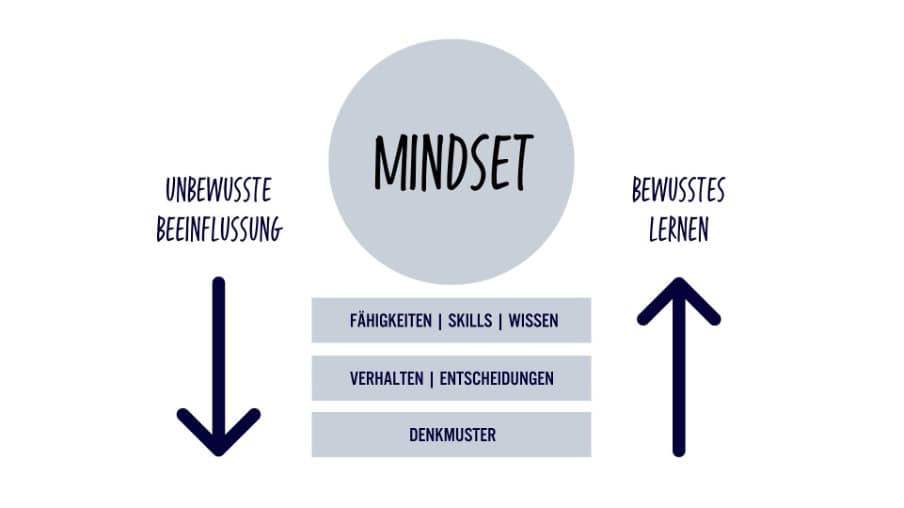
Rumms. The announcement hit home. But it led to me adopting a new perspective. Because I realized that the imprints, messages and suggestions of the education system would only get in the way of my future. And before I knew it, I was facing what was probably the most difficult Shift of my life so far. I had to learn to unlearn everything I had grown up with. What had been drilled into me at school for years. I had to discard the messages from the past and redefine who I wanted to be. What I believe in. And which Mindset should drive me. There is a direct connection between the results in our lives and our current mindset, which you can imagine as follows.

Mindset unconscious self-sabotage

The mindset as a determining factor in thinking and behavior

However the Mindset you are currently going through life with, it is the unique combination of your Identity, your most important Values and your deepest convictions. This special mix not only determines your general world view, but also your skills, your behavior, your decision-making strategies and, at the end of the day, your results. Or to put it in a nutshell:

Your behavior is always a direct reflection of your mindset.

No matter how much you want to be a successful entrepreneur on an intellectual level, achieve financial freedom or finally find your partner for life. If your mindset is based on an identity that is contrary to these dreams and the associated beliefs, then you will do everything you can to ensure that reality aligns with your convictions. This is due to a universal correlation when it comes to change in life.

The more a behavior attacks our current mindset, the more we will unconsciously do everything we can to postpone or even completely prevent this behavior.

Please note that this process takes place completely unconsciously, even if you are rationally guided by your Targets are convinced. Nevertheless, people are true artists at unconsciously sabotaging all these consciously expressed intentions in order to preserve their own identity and the convictions that go with it.

Limiting beliefs as the origin of unconscious self-sabotage

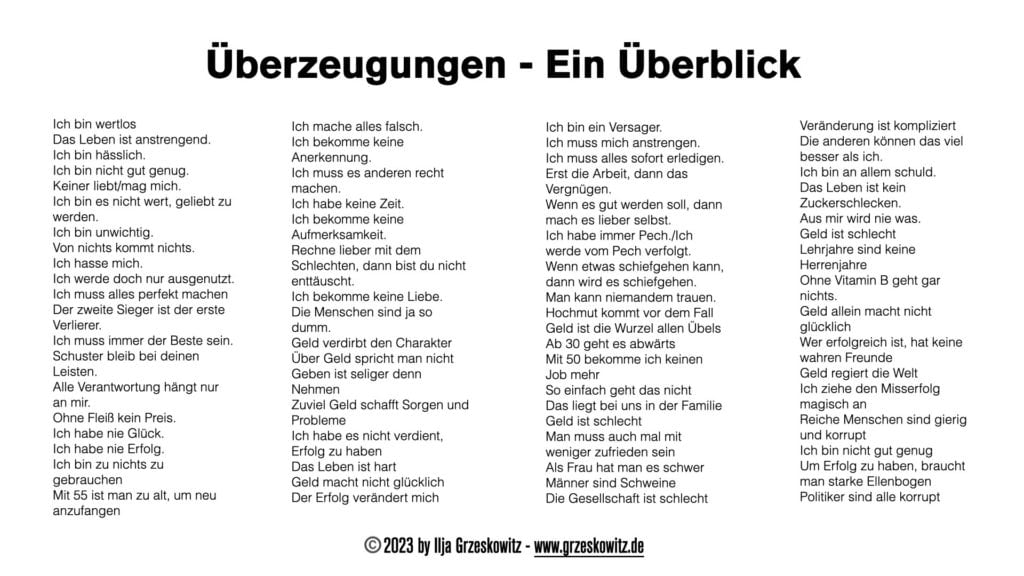
Instead of beliefs, you can also say convictions or beliefs. This refers to the supposed facts and connections that you believe to be true, as well as the general principles of how life works, what is possible or who you are or could be as a person. Would you like a few examples? Here is an incomplete selection of a few classics:

  • Cobbler stick to your last
  • I am not good enough
  • Money corrupts character
  • Rather expect the worst, then you won't be disappointed
  • First the work, then the pleasure
  • Life is no walk in the park
  • Humanity is getting worse and worse
  • I magically attract failure
  • It's not that easy
  • To be successful, you have to extend your elbows
  • I am to blame for everything
  • I don't have the time for that
  • That may work for others, but it's different for me
  • Or my absolute favorite: change has to be hard for it to work.

I'm sure you're thinking of other examples as you read this, aren't you? Then let's move on to what is probably the most important characteristic of beliefs. They don't just appear out of nowhere and are suddenly there. Quite the opposite.

Beliefs always come from outside. We adopt them from other people.

Do you know a baby who was born racist? Do you know a little boy who goes through life with discriminatory prejudices? Or a girl who ostracizes her foreign friend in kindergarten because she is convinced that she will take her job away later on? You see, I don't either. We only learn all our beliefs (both positive and negative) over time from important people in our social environment. Whether we like it or not, we adopt the world view of our parents, relatives and later our teachers. At first, these beliefs are still very small and fragile. But the more we see them confirmed, the more they become entrenched. Until at some point they are deeply anchored in our subconscious, where they reliably unfold their effect.

Beliefs as a central pillar of the mindset

By the time we are teenagers at the latest, we have developed a mindset that serves as a compass for our lives. We have learned what is good and what is bad. What to do and what not to do. What place fate has assigned us and what our future will look like. And since the mass of messages we have been bombarded with has tended to be negative, the mass of our beliefs is correspondingly limiting. The result: despite our best intentions, we sabotage ourselves and struggle with the constant feeling that we are running into a glass wall. Because our behavior is always a reflection of our mindset. And what is even more insidious is that we are completely unaware of all this.

„Okay Ilja, if my mindset automatically influences my abilities, my behavior and my decisions, then all I have to do is change my mindset in a positive way and my subconscious programs will automatically lead me closer to my goals and dreams, right?“ I'm glad you asked. My answer comes in Radio Yerevan style (based on the jokes that were very popular in my youth) and is: In principle, yes, because the big challenge is actually lurking in the inconspicuous word. It doesn't work at the snap of a finger and takes a certain amount of time. As you can see in the illustration, the only way to permanently change your mindset through your thoughts, decisions and behavior is through conscious learning.

Learning to unlearn: one of the most important skills of the future

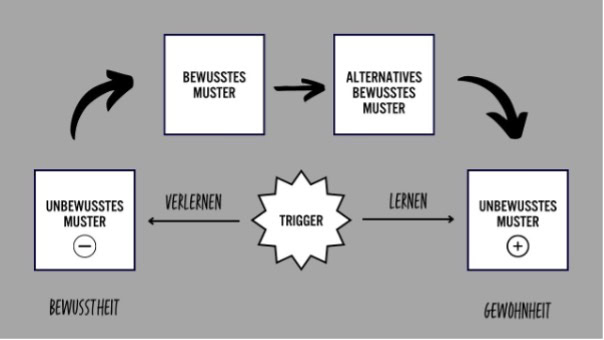
The basic process of learning how to unlearn something is surprisingly simple. It involves identifying a limiting pattern and bringing it from the subconscious to the conscious surface. There we can then replace it with a beneficial alternative and turn it back into an unconscious automatism that then does its positive work for us. Sounds simple at first, doesn't it? And it is. However, as is so often the case, the word simple means, above all, not complicated and not easy. Because unconscious patterns can be extremely stubborn and it takes a great deal of discipline, commitment and perseverance to transform a negative habit into a positive one.

Of course, I know that these values don't sound particularly sexy in times when everyone just wants to live in the moment and have all their needs met immediately. But not only is it worthwhile, it can also be a lot of fun. If you look at the illustration, you can see the 4-step process at a glance.

Learning to unlearn: breaking through and overcoming unconscious self-sabotage

Before we look at the individual stages, it is important that we take another detailed look at the principle of unconscious automatisms. They always work in the same way. Imagine that you are writing a computer program based on the following algorithm: Whenever X happens, respond with Y. A classic stimulus-response scheme. In the context of human behavior, X is a certain trigger that evokes an emotional response, reminds us of a certain experience or triggers a state. Images, words, sounds, smells, tastes or tones can serve as triggers. If such a trigger is activated, our subconscious automatically rewinds the learned program. Here are some specific examples:

  • You smell the aroma of fresh cake and immediately remember a wonderful situation from your childhood
  • Your partner reacts to a suggestion with a typical facial expression and you automatically feel insecure
  • You listen to your favorite song in the car and are motivated as if by magic
  • You look at your overflowing email inbox and immediately start distracting yourself with pointless social media surfing
  • Your boss uses a certain tone of voice and you feel insecure
  • Before a presentation, you look into the faces of your audience and your heart starts to beat faster
  • You're driving down the highway hungry and spot the glowing M of a large fast food chain. Although you want to eat healthily, you pull off at the exit and order a double cheeseburger with fries and a milkshake (you know, I got this example from a friend)

Overcoming unconscious self-sabotage: The 4-step process

In each of these examples, the respective trigger ensures that an automatic program is unwound. Your subconscious doesn't care whether it's something positive or negative. Only one thing is important: when X happens, it reacts with Y. This leads to a crucial insight. If we are dissatisfied with Y, then we have to start with X.

Overcoming unconscious self-sabotage Level 1: Awareness

Your subconscious runs at full speed every day. You think, decide and act. The problem is that the whole process is so automated that it has become so normal for you that you no longer even notice it. The aim of this step is to cut through this unconscious loop and bring unconscious patterns to the conscious surface. To do this, go through life with a high degree of mindfulness.

Be aware of which triggers trigger which behavior in you. Which thoughts you think in which situations. Which strategy your Decisions determined. And which patterns you can recognize in your behaviour. At first, this will seem like an almost impossible task. No wonder, because where your everyday life was on autopilot not long ago, you are now taking the wheel into your own hands. But mindfulness can also be trained. And the more consciously you become of the many processes that were previously completely unconscious, the easier step two will be for you.

Overcoming unconscious self-sabotage Level 2: Unlearning

The more mindfully you go through life, the more unconscious patterns you will notice that are limiting rather than beneficial for you. Now choose one of these patterns that you would like to change. Pay close attention to the strategies behind the behavior for a few days. How exactly does the pattern work? What exactly do you do and in what order do you do it? Which senses are involved? And most importantly: What trigger sets off the behavior? The aim is to interrupt the learned program „If X happens, then react with Y“ as consciously as possible and reprogram it in the next step.

Overcoming unconscious self-sabotage Level 3: Learning

Now it's time to make a decision. Which alternative behavior would you like to establish as an unconscious automatism instead of the old one? Unfortunately, it is not enough to simply say goodbye to a negative habit. Without a positive alternative, this attempt is doomed to failure. Why? Because once the behavior has been banished, a vacuum is created. Whenever trigger X is triggered, the „program“ desperately searches for the usual reaction Y.

If you do not offer an alternative at this point, people will revert to their old behavior after a short time. It is not enough just to decide that you no longer want to eat fast food, for example, you also need the corresponding new choice. The algorithm could then look like this: „Whenever I see the glowing M on the highway, I take a deep breath, drink a sip of water and enjoy a protein bar.“

Overcoming unconscious self-sabotage Level 4: Habit

The final step is to turn the chosen change into a new - and beneficial - automatism. The more consciously you associate the trigger with the new behavior, the more successful the transformation will be. As James Clear describes in his bestseller Atomic Habits, it takes an average of 66 days to establish a new habit. So why not start a project that takes just as long? Two factors are important here. Firstly, consciously incorporating the new behavior into your everyday life. And secondly, regularity. Because the more often the new program is repeated, the more likely it is to sink back into your subconscious and from then on achieve its positive effect as an automatism.

Unconscious self-sabotage: examples from everyday life

In this way, you have a wonderful method at hand to unlearn limiting patterns, establish new habits and thus gradually overcome your unconscious self-sabotage. Do you still need some inspiration as to which areas are worth learning how to unlearn unconscious automatisms? Here we go:

  • Limiting beliefs
  • Poor decision-making strategies
  • Negative thought patterns
  • Unnecessary assumptions
  • Impulsive behavior
  • Emotional reactions
  • Unfounded prejudices
  • The tendency to look for excuses as to why something doesn't work
  • The focus on problems
  • Excessive doubting
  • The tendency to justify oneself
  • The urge for perfectionism
  • The stories you tell yourself every day

I wish you joy and success in discovering and breaking through your unconscious self-sabotage. But make sure that you don't want too much at once. Not only is automaticity more than enough at the moment, but you also increase the likelihood of lasting change.

Self-employment tips: 16 lessons from 16 years as a self-employed entrepreneur

You know that rare feeling when you think you should pinch yourself because you're just so grateful for certain things in your life? I had just such a moment this morning when I looked at my calendar. Because this year, on March 1, 2025 to be precise, I will be exactly sixteen years old as a Keynote SpeakerAuthor and Business Coach independent.

This always seems surreal to me because I can still remember exactly how long I was afraid of making the necessary decision. And even more so how hard the early days were.

After I left my old job as a Managing Director at Karstadt and IKEA I started from scratch again in 2009. With zero customers. Zero network. And nothing but my big dream of self-employment in my head. You can't imagine how much criticism I received at the time, because those around me simply couldn't understand my decision to turn down a supposedly secure job in favor of an obviously completely crazy idea.

The dream of self-employment

Nevertheless, I refused to be intimidated by the naggers, complainers and naysayers and passionately embarked on the rollercoaster ride that is self-employment, which has now lasted a decade and a half. And in the moments when I have a little time to reflect, I gratefully realize how proud I am.

Not only have I been able to increase my sales year after year, I also have a great team at my side, have 13 books (which has sold hundreds of thousands of copies, been translated into dozens of languages, and three of which have become bestsellers), was allowed to become a Keynote Speaker at events around the world and was able to continuously expand my personal brand.

Self-employment is not a straight path, but an emotional rollercoaster ride

When I look back on my journey so far (because I still have a lot to do!), I realize how many mistakes I've made, how many wrong decisions I've taken and how many setbacks I've had to deal with. But these were the moments when I developed as an entrepreneur and learned important lessons. And it is precisely these that I have summarized in a kind of best-of that I would like to share with you today. If you are just starting out as an entrepreneur, I hope that these ideas will help you to put your business on a solid footing right from the start.

And if you already have a few years of entrepreneurial experience under your belt, I would hope that you can still take one or two ideas with you. Are you up for it? Then here are my 15 best self-employment tips and lessons from 15 years of self-employment:

Self-employment tips #1: Build up a network in good time

Nobody wins alone. That has been my mantra for many years. And it hits the nail on the head. As a solopreneur in particular, a high-quality network is a decisive success factor for sustainably successful self-employment. A network can open doors, establish contacts, make recommendations and act as a sparring partner in the everyday life of a self-employed person.

It is important to build up your network in good time. By following the principle of “give first - take second”. Because a network is not something you build up so that you can tap into it one day, but because it is a wonderful symbiosis that thrives on mutual support.

Self-employment tips #2: When you are particularly successful, the pressure to change is at its highest

Yesterday's success prevents tomorrow's success. This is something I realized early on in my career as an independent entrepreneur. Because being successful usually leads to us becoming comfortable, less innovative and productive and developing a certain “keep it up” mentality. This leads to an important realization: in moments of success, the need for innovation, courageous decisions and Changes largest.

Self-employment tips #3: Sales and marketing are skills that EVERYONE should master

We can spin it however we want, but without marketing and sales, every business is doomed to failure, because what good is it if you are really good but nobody knows about you and your offers? These two skills are therefore no longer “nice to have”, but an essential skill that you should acquire today rather than tomorrow. Your sales, your brand awareness and your long-term Success will thank you for it.

Self-employment tips #4: Define your company structure

In order to run your own business successfully and with personal satisfaction, one of the most important steps is to define your company structure in good time - and consciously. How exactly should your company be structured? How do you organize yourself? Which tasks and processes are recurring and what should the standards for completing them be?

These are all preparatory considerations for the most important question of all: What do I most want to spend my time doing all day (because I like doing it, am particularly good at it or because it's the best way to earn money)? Once you have found the answer, you can either automate or delegate everything else. The result: you do what you want to do, experience deep gratitude and are maximally profitable.

Self-employment tips #5: Personal branding is the decisive factor for sustainable self-employment

I cannot emphasize enough how important the development and expansion of your personal brand is for sustainable success. Because as a self-employed person, you are the head, the heart, the soul and also the face of your company. The more generous you are with your Personality the more sharply you will be able to position yourself and thus become the number 1 in the minds of your target group's customers in the long term.

Self-employment tips #6: Define (and live!) your values

Anyone who knows me knows that I have a certain positive obsession with the subject of Values have developed. No wonder, since they are not only the mirror of our behavior, but also the basis of our Decisions, our inner attitude and our entire business orientation. The time you invest in consciously defining your own values can hardly be valued in euros or dollars, such is the leverage you will achieve. Because once you know your values (and live them every day!), you will never again have difficulty making difficult decisions.

Self-employment tips #7: Be aware of your value and demand a corresponding price for it

“Unfortunately, we don't have a budget, but there are a lot of decision-makers in the audience and you also benefit from our social media reach”. This is how many interested parties try to engage prospective self-employed people (e.g. if you have a Book a speaker want). They want the full service without wanting to pay the corresponding price. But the concept of “something for nothing” simply doesn't work. Or do you know any baker, lawyer, chef, car dealer or fashion retailer who will give you their products or services for free because you promise them reach and possible follow-up orders? Of course not, right?

Nevertheless, this behavior is common among creative freelancers and solopreneurs. Not only does this not earn you any money, it also destroys your own brand and makes you even less successful in the long term. The following therefore applies: Know your value (and that of your products and services) and then charge the appropriate price for it. Always. Without exception.

Autonomy Tips #8: Internalize the concept of lifelong learning

Have you ever had thoughts like “I already know that”, “I already know that” or “I can already do that”? We all regularly fall victim to this inner illusion, which has a fatal result: We stop developing, stop growing and, at best, manage to stand still.

Even more fatal, however, is another thought that often occurs when we have celebrated our first successes as self-employed people: “Now I've made it!”. If you give in to this, it is often the beginning of the end. This is why the concept of lifelong learning is so crucial, especially for the self-employed. So that we can continue to develop, grow as a person and continuously expand our independence.

Self-employment tips #9: Mindset shift from consumer to producer

As a self-employed person, there is no one to tell you what to do and what not to do. As a result, the distinction between your private everyday life and your entrepreneurial activities is not always clear-cut. It is therefore crucial to adapt your own mindset accordingly. And this can be achieved by Mindset Shift away from consuming to producing content. Content marketing is one of the most important components in building a personal brand and for your own acquisition.

Where self-employed people used to read books, attend lectures, attend seminars, consume online courses, listen to podcasts and watch videos, they now have to write books, give lectures, give seminars, offer online courses, produce podcasts and record videos. Of course, this doesn't mean that you shouldn't consume anything from now on. On the contrary, after all, we are committed to lifelong learning. But when we do, it is always with the intention of gathering inspiration and ideas.

Self-employment tips #10: Treat yourself like a business

While we're on the subject of mindset shifts, here's another lesson in which your Identity as a self-employed person takes center stage. I'm talking about the idea of treating you as an entrepreneur right from the start. The rapper Jay-Z summed up this philosophy wonderfully when he once said in an interview: “I'm not a businessman, I'm a business, man!”.

As a self-employed person, you are the business. You are the head, the heart and also the soul. And this must be taken into account. In all decisions, investments and activities. The sooner you are able to look at your everyday working life through an entrepreneurial lens, the faster your professionalism will increase.

Self-employment tips #11: Build an email list

Even if it is repeatedly emphasized that email marketing is actually dead, in 2024 your own email list is still the best marketing channel there is in my opinion. What could be better than thousands of people who have voluntarily signed up because they value your personality, love your content and want to be part of your community? Combined with a sustainable content strategy, your email list can quickly become your most successful salesperson.

No matter how small or young your business may be, you should start building your email list as soon as possible. When you look back fifteen years from now, you'll thank me for this lesson.

By the way, you can sign up for my e-mail list here enter.

Self-employment tips #12: Find coaches and mentors

There is an old saying that the best interest is still earned by investing in yourself. And that is true. Because you can never know and be able to do everything, especially as a self-employed person. That's why ongoing training and further education is essential. My success is largely the result of my collaboration with various coaches and mentors. For example, I have received targeted support in the areas of stage performance, business development, online marketing, speechwriting and impact.

And that's exactly what I recommend you do. Even though I now work as a mentor and coach myself, you don't have to book me, of course. But I can't emphasize enough the positive leverage of coaches who work together and primarily individually with you on your business.

Self-employment tips #13: Pay your partners well

Do you know those supposed premium providers who charge very high prices for their own products and services, but then suddenly want to save as much as possible when hiring their own business partners (web designers, photographers, copywriters, etc.) in the best Scrooge McDuck manner? This leads to nothing in the long term and I can only recommend that you always pay your partners well. Of course, this always depends on your current situation, but the basic rule is: if you want others to pay you well, then pay others well first. Sounds a bit esoteric, but it's probably the most practical tip of the fifteen lessons.

Self-employment tips #14: Take a break

“Self-employment means self and constant.” I don't know how often I've heard this sentence. And there's a lot to it, especially at the start of your own entrepreneurial career. Because you only make sales when you are active. One day, however, this leads to you no longer daring to take breaks or go on vacation because you could actually be working on your business during that time.

As counter-intuitive as it sounds, breaks are not only important, but essential for your business growth. I've had my best ideas during a walk in the woods, made my best decisions after a short break, and my biggest eureka moments have always happened after a phase in which I was able to recharge my creative and productive batteries. So here's an important recommendation: take a break more often. Your success will thank you for it.

Self-employment tips #15: Dare to be yourself

The last lesson sounds extremely banal, but the effects could not be greater if applied consistently. I'm talking about daring to be yourself. To throw all your masks into the corner and generously share all facets of your personality with the world. This sounds easier said than done, because you will always encounter people who want to tell you what to do and what not to do. As soon as you are able to free yourself from these external expectations and dare to consistently live your inner values in all contexts, your personal brand will become more successful, which will also be reflected in increasing inquiries, customers and sales in the long term.

Self-employment tips #16: Be boring

No, of course I'm not talking about character, because who likes boring people, right? I'm talking about something completely different. We all love the big, emotional, stand-out moments in life. But true freedom comes when you realize that success (whatever that means to you) is never the result of a one-off flash of inspiration, a hair-trigger move or a secret and long-lost trick. No, success is extremely boring in nature. Because it's always about the consistent implementation of the simple, supposedly unimportant and not particularly sexy sounding things that make a huge difference at the end of the day. Everyone knows them and everyone knows it. But very few are focused, disciplined and determined enough to do them every single day. So concentrate on the boring tasks. Get really good at them. And your life will become the exact opposite: Intense, exciting and fulfilling.

Enjoy the rollercoaster ride that is self-employment

Let's come to a brief conclusion. In addition to the lessons I have learned from my own entrepreneurial career, I have worked with hundreds of self-employed people over the past few years to build and expand their business. And since the challenges are almost always the same, despite their individuality, the following conclusions can be drawn:

  • Not everyone is suitable for self-employment. For many people, a job as an employee is definitely the better choice.
  • The start can be particularly tough, and the increasing bureaucracy costs nerves, time and, unfortunately, money.
  • The path as a self-employed person is characterized by doubts, worries and setbacks. Don't let this throw you off course. This is normal and will never stop.
  • Your long-term success depends on your willingness to actively work on your business, to be disciplined in its implementation and to consistently go the extra mile.

But the most important section comes at the end: If you are not put off by all of this, then self-employment is probably the most fulfilling profession imaginable. Nowhere else will you experience this feeling of freedom and the opportunity to actively shape your life in a way that is in line with your values and purpose.

I wish you all the best for the upcoming rollercoaster ride called self-employment.

I look forward to your comment. Please let me (and all readers) know what you have done (or are planning to do) to start your own business and what your biggest learnings are.

What is personal development?

What is personal development? You have probably already asked yourself this question. No wonder, because the topic is a popular, much-discussed and often controversial one. For some, it is the holy grail for getting as far as possible in your personal life and job, while others see it more as a dubious method used by dubious gurus to take their customers' hard-earned money out of their pockets.
 
So let me give you my opinion right at the beginning of the article: I think personal development is essential if you want to lead a life that is characterized by Self-determination, satisfaction and Success is marked. And we will now take a detailed look at how this works.
 

What is personal development?

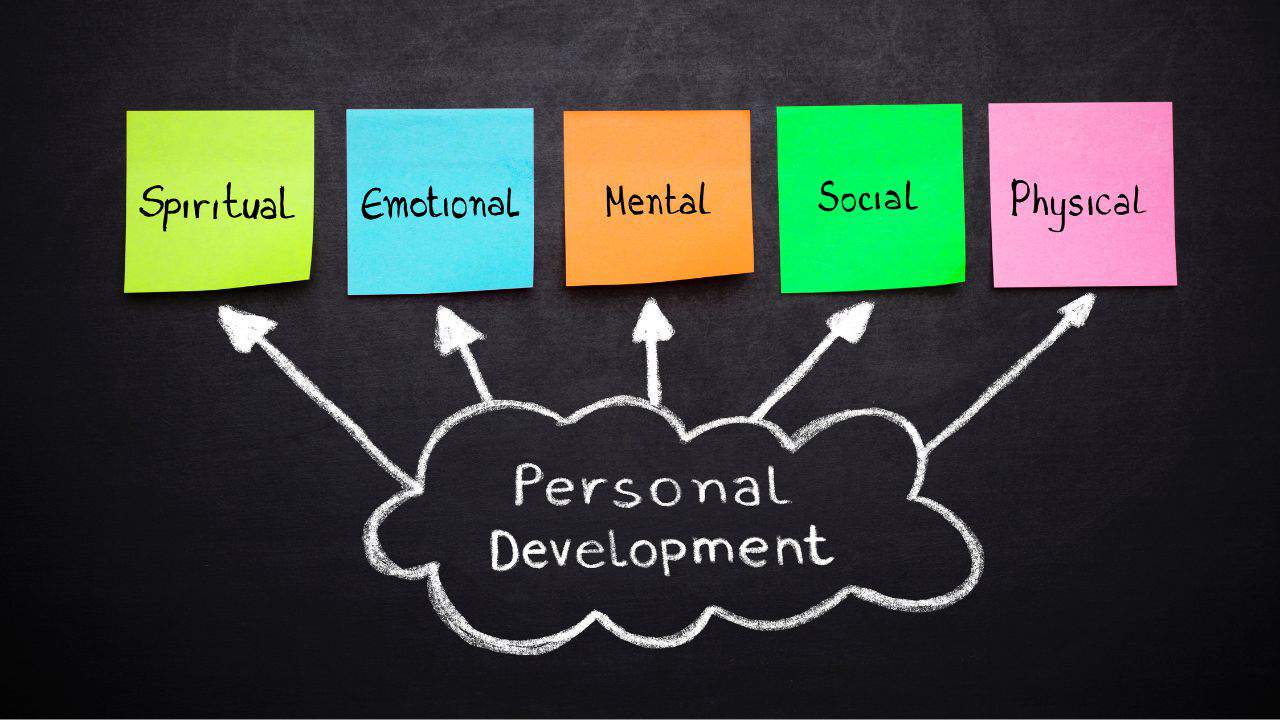
Personality encompasses all of a person's characteristics such as strengths, weaknesses, talents and abilities, Values, Beliefs, experience, self-confidence, the accumulated knowledge, as well as the general Mindset, with which you go through life. If you want the (positive) Shift If you do not leave these characteristics to chance, but instead control them in a targeted manner, this is known as personality development. Or to put it in a nutshell: the conscious control of personal development with intention is referred to as personality development.
 

Personal development as a source of happiness and satisfaction

In my seminars, coaching sessions and consultations, I almost always ask my clients one question: „What is your most important Goal for the next twelve months?“ And the answer, which I hear as often as all the others put together, breaks my heart every time: „I want to be happy and content.“ Wondering what's wrong with that? It's not the wish itself, of course, because what could be better than experiencing genuine happiness and deep contentment?. 
 
The tragedy of this supposed goal is something completely different. It is the assumption that happiness and satisfaction are states that depend on external factors. The internal pattern is based on the following pattern: once I have achieved my goal (finished my studies, completed my further training, been promoted, moved house, bought a new car, started my business, become a mother, etc.), then I can finally be happy and satisfied. 
 
Do you recognize the error in thinking? Happiness and contentment are never dependent on external circumstances. You can't buy these states, they don't develop over time and they don't fall from the sky over time. If you were to retain just one idea from this article, it would fill my heart with joy if it were this sentence: Happiness and contentment are a decision that we have to make anew every day.
 

The big mistake that prevents personal development

Have I shaken your convictions too much with this sentence? If so, then I'm delighted. Because if you are one of those people whose most important goal is to be happy and content, then it's time for a rethink. Let me repeat it once again: happiness and contentment are a Decision, that you have to make anew every day. These conditions do not arise at some point as a result of external events, but arise deep within you. 
 
By being grateful, enjoying the little things in life and savoring every single moment. Do you want to be happy? Wonderful, then be happy. And not in twelve months' time, but today. Right now. Right now. Do you want to lead a happy life? Then make the decision to do so. Where you are right now, with the external circumstances that currently exist. Don't wait for a At some point, because this almost always results in a Never.
 

Personal development: the growth ladder model

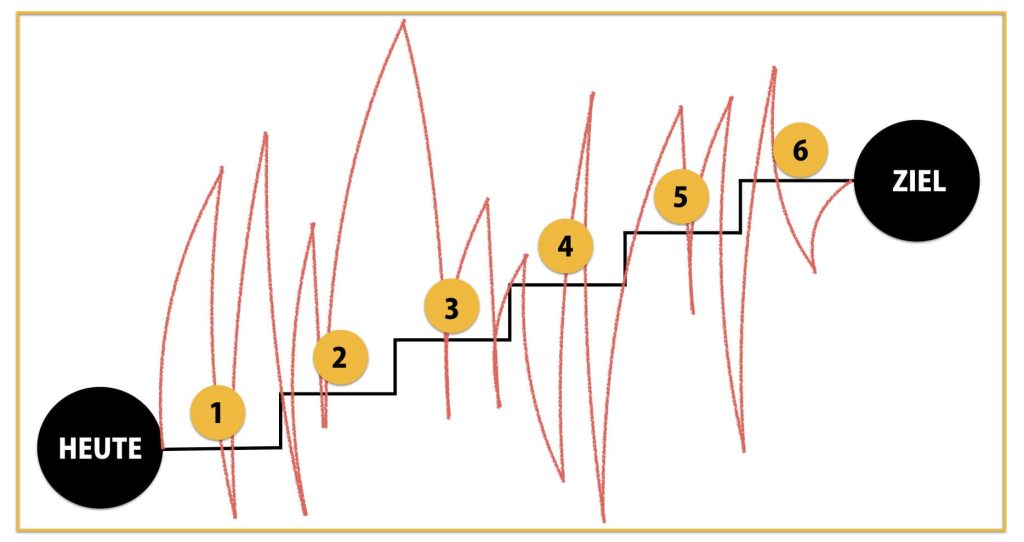
The most important thing to be happy and content is to make a decision. The rest will follow by itself as soon as you begin to embark on the journey of personal development. And we are already in the middle of a model that has shaken up my business, my everyday life and also my life, and will hopefully have the same effect on you. I am talking about the growth staircase, which I have visualized for you in the following illustration.
 
Personal development: the growth ladder model


Personality development stages

The idea behind it is very simple. The bottom left-hand circle represents the status quo, the person you are today and the life you are currently leading. The top right-hand circle symbolizes your future, your visions and represents the person you want to be in the future. And that brings us to the huge mistake that many people make: Assuming that the path between today and our destination is a straight line. 
 
But that's simply not how life works. It's more like a fast-paced rollercoaster ride, with highs and lows, successes and defeats, rapid changes of direction, steep climbs, adrenaline-inducing loops, but above all a huge portion of fun. I have tried to visualize this hussar ride with the zigzag line.
 
In reality, this would look even more complex, more like a mighty ball of wool, after all, we often have to overcome obstacles on our way, make new attempts or deal with failures. Do you agree?
 
But that is by no means all. Because within the zigzag line, the very special (and always individual) process that we call personality development emerges. This process takes place in stages, which I have labeled circles one to six in the illustration. The idea behind this is that we go through different stages of development over time, which reflect our current status in terms of knowledge, skills, experience and insights.
 
Each individual stage has its own special features and very specific learning tasks. Once we have mastered these, we grow as a person and climb to the next personality level, where we then have to master the next learning tasks. Until we finally arrive at our destination. Or realize along the way that another goal is much more attractive or relevant. 
 

Personal development as a sequence of learning tasks

Whatever you want to achieve in life, with every goal, every vision and every dream, the growth staircase is waiting for you to climb it. And I know what's going through your mind right now, but no, there are no shortcuts, no elevator or other ways to reach the top right circle faster. 
 
And that's a good thing, because each individual stage is a milestone that is worth enjoying and savoring to the full. Above all, however, you need to master the challenges in order to tackle the next stage of your personal development.
 
For this reason, it is not worth comparing yourself with people who have been where you want to be for ten years. These people are many steps ahead of you and you have yet to successfully complete them. These people are struggling with their own learning tasks and challenges.
 
And it is precisely for this reason that the famous sentence Fake it 'til you make it What nonsense. After all, what's the point of pretending you're already at level six if you're currently busy mastering the tasks at level one! Enjoy your current stage of development and be pleased that the journey itself is the real goal. Each stage has its positive and negative characteristics. At each stage there are people who enter your life, while others leave it again. And at each stage, fate presents you with tasks that need to be mastered. Until the game starts all over again at the next stage. True to the motto: Once you have found the answer, life changes the question.
 

What is personal development? A conclusion

And almost imperceptibly, the circle of thought that we opened at the beginning of the article comes full circle. Because in times of permanent Shift, In a world of increasing complexity and constant uncertainty, a radically human approach with a full focus on the success factor of personality will be the key to a life of self-determination, personal breakthroughs and fulfilling freedom. 
 
It doesn't matter where you are today. As long as you are prepared to climb the growth ladder step by step and enjoy the resulting rollercoaster ride, you will be more than prepared for the challenges of the coming years. I can't tell you exactly what our future will look like. But I have decided to put my personal stamp on it and actively shape it. And in a radically human way. The philosopher and poet Dante Alighieri put it like this: „One waits until the times change. The other tackles it head on and takes action.“ I made my decision many years ago. What is yours? 

Self-determination is the new security

Self-determination is a Value, which is no longer considered particularly sexy or desirable in this day and age. The masses have become too accustomed to a world in which other people, organizations and authorities plan, manage and control their entire lives. But placing one's own future in the hands of others is not an option in the VUKA World is completely the wrong approach. Instead, self-determination is becoming the new security. And let's take a closer look at exactly why this is the case.
 

Self-determined living: Be like water, my friend

In my experience, people can be divided into two general categories. They are either team sea or team mountains. What about you, have you ever asked yourself whether your heart feels most at home on the summit of a majestic mountain or on the endless beach of a rough ocean? I myself don't have to hesitate for a second to answer that question. I am Team Sea. 
 
Maybe it's because, as a child, I used to sit on the stones in my home town of Travemünde (a district of the Hanseatic city of Lübeck) like Tony Buddenbrook (every famous scene from the novel „The Buddenbrooks“ by Thomas Mann (who, like me, was also born in Lübeck), and impressed by the vastness of the horizon, I dreamed of faraway countries and traveling by boat. Even though I love the breathtaking scenery of the mountains, nowhere do I feel as free as by the sea. 
 
I could gaze at the crashing waves for hours while the unique salty smell fills my nose and the screeching of seagulls fills my ears. And every time I find myself by an ocean anywhere in the world, I can't help but think of what is probably the most famous quote in the world. of the martial artist and actor Bruce Lee (You can watch the interview with Bruce Lee here as video view):
 
Empty your mind, be formless, shapeless, like water. Now you put water in a cup, it becomes the cup. You put water into a bottle it becomes the bottle. You put it in a teapot it becomes the teapot. Now water can flow or it can crash. Be water, my friend.” 
 
My German translation is as follows: “Empty your mind, be formless, shapeless - like water. If you put water in a cup, it becomes the cup. If you put water in a bottle, it becomes the bottle. If you put it in a teapot, it becomes the teapot. Water can flow or destroy. Be like water, my friend.”
 

Self-determination as a response to fear and uncertainty

Of course, this metaphor was primarily intended for use in martial arts. If you don't confront your opponent with a rigid strategy, but can adapt flexibly, then the chances of success are much higher. And perfection is achieved when you are like water. Because you simply cannot grasp this element. At the same time, however, it is also able to make its way through impenetrable terrain and defeat seemingly overpowering opponents.
 
Over the last few months, I've been thinking about Bruce Lee and his metaphor of water almost every day. The world has changed massively, and not just since the global pandemic. Many people's everyday lives are characterized by a gnawing fear of the future, priorities have shifted and the vast majority of the population shares the increasingly intense feeling of being hopelessly at the mercy of the whims of fate.
 
And as is the case with drastic Changes As is the case nowadays, we try to overcome this uncertainty by clinging to familiar things, by organizing our everyday lives around routines and by taking as few risks as possible. As absurd as it may sound, the more uncertain the external circumstances are, the more important a feeling of inner security becomes for us.
 

Security is the result of self-determination

But where can this security still be found today? A job as a civil servant in the administration? Of course, you get your salary paid into your account on time every month for the rest of your life. But at what price, when your days are characterized by a lack of creativity, monotony and the often pointless processing of forms? Even the supposedly secure career in a large company only exists in theory. The transformation from an industrial to a knowledge-based society will result in millions of jobs being lost in the future, more and more jobs are being cut on a massive scale in almost all sectors and the coronavirus crisis has accelerated the wave of insolvencies.
 
And even if you manage to make a career as an employee in a future-oriented industry, the organizational constraints, the stress caused by increasing pressure to perform and the almost non-existent work-life balance are the main reasons why more and more people are asking themselves the question:
 
„Should that be it now? Am I supposed to drive to the gray open-plan office every day for the next thirty years to do a job that doesn't fulfill me, often frustrates me and hasn't been fun for a long time?“
 
Believe me, dear readers, I know these thoughts only too well, because they used to run through my head in a kind of continuous loop. And I would probably have drowned in the negative spiral of hopelessness and frustration if I hadn't listened to the biography of one of my childhood idols as an audio book in the car. I'm talking about John Michael Osbourne, the singer of the legendary hard rock band Black Sabbath, who you may only know by his nickname Ozzy.
 

What you can learn from Ozzy Osbourne about self-determination

He grew up in poor circumstances in Birmingham in the 1950s and decided as a teenager to train as a skilled worker. To become a car horn tuner. Doesn't sound particularly sexy, does it? Ozzy explained his decision as follows: „Back then they thought you take what little education you can get hold of. Then you learn a trade and get a shitty job that you're really proud of, even though it's a shitty job. And then you do this shitty job for the rest of your life. This shitty job simply means everything to you.“
 
And so it was that the future international star began to learn the art of car horn tuning. If you're thinking: „Art? That sounds like a very dull activity“, then you are absolutely right. Because the young Ozzy's daily routine looked like this.
 
He sat at the assembly line and grabbed a horn. Tuned it with the screwdriver. Tested the sound. The next horn followed. The same action with the screwdriver. Tune it again and test the sound. Then the next horn. And the next one. Again and again. Grip. Tuning. Testing. All day long. The work was so frustrating, loud and monotonous that he feared he would go mad.
 
So he asked the colleague next to him, an older gentleman with a bald head and huge dark circles under his eyes: „Tell me Jimmy, how long have you actually been here?“ To which he replied: „Twenty-nine years and seven months. And you know what the best part is? In five months, I'll have been here exactly thirty years. Then I'll retire and get my gold watch from the company.“
 
At that moment, the future multimillionaire had the following thought in his head: „I'd rather the Russians drop a bomb on the factory before I have to spend thirty years in this room.“ And he said: „Listen, Jimmy, if you really wanted a gold watch, you should have stolen one from the jeweler in the pedestrian zone. Even if they'd caught you, you'd only have done a tenth of the time you've spent in this hole.
 
And that would undoubtedly have been the better choice.“ He then left his job without a word and made the decision to swap frustration for a self-determined life. To do what really fulfilled him and what he had been dreaming of for years. And that dream was music.
 
Together with his childhood friends Tony Iommi, Geezer Butler and Bill Ward, he founded the band Black Sabbath and made his mark on music history with hits such as Iron Man, Paranoid and War Pigs. If you ask the superstar today what has driven him the most during his long career, Ozzy Osbourne likes to say that the memory of the gold watch has saved him more than once.
 
Whenever he doubted whether he was still on the right path, whenever there were crises and setbacks, the huge image of a gold watch appeared in his mind's eye and suddenly reminded him of the conditions in the car horn factory and how his life might have turned out if he had not made the choice to take the path of self-determination.

Live independently and enjoy freedom

This is just one example of countless others where the Decision against traditionally prescribed paths and for a self-reliant life began with the following realization:
 
„There must be more to it than paying bills, working for an anonymous organization and counting down the days until retirement.“
 
Ever heard of it? Perhaps often thought of it yourself? I certainly hope so, because life really does have so much more to offer than a dull 9 to 5 job, having to endure a monotonous office routine and carrying out pointless instructions. If you take it by the horns and don't rely on others to make the right decisions for you. It may seem counter-indicative at first glance, but traditional employment models will be associated with maximum uncertainty in the future. 
 
Because you are dependent on other people for every external change. And as harsh as it may sound, they unfortunately don't care about you at all.
 
It doesn't matter whether they are politicians, managers of large corporations, civil servants in various administrations, company superiors or state bureaucrats, they are all solely concerned with maintaining their own vested interests, their own power and their own status. And to achieve this, they only pursue their own goals. And these are further removed from their own than HSV is from the next German championship.
 

The old rules no longer apply

If you need to reach these external Goals are labeled as no longer good enough, you will be dropped like a hot potato. It doesn't matter how good, hard-working or loyal you were in the past. You can't imagine how many people I know who have worked for a company with passion and dedication for decades and have been thrown out the door overnight. Without a single thank you. Without appreciation. Without any recognition of their previous achievements. A quick handshake, maybe a bouquet of flowers to keep up appearances and then that's it. In many organizations, people are unfortunately just a cost center that is cut immediately and with mathematical precision at the slightest pressure.
 
And if you think that this could never happen to you, just take a look at the industries that are in the process of shrinking back to health: banks, car manufacturers and their suppliers, retailers and traditional media companies are just a few of many prominent examples. And since the exclusive focus on cost savings has never led to corresponding results, the end of the trend is still a long way off.
 
Many a well-known group was only able to survive thanks to massive support from the taxpayer, while well-known brands such as Galeria Karstadt Kaufhof, Vapiano, Esprit and the Adler fashion chain had to file for insolvency. Too big to fail is long gone. Today more than ever, the leaner and more adaptable a company is, the greater its chances of success in the future.
 

Flexibility as the key to dealing with an uncertain future

The more uncertain times become, the more important self-determination becomes. The more important it becomes to shape your own life, to be able to react to changing conditions with maximum flexibility and to take responsibility. For your own goals. For your own dreams. For your own life. Of course, there are also a lot of imponderables here, things that you cannot influence and hurdles that need to be overcome.
 
But at the same time, you have full control over your vision, your goals, your decisions and what you do or don't want to do every single day. And isn't that the true definition of Freedom? It doesn't mean that you can (finally) do what you want. Rather, it's the liberating feeling of no longer having to do what you don't want to do.
 

Self-determination is the new security: a conclusion

And with this thought, the circle of this article closes, because in order to break through the old thought patterns of „be diligent at school, get a good job and then enjoy life after retirement“, „the company and the state will take care of you“ and „there are no alternatives to a career as an employee“ and replace them with a future-oriented, independent way of life, we have to be like water.
 
In the best Bruce Lee sense, we should not hope that the stone lying in our way will disappear by itself, be removed by managers from the carpeted floor or be moved by an authority, but become active ourselves. To pave a path around the stone, through it or over it. Or perhaps to look for a completely new river.
 
In our case, we can of course replace the metaphor of water with the word self-determination. Those who think for themselves become the solution. Those who make self-determined decisions create opportunities. Those who live self-determined lives create a future according to their own ideas.
 
And it is precisely for this reason that self-determination will become the new security in the coming years. A newfound freedom that motivates us from deep within. To an independence that gives us a lifestyle based on a very special mix of gratitude, purpose and fulfillment. And there is a way of organizing life and work that combines all of this in a unique form: self-employment as a working model that minimizes dependence on external factors (which are difficult or impossible to influence) and focuses on self-determination.
 
Are you already self-employed? Or are you planning to start one? Then please post the link to your homepage in the comments.

Critical thinking as a success factor for change and transformation

I admit it, critical thinking has fallen into a bit of disrepute and is often equated these days with lateral thinkers, con-artists and “whatever-it's-about-I'm-just-basically-against-everything types”. But this form of anti-attitude has nothing whatsoever to do with critical thinking. What's more, if you make critical thinking an integral part of your everyday life, you will not only be able to deal better with any form of change, but also lead a more successful life overall. So it's time to take a closer look. Do you feel like it? Then let's get started.
 

Why is critical thinking important?

As an internationally active Keynote Speaker I have the great pleasure of being booked by my clients for conferences around the globe. Sounds sexy, doesn't it? And it is to a certain extent, but of course it also means that I spend a lot of time at airports and on board all kinds of airplanes, which admittedly isn't one of my favorite things to do. By the way, I love flying itself. It's the waiting and the increasing complexity of air travel that I don't like.
 
But I make the best of it and use the many hours in the air for a very important thing that often falls by the wayside in the otherwise often hectic everyday life. I enjoy the time for myself. I read an exciting thriller, watch a series on Netflix or think about life itself. No incoming emails, phone calls or other distractions can disturb me, and it's a bit like a spa for my soul. 
 
But when I look around me on my many flights, most people are mainly in „function mode“. They talk frantically into their cell phones, like to blurt out internal company information at an extremely high volume so that everyone around them knows exactly what the company's current problems are, open their laptops immediately after take-off and work on extensive Excel spreadsheets with a fascinating obsession. But why is that? Why do some people not even manage to relax a little on a 45-minute flight from Berlin to Frankfurt? 
 

Meaningfulness vs. mindless routines

On the one hand, I suspect that many a manager - and increasingly many a female manager - considers themselves too important and has succumbed to the fatal misconception that the company would not be able to manage without them for a single hour. The other reason, however, is even more widespread. People simply don't manage to break out of their usual routines and standard procedures. And of course, familiar routines are important because they give our job a certain stability and familiarity - just think of one of our most important human needs, safety. But if you are trapped in your own routines, this fundamentally positive quality can quickly turn negative. When procedures, processes and behaviors are no longer questioned, they tend to become absurd, ridiculous and stupid.
 
One decisive mantra therefore applies above all: The focus should ALWAYS be on the needs of your customers, never on internal processes. Haven't you ever been annoyed when employees of a company have completely lost sight of you as a customer and their behavior is oriented exclusively to internal company processes and requirements? In such cases, I always have to think of the ingenious book title of my esteemed colleague Edgar Geffroy, who summed it up so well with the title of a book: „The only thing that bothers us is the customer!“
 

Critical thinking: question the status quo

Especially when I think of visits to authorities or calls to hotlines of large corporations, I can think of hundreds of examples off the top of my head, but since we were just talking about air travel, let's stick with that. Have you ever asked yourself why the procedures on board are the way they are? Why does the crew really have to explain the safety instructions every time, even though nobody is listening anyway? Why should my little iPhone be able to disrupt the operation of a huge Airbus A380, but the other way round there are no problems? (By the way: If you want a good laugh, enter „Why can't you use phones on planes?“ in the YouTube search. Just great, and somehow sad at the same time). 
 
And every time I ask myself anew where the flight attendants learn their announcements. And by that I mean, of course, the mostly irrelevant content, but especially the form. Seriously, no normal person speaks in such an artificial manner and with such an obvious lack of interest. No wonder nobody listens. Incidentally, the same announcements from the cockpit fall into exactly the same category. For many years I have wondered who actually cares what altitude you are flying at, what the outside temperature is and where the wind is coming from at the destination airport. This information may be interesting for the captain and his co-pilot, but the passengers, i.e. the customers, are not interested at all.
 

The biggest killer argument of change

The answer, as in so many other areas of life, is that we have always done it this way. At some point, a process was set in motion that is now reliably carried out by everyone involved without anyone questioning it critically. The person performing the task brushes aside any question of meaning and undergoes a metamorphosis into a mindless worker bee. This leads to fatal behavior. People only think in terms of internal processes, rules and mechanisms, completely forgetting the needs of their own customers.
 
But fortunately there are more and more people who can no longer be fobbed off with the killer argument „We've always done it this way“. Critical thinkers, in other words, who think for themselves, question the status quo and then give meaning back to the soulless process. I recently flew home from Munich to Berlin late at night. And suddenly the unexpected happened. The pilot announced himself from the cockpit. 
 

Critical thinking as a characteristic of successful people

In a perfectly normal voice, he announced: „Dear guests, I would like to invite you to take a look out of the window. Even we pilots rarely experience a starry night like this. It is simply a wonderful view. At this moment, you can see almost all of Brandenburg. And our passengers on the left are particularly lucky, because the view as we fly towards Berlin is simply breathtaking. It fascinates me every time. I just wanted to let you know briefly. I hope you continue to have a good flight. Thank you for allowing my team and I to take you safely to your destination today.“
 
How often do you experience situations where you want to applaud spontaneously? Luckily, the man was standing in front of his cockpit when I got out, so I (and many other guests) could shake his hand and say thank you. Because even if it was only a few sentences, the departure from the mindless (and in my eyes pointless) routine meant that we experienced one of those magical moments that you remember fondly for a long time to come. And if you look closely, life is full of people like that. 
 

Learning to think critically: question everything

Unfortunately, however, we have become too accustomed to the fact that the masses prefer to act according to the rulebook and leave thinking to regulations and pointless rules. An important component of the Success is therefore critical thinking. An ability that has unfortunately become very rare because many people have become accustomed to the media, politics or anonymous committees telling them what is important, right or wrong. Please never succumb to this fatal convenience, but cultivate the art of critical thinking. And by that I don't mean that you should become one of those anti-people who are fundamentally against everything. No, critical thinking is above all the question of the Sense, relevance or customer orientation. My advice: question everything. Pointless processes, internal procedures and mindless routines. Question entrenched opinions, beliefs and prejudices, especially your own, of course.
 
Or in a nutshell: Question everything. Including this impulse that you should question everything.
 
Two things will happen as soon as you start to make a difference as a critical thinker: Firstly, you will receive a lot of headwind from those around you. No wonder, because you are suddenly questioning processes, routines and procedures that are considered to be universally valid. This is not always pleasant, but what would be the alternative? 
 
And something else will happen. You will notice a dramatic increase in fulfillment, satisfaction and meaning in your everyday life. Because you will only do things that really have a purpose and you will clearly reject all meaningless activities. To make this much easier for you in the future, I would like to introduce you to three specific tools that will help you cultivate critical thinking.
 

Critical thinking tool #1: Ask the question of meaning

The best guide we have in life is meaning. It gives an ordinary job meaning, a routine a raison d'être and our lives significance. Just as an aside: something can be meaningful or have meaning, but the common phrase „that makes sense“ is meaningless. This is yet another example of something being used by everyone and then no longer critically questioned by anyone.
 
Now we come to the all-important question with which you can reliably put the opinions, prejudices, values, beliefs and supposed facts of those around you, and of course yourself, to the test. The question is: How do I know that? In order to be able to give an answer, force yourself to get to the core of your original experience and thereby examine its meaningfulness. The more often you ask yourself this question, the more you will realize how many opinions and beliefs we have simply adopted from other people, the media or our environment. On the one hand, this requires courage, of course, but on the other hand it is the only option if you want to lead a self-determined life based on your own standards.
 

Critical thinking tool #2: Create a not-to-do list

Yes, you read that right. Create a list of things that you want to consciously avoid from now on. not will do more. Because isn't that the case? A classic to-do list can take on gigantic proportions, and we often simply feel overwhelmed by the mass of obligations. Fortunately, there is an extremely effective antidote to this: prioritize and consistently 
 
Say no. No to time wasters. No to procrastination. No to all the tasks that we like to deal with day in, day out, but which ultimately don't bring us an inch closer to our goals. The more you cultivate saying no, the more you say yes at the same time. Yes to more personal freedom. Yes to more focus. Yes to more Self-determination. So grab your journal or a piece of paper and write down all the things you will no longer do from now on. After just a few days, you will notice how your time management becomes more effective and productive. And as a nice side effect, creating your not-to-do list will also increase your inner clarity at the same time.
 

Critical thinking tool #3: Create an IDGAF list

And then comes the next list, which really packs a punch. Similar to the Not-to-to list, its big sister, the IDGAF list, also focuses on letting go, saying no and setting boundaries. However, its effect is even more powerful. And of course the name is also a touch cooler, because IDGAF stands for „I don't give a fuck!“. And precisely this Attitude is essential if you want to lead a self-determined life. Because the more you do your own thing, the more you will experience the following reactions from those around you: Lack of understanding, criticism, rejection, know-it-all attitude, nagging, active opposition and very often subtle emotional blackmail. You will hear phrases such as „You can't just...“, „But you should...“ or „You urgently need to...“. Does this sound familiar to you?
 
On the one hand, you can be a little proud when you receive such reactions to your personality, because people can only rub up against rough edges. On the other hand, it can also become a real burden if the headwind becomes too strong. This makes it all the more important to let go of what other people think about you, expect from you or demand how you should function. You can't prevent all of this, but you can make the decision that you are no longer interested in it from now on. 
 
So from now on, follow the mantra of bestselling author Tommy Jaud, who summed it up so wonderfully: „I don't have to do shit!“ And then create your own personal IDGAF list. Write down everything that annoys you: whether other people like your life, your opinion, your decisions or your ideas. How your clothes are received, what people say about your driving style or taste in music. All the many things that make you say inwardly: „I don't give a fuck! As long as it makes me happy, I don't care what other people think of it.“ The more you detach yourself from the expectations of others in this way, the more you can align yourself with your own aspirations and standards.
 

The art of critical thinking

With these three tools, you can take your critical thinking skills to a new level. It is best to hang the two lists up in a clearly visible place at your workplace so that you can refer to them every day. And then enjoy your life as a critical thinker. You may often seem exotic to others in an age of conformity, uniformity and mediocrity, but it is the only way to lead a fulfilled and happy life. Well, and of course you should immediately subject this claim to critical scrutiny.
 
And, of course, I'm very interested in how you see the topic of „critical thinking“. Write me your opinion as a comment...

What is success - the most important question in life

Success is not happiness! That's the chorus of the famous song by the band Kontra K from 2015. But if it's not luck, then a crucial question arises: what is success? And that's exactly what this article is about. We will take a closer look at the nature of success, attempt to define it and, of course, discuss the best way to become successful. However, I would like to start with a little journey through time.
 

Success is an asshole

„Success is an asshole!“ I slammed the sentence in my reflection's face with contempt. It was New Year's Eve many years ago. I was still Managing Director at Karstadt, and, after another transfer, freshly arrived in a new city. Despite the special day, I had worked late, as I often do, and only returned to my furnished apartment at around 7pm. I felt a certain trepidation. No wonder, as it was the first time I was to spend the new year completely alone. 
 
In a city that I hadn't chosen and where I didn't know a single person. While parties were going on everywhere, corks were popping and boisterous laughter was ringing in my ears, my evening plans were different. First a pizza from the delivery service, a six-pack of beer to wash it down, then a bit of TV watching and a toast with myself at midnight. An absolute low point in my life, because never before had I felt so lonely and empty. 
 
And this was at a time when everyone around me would have described me as very successful. No wonder, because from the outside I really was something of a high-flyer who had taken the career ladder by storm and had achieved everything that others only dreamed of. There was just one huge problem: if this was actually true, why was I so frustrated inside?
 
And suddenly my negative emotions got the better of me and I was firmly convinced: Success is an asshole. Because if you had to pay such a price for success in life, then there was no way I wanted to be successful. A little later, I went to bed depressed before throwing myself back into the hamster wheel two days later. Today, I am very grateful for that New Year's Eve, because my absolute low point was also a turning point in my life. It was as if a switch had been flipped inside me. 
 

What is success? The question of all questions

I realized for the first time that my frustration had nothing to do with external circumstances, but was entirely the result of my own Decisions that I had made over the last few years - and of course the decisions that I hadn't made. It wasn't success that was the asshole, it was just me. Because I had allowed myself to be guided by a definition of success that wasn't mine. Because I hadn't had my own story for a long time and had based myself on other people's expectations. 
 
And there was only one person who could change that. That was me. So I gave myself my word that I would change. Not just a little, but radically. To stop accepting compromises and finally do my own thing. This didn't happen overnight, because I first had to find out what I really wanted. But the seeds were sown and I am still reaping the benefits today. Because I have learned three things:
 
  1. It is never the shiny, flashy and glamorous moments in our lives that shape our character. It is the low points, because these are almost always also turning points.
  2. Dissatisfaction, defeat or frustration can be extremely powerful sources of motivation if we manage to transform these powerful emotions into productivity and a corresponding „right now“ mentality.
  3. Success is an individual thing that everyone defines differently.
 
Yes, now it's time to get down to business. Because I want to talk to you about the word I wrongly called an asshole so many years ago. No other subject has ever had so many books written, lectures given and articles published about it, and entrepreneur Darren Hardy has given it a new meaning with the Success Magazine even paid a printed tribute. 
 
[cp_popup display=“inline“ style_id=“27000″ step_id = „1“][/cp_popup]
 

What does it actually mean to be successful?

I would like to start with a very personal question: Would you describe yourself as successful? Not so easy to answer, is it? Because success is actually much more complex than what is always sold to us in the media as a prototype. I mean the big bank account, the Rolex on the wrist, the stellar career, the Porsche in the garage, the yacht in the port of Monaco and, in general, a life characterized by luxury and status symbols. Take a look at any advertisement of your choice or walk through any shopping mall and you'll know what I'm talking about.
 
However, it is precisely this definition of success, which is fixated on external factors and recognition from other people, that is leading more and more people to chase after goals that are not their own. They follow the dictates of the zeitgeist, succumb to the temptations of the modern media world and, in doing so, imperceptibly but steadily move away from their own goals. Values, beliefs and dreams. And that makes you extremely unhappy in the long run. Because you unconsciously feel that you are living a life that is at odds with your own identity.
 

Success is more than faster higher further

After all, can success really only be measured by material things, external achievements and the attainment of socially conforming standards? Targets can you pin it down? Is it not a success if a single mother raises her three children, works two jobs at the same time and is still happy and content? Is it not a success if a family decides to live far away from the big city in an old farmhouse and become completely self-sufficient? And is it not a success if a successful lawyer gives up his career and lives on ten dollars a day as a diving instructor in Thailand, but has finally found peace of mind through this activity? 
 
These are just three examples from millions of others that clearly show one thing: Success always comes from the inside out, for example when we have put a plan into action, achieved a goal that is important to us or made a significant decision. Above all, however, success is always linked to our entire personal Change diamonds linked.
 
Because it is your identity, your values and your beliefs that ultimately determine what is really important to you in life. Of course, money and material things always play a certain role; all those people who try to persuade you that money is not important are not telling you the truth. However, it must not become an end in itself. Because the factors responsible for happiness, satisfaction and fulfillment usually lie on a completely different level.
 

Success definition

I would therefore like to ask you the same question that I asked my Coaching clients as well:
 
What success means for you?
 
It is helpful if you have some clarity about what is really important to you, what drives you and what gives your life meaning. This will be very useful to you in answering the question and I cannot emphasize enough how important deep reflection is for your personal future. Do I need to point out again that you absolutely must be radically honest with yourself? As always, the same applies here: You can fool the people around you for a while. But the person who looks at you in the mirror every morning can sense very clearly when appearance and reality are permanently out of sync.
 
So now „butter to the fish“, as they say in my northern German homeland, here are the facts: 
 
What is your personal definition of success? 
 
Is it a career in a global corporation? The dream of owning your own business? Or perhaps a harmonious family life in the country with five children, a large collection of pets and your own farm?
 
Please block out all thoughts of other people, other people's expectations or social conformity. It's your life and your satisfaction, and therefore also your definition of success. „Okay, Ilya, but I honestly think fast cars, lots of money and an international jet-set lifestyle are pretty sexy.“ Wonderful. If money and material things are important to you, then do everything you can to get as much of it as possible. But if it's something completely different, then please give these needs the space they deserve.
 

Success always comes from the inside out

I myself always enjoy the luxurious aspects of life. I collect beautiful (and unfortunately expensive) watches, I prefer to stay at the Ritz Carlton when I travel rather than in a flat-rate bed in an industrial estate and there is nothing I enjoy spending as much money on as good food in excellent restaurants. It fills me with gratitude every time that I have worked hard to be able to afford all these luxuries. But I don't need these comforts to be happy and I could always live without them. This awareness alone dramatically increases my personal freedom.
 
The better you know what is important to you, the better you can fill the word success with appropriate content. And this puts you in a position to organize your life, your job and your everyday life in such a way that you can be successful in all these areas. In order to provide you with the best possible support, I would like to give you my formula for success, which you can apply to every conceivable definition of success. But before that, I would like to share a mantra with you that has often served me well and can do the same for you. It reads: If it feels good, it can't be that bad! There's a lot to it, isn't there?
 

What success means: clarity, focus and diligence

Your own individual definition of success is the indispensable foundation for happiness and satisfaction in life. And in order to be successful in the long term and, in particular, simply to be successful, we now want to fill the abstract concept of success with life and transform it into concrete results with the corresponding actions. Because the bottom line is that success comes from the consistent and constant repetition of supposedly small things. And that is why my very personal formula for success is:
 
 
Success = clarity x focus x diligence 
 
Genuine and sustainable success is always the result of these three factors. It starts with a deep clarity about what is important to you. This is followed by an unconditional focus on the necessary factors. And if you then combine these two qualities with hard, motivated and, in particular, long-term work, then success will almost inevitably follow. So let's take a closer look at the individual components of the success formula.
 

What is success? Clarity as a success factor

As children, we often played cowboys and Indians. We all had our own preferences as to which role we wanted to play in our afternoon activities. However, we didn't have much choice back then, simply because we didn't have the right role models. So some of us usually played the Apache chief Winnetou, while others preferred to be Marshal Matt Dillon, the protagonist from the cool series „Smoking Guns“. 
 
These days, superheroes are a dime a dozen (my favorites are definitely Batman, Ironman and Rocket the raccoon from Guardians of the Galaxy), and when I watch my kids play, it's not so much about which role they want to take on, but a completely different question: „Which superpower would you like to have?“
 
Their eyes regularly light up at the answers that follow. Mind reading, invisibility, time travel, speed, flying or the ability to move objects using only the power of thought are just some of the things that children today wish for. How would you answer me? What would be your favorite superpower? My choice will probably surprise you, because I would choose clarity. 
 
No other quality is so crucial when it comes to leading a fulfilled and satisfied life. And clarity is also essential for our individual definition of success. Only when you know what you want, what is important to you and what really makes you happy - and of course what you don't want, what is not important to you and what makes you unhappy - can you make the necessary decisions to get it.
 
The bottom line is that your own level of clarity stands and falls with the answer to the question of what really counts in life and what exactly you expect from it. And then there is a special domino effect that fascinates me time and time again. I have been able to marvel at it myself, but also in my work with my clients. Clarity leads to more commitment in the first step, because the increased awareness of your own values and what you really want is naturally also noticeable in your own communication. 
 
You make faster, more comprehensible decisions and give people around you guidance. This increases your charisma and ultimately the impact you achieve in different areas of life.
 
Clarity => Commitment => Effect
 
But the clarity also has another, also very important side effect. The Americans like to refer to this as Skin in the Game, and the term can best be translated as commitment. Incidentally, I searched for a long time, but I couldn't think of a German word that would even come close to describing the meaning of commitment. So please forgive me for the Anglicism. But you know what I'm getting at, don't you? 
 
Because if something is really important to you, you will do everything you can to make it happen. You invest time, energy and money. You go the extra mile and persevere when you come up against headwinds or your original Motivation something wears off. No matter what you plan to do, please always make sure that you Skin in the Game that it is really important to you.
 
Your motivation is wearing off? Ask yourself: Do I have enough skin in the game?
 
I regularly observe the effects this can have at my own seminars and events (e.g. my certified coaching training). Sometimes I offer discounted tickets or even invite someone - I do this for people who are at the start of their career or are going through a difficult financial phase. However, with this group of participants, I regularly find that although people start the courses with great ambitions, they usually fail to put them into practice. 
 
This is completely different for participants who have paid the full participation fee. Here, words are usually followed by deeds. Because these people Skin in the Game have. Because they have invested a considerable amount of money in themselves and have massively raised their own standards as a result. Clarity therefore not only leads to more commitment and a high impact, but ultimately also to increased implementation competence.
 

What is success? Focus as a success factor 

Now that you have worked on your clarity, it is time to bundle your strengths and align your focus. Concentrate on what really moves you forward and not get distracted and bogged down with unimportant things. I recommend the metaphor of heaven and hell. What is behind it? It's quite simple. The exclusive focus on two areas: On the one side is heaven. 
 
By this I mean everything related to your dreams, your vision and your strategy. You could also call it working on your company or your life. To build a mnemonic bridge, you can also think of castles in the air that are so huge that there is only room very high above them. Well, and then of course there's hell. By that I mean the hard work, the doing and the concrete implementation of the strategy you developed in heaven. 
 
Please don't be confused by the negative meaning of the word hell, but I chose the term because it is the antidote to heaven. And if we're honest, focusing on the three oft-cited letters T, U and N can sometimes feel a bit like hell, can't it? That's the notorious price we have to be prepared to pay. (I then like to imagine the voice of Wolfgang Petry in my head, belting out „Hell, hell, hell“ at the top of his voice, and I'm back in a positive frame of mind. Definitely try it out!)
 
Success lies in heaven or hell. Anything in between will only distract you.
 
Whatever your specific goals and plans are, always ask yourself: am I in heaven or hell? In other words: from now on, only use your three most important resources - time, energy and money - for tasks that are directly related to these two areas - i.e. either your vision, your strategy or the development of great ideas - or for the concrete realization of your goals. Implementation of these things. 
 
Everything in between should either be delegated or left alone. Because the tasks that are between heaven and hell may keep you wonderfully busy, but the bottom line is that they are just a distraction that is not productive and does not bring you any closer to your goals. So adjust your focus. Your success will thank you for it.
 

What is success? Success factor diligence

I would like to share three of my most deeply held beliefs with you: „No pain, no gain“, „Fortune favors the hard-working“ and „In the long run, hard work always beats talent“. Because I believe in nothing more than good old hard work. „But Ilja, that's really outdated now, because in times of digital change, it's much more important to work smart, isn't it?“ I hear this objection regularly. And yet I stand by my statement. Because everyone works smart today. Me too, by the way. Because it's simply an absolute basic requirement, but by no means a distinguishing feature. And because that's the case, hard work pays off after all.
 
Work smart and hard. This rare combination automatically gives you a unique selling point.
 
This brings us to the third factor of the success formula, namely diligence. If you know what is important to you and put all your focus on these things, then it depends on how intensively and, in particular, over the long term you get involved. And not just once, but again and again. Even on days when you don't feel like it.
 
When you are struggling with a setback. When you would like to give up everything. In all these situations, diligence helps you to keep going. One of my great idols, the Terminator Arnold Schwarzenegger himself, said this in his famous „Six Rules of Success Speech“ perfectly summed up with two legendary sentences:
 
„You can't climb the ladder of success with your hands in your pocket“ and „While you are taking a nap, somebody else is working his butt off“.
 
In translation, this means „You can't climb the ladder of success with your hands in your pockets“ and „While you're taking a nap, someone else is working their butt off“. There's nothing more to add. No success without hard work. It's as simple as that.
 

Success is individual. And it always is.

These were the three factors of the success formula. Clarity. Focus. And diligence. Let these qualities become an integral part of your attitude to life and success will inevitably follow in all areas of your life. Of course, this does not mean that things will become easier from now on or that everything will happen by itself. On the contrary, you will continue to make mistakes, experience setbacks and struggle with defeats. 
 
But you will grow from these challenges and become better. And that is perhaps the greatest success of all. However, the more confidence you have in yourself, the more the whingers, know-it-alls and naysayers will come crawling out of their holes. It will therefore be crucial for your personal satisfaction that you dare to do your thing even more. 
 
Let's come to the last question of the article, dear readers: What is success for you? I look forward to your comments...

Wahrnehmung – Definition, Bedeutung und Wichtigkeit 

Wenn es um erfolgreiche Shift im Leben geht, dann gibt es einen entscheidenden, aber häufig vernachlässigten Faktor: Ich spreche von der Wahrnehmung, oftmals auch als Sinneswahrnehmung bezeichnet. Und genau diesem wichtigen Teil der Kommunikation wollen wir uns in diesem Artikel widmen. Haben Sie Lust? Dann lassen Sie uns am besten direkt loslegen.

Selektive Wahrnehmung verhindert optimale Ergebnisse

Vor kurzem kam es in einer Kleinstadt zu einem Banküberfall. Insgesamt 11 Kunden waren zu dem Zeitpunkt im Schalterraum anwesend und wurden später von der Polizei als Zeugen zum Tathergang befragt. Was glauben Sie, wie viele Aussagen es im Nachhinein von dem Überfall gab, der nicht länger als 1 Minute dauerte? Richtig, es waren genau 11 verschiedene Beschreibungen, obwohl doch alle dem gleichen Ergebnis dabei waren.
 
Die Kenntnis um diese Tatsache spielt eine große Rolle im Change management, denn je detaillierter Sie wahrnehmen und je besser Sie die damit verbundenen Prozesse steuern können, desto mehr Erfolg werden Sie haben.
 

Wahrnehmung Definition: Die 5 Sinne

Grob gesagt funktioniert das Thema Wahrnehmung wie ein großer Computer. Nachdem die entsprechenden Daten eingegeben werden, verarbeitet der Prozessor diese und spuckt am Ende den entstandenen Output aus. Und genau so ist es auch bei Ihnen, bzw. ihrem Gehirn. In jeder Sekunde ihres Lebens nehmen Sie Informationen über ihre fünf Sinneskanäle auf. Sie sehen mit ihren Augen, hören mit ihren Ohren, schmecken mit ihrer Zunge, riechen mit ihrer Nase und spüren mit ihrer Haut und manchmal auch mit dem gesamten Körper. Und es gibt nicht wenige Menschen, die von sich behaupten, dass Sie über den sechsten Sinn verfügen, den Sie möglicherweise als Intuition oder Bauchgefühl bezeichnen.
 
Jetzt ist es wichtig zu wissen, dass Sie über ihre fünf Sinneskanäle nur einen Bruchteil der Informationen bewusst verarbeiten können, die den ganzen Tag über auf Sie einwirken, nämlich ungefähr fünf bis neun Einheiten gleichzeitig (Die restlichen Infos gehen natürlich nicht verloren, sondern werden zu hunderttausenden von ihrem Unterbewusstsein aufgenommen und gespeichert).
 

Wahrnehmung einfach erklärt

Diese „Daten“ durchlaufen dann in ihrem Gehirn diverse Filter (die von ihren Überzeugungen, Values, ihrer Erziehung, ihrer Kultur oder ihrer sozialen Herkunft geprägt wurden) und werden schließlich zu so genannten internen Repräsentationen des von ihnen Erlebten transformiert. Dies sind nichts anderes als innere Bilder oder Filme, die Art und Weise, wie Sie mit sich selbst sprechen, oder die Gefühle, die sie in einer bestimmten Situation haben.
 
Können Sie mir so weit noch folgen? Sehr gut. Denn die Qualität ihrer internen Repräsentationen bestimmt wiederum ihre Handlungen und damit ihre Ergebnisse im Leben. Ganz einfach zusammengefasst lautet die Schlussfolgerung dieses Wahrnehmungsprozesses wie folgt: Der Fokus ihrer Sinnesaufmerksamkeit bestimmt die Qualität ihrer Ergebnisse im Leben.
Und diesen Fokus sollten Sie von diesem Zeitpunkt an so oft trainieren, wie es geht. Denn von Haus aus besitzt jeder Mensch einen bevorzugten Sinneskanal, den er hauptsächlich verwendet, um Informationen aufzunehmen und zu verarbeiten. Aus diesem Grund gab es auch beim besagten Banküberfall Zeugen, die sich besonders gut das Aussehen und die Kleidung des Täters merken konnten, während andere vor allem auf den Dialekt oder die Lautstärke der Stimme geachtet haben. Tja, und dann waren natürlich auch Zeugen anwesend, die kaum etwas zur Beschreibung beitragen konnten, weil Sie hauptsächlich mit ihren Gefühlen beschäftigt waren.
 

Wahrnehmung: Die verschiedenen Sinneskanäle

Wie sieht es bei ihnen aus, haben Sie schon mal darauf geachtet, welcher Typ Sie sind? Sind Sie eher visuell orientiert? Dann reden Sie wahrscheinlich eher schnell (eben weil ihr Gehirn die vielen Bilder im Kopf verarbeitet muss) und nutzen auch entsprechende Wörter und Redewendungen wie „mir geht ein Licht auf“, „ich sehe es deutlich vor mir“ oder „wenn Sie einmal schauen wollen“.
 
Wenn Sie eher ein auditiver Typ sind, dann nutzen Sie als bevorzugten Sinneskanal hauptsächlich ihre Ohren und achten auf Töne, Geräusche und Musik. In diesem Fall ist ihre Stimme höchstwahrscheinlich sehr melodiös und Sie nutzen gerne auditive Wörter und Redewendungen wie „das klingt gut“, „davon hab ich schon viel gehört“ oder „das ist wie Musik in meinen Ohren“.
 
Als kinästhetischer Mensch liegt ihr Schwerpunkt auf dem Spüren und Fühlen. Sie reden eher langsam (weil ja jede neue Information erst einmal abgeglichen werden muss, wie gut sie sich anfühlt) und benutzen Wörter und Redewendungen wie „das fühlt sich rund an“, „packen wir es an“ oder „bringen wir das Projekt jetzt auf die Schiene“.
 
Das Riechen und das Schmecken blende ich an dieser Stelle einmal aus, weil diese beiden Sinneskanäle nur von wenigen Menschen als primärer Sinneskanal genutzt werden. Aber achten Sie doch in den nächsten Unterhaltungen einmal darauf, was genau ihre Gesprächspartner sagen und zu welchem Sinneskanal die Wörter und Redewendungen passen. Denn mit ihrer Sprache beschreiben sie, was gerade in ihnen vorgeht und welche interne Repräsentation ihr Gehirn gerade für sie kreiert.
 
[cp_popup display=“inline“ style_id=“27000″ step_id = „1“][/cp_popup]
 

Wie funktioniert Wahrnehmung?

Wenn der Fokus nun aber permanent auf einem bestimmten Sinneskanal liegt, dann heißt dies nichts anderes, als dass er auf den verbleibenden vier eben in diesem Moment nicht liegt. Und damit gehen ihnen wichtige Informationen und Eindrücke verloren, die ihnen auf ihrem Weg zum Erfolg sehr nützlich sein könnten.
 
Trainieren Sie also ihre ihre Sinnesaufmerksamkeit, und damit Ihre generelle Wahrnehmung. Üben Sie so oft es geht, jeden einzelnen ihrer fünf Sinne bestmöglich zu nutzen und Dinge in ihrem Leben wahrzunehmen, die sonst an ihnen vorbeigehen würden. Und je mehr und besser Sie in der Lage sind, ihre Wahrnehmung nach oben zu schrauben, desto leichter fällt es ihnen auch, Ziele zu erreichen und ihr Verhalten in so gut wie jeder denkbaren Situation flexibel zu gestalten.
 
Wahrscheinlich sind Sie in ihrem bisherigen Leben eher wie auf Autopilot durch die Welt gegangen und haben sich und ihre Umgebung eher zufällig wahrgenommen. Aber sobald Sie anfangen, sich bewusst mit etwas zu beschäftigen und ganz gezielt wahrzunehmen, dann eröffnet sich ihnen eine ganz neue Welt. Dafür bedarf es nur eines regelmäßigen Trainings. Und schon bald werden Sie wieder auf Autopilot durch die Welt gehen. Diesmal jedoch mit einer messerscharfen Wahrnehmung und einem völlig neuen Lebensgefühl, welche nun wie selbstverständlich zu ihren Gewohnheiten gehören.
 

Wahrnehmung trainieren: Mit diesen Übungen klappt’s

Viele meiner Kunden berichten mir immer wieder das Gleiche, wenn sie dieses Training erfolgreich durchgeführt haben. Es kommt ihnen vor, als wären sie jahrelang mit Scheuklappen oder gar verbundenen Augen durchs Leben gegangen. Und sie fragen sich, wie sie bestimmte Dinge übersehen konnten, die auf einmal so klar und deutlich wahrzunehmen sind. Lassen Sie sich einfach mal überraschen, was da so alles passieren kann. Je bewusster Sie nämlich ihre Sinnesaufmerksamkeit einsetzen und trainieren, desto größer werden die Möglichkeiten, die ihnen das Leben anbietet.
 

Sehen: Der visuelle Sinneskanal

Achten Sie darauf, was Sie alles mit ihren Augen wahrnehmen. Sehen Sie sich so viele unterschiedliche Dinge so detailliert wie möglich an: Bilder, Fotos, Pflanzen, Gesichter, Autos, Plakate, Zeitschriften, Bekleidung oder auch so ungewöhnliche Objekte wie Spinnenweben oder Holzstämme. Es gibt so viel wahrzunehmen. Achten Sie vor allem auf die kleinen Details, die Farben, die Schärfe, den Kontrast oder die Helligkeit.
 
Nehmen Sie sich als Übungsobjekt beispielweise ein Gemälde ihres Lieblingsmalers. Sie werden feststellen, dass Sie auch nach Wochen des Anschauens noch viele neue Aspekte und Nuancen wahrnehmen werden. Oder gehen Sie mal in eines der vielen Dunkel-Restaurants, die vor allem in den Großstädten vermehrt vertreten sind. Dort sitzen Sie in völliger Finsternis, werden von blinden Kellnern bedient und müssen komplett ohne ihren visuellen Sinneskanal auskommen. Ich garantiere ihnen, dass ihre Wahrnehmung nach dieser Erfahrung eine andere sein wird.

Hören: Der auditive Sinneskanal

Gehen Sie mit offenen Ohren durchs Leben und legen Sie ihren Fokus auf Geräusche, Stimmen und Töne. Trainieren Sie ihren auditiven Kanal in den unterschiedlichsten Umgebungen: Im Rockkonzert, im nächsten Meeting, im Wald, auf der Autobahn, beim Radiosprecher, in der U-Bahn oder wenn Sie entspannt am Strand relaxen. Achten Sie dann vor allem auf die Lautstärke, die Melodie, die Klangfarbe, das Echo, den Rhythmus oder die Geschwindigkeit.

Fühlen und Spüren: Der kinästhetische Sinneskanal

Beginnen Sie, unterschiedliche Dinge anzufassen und in jeder Situation darauf zu achten, was Sie fühlen. Denken Sie immer daran, dass die im limbischen System des Gehirns beheimateten Emotionen ihre Entscheidungen und damit ihr Verhalten bestimmen. Nehmen Sie die ganz feinen Nuancen wahr, wenn Sie das nächste mal etwas spüren oder fühlen. Achten Sie auf die Bewegung, die Form, die Farbe, den Druck, die Temperatur und vor allem auf die Intensität ihrer Gefühle (Und wenn Sie bisher noch nicht wussten, dass Gefühle diese Qualitäten haben, dann wird es höchste Zeit).
 
 
Üben Sie ihre Wahrnehmung so oft Sie können. Schaffen Sie sich Gelegenheiten, in denen Sie ausschließlich einen bestimmten Sinneskanal trainieren. Und vergessen Sie bitte auch das riechen und schmecken nicht. Laden Sie doch ihren Partner einmal wieder schick zum Essen ein und lassen sich überraschen, wie groß die Vielfalt eines guten Weins oder einer einfachen Suppe doch sein kann.
 
Und je öfter und regelmäßiger Sie ihre Sinneswahrnehmung trainieren, desto bunter, schöner und facettenreicher wird ihr Leben werden. Bis ihre scharfe Wahrnehmung eines Tages eine Gewohnheit geworden ist, mit der Sie leichter und vor allem besser Richtung Erfolg gehen werden.
 

Wahrnehmung Psychologie: Der Semmelweis-Reflex

Die Welt ist voller Wunder. Da draußen warten so viele Chancen und Möglichkeiten auf Sie, doch die meisten Menschen gehen an ihnen vorbei, weil ihre Wahrnehmung nicht scharf genug ist. Das lässt mich oft an den weisen Satz meiner Großmutter denken: „Ob jemand nicht lesen kann oder nicht lesen will, führt letztendlich zum gleichen Ergebnis“. 
 
In der Mitte des 19. Jahrhunderts lebte in Budapest ein Arzt namens Ignatz Phillip Semmelweis. Er wollte sich nicht damit zufrieden geben, dass so viele Mütter an den Folgen des Kindbettfiebers starben und setzte seine ganze Kraft dafür ein, herauszufinden, wie man diesem Problem Einhalt gebieten könnte. Schon bald kam er auf die Lösung, denn er fand heraus, dass es an der mangelnden Hygiene der Ärzte und des Krankenhauspersonals lag, die ihre Bakterien durch die offenen Wunden an ihre Patientinnen übertrugen. Semmelweis schlug also vor, die Hygienestandards drastisch zu erhöhen und forderte Ärzte und Schwestern auf, sich regelmäßig die Hände zu waschen.
 
Im Jahr 1847 veröffentlichte Semmelweis diese Erkenntnisse im Rahmen einer wissenschaftlichen Studie, die auf der Untersuchung vieler Einzelfälle basierte und heute als erster Fall evidenzbasierter Medizin in Österreich gilt. Diese Ehre wurde ihm jedoch erst nach seinem Tode zuteil, denn zu seinen Lebzeiten wurden die Ergebnisse der Semmelweis-Studie von seinen Kollegen und der Fachwelt als „spekulativer Unfug“ abgetan. Warum sollte man sich denn bitteschön die Hände waschen? Diese sahen schließlich sauber aus und auch von den vielzitierten Bakterien war keine Spur zu sehen. Die Ärzte vertrauten nur dem, was Sie mit ihren Augen sahen. Doch ihre Wahrnehmung war eingeschränkt und spielte ihnen einen Streich.
 
Erst als man durch die Erfindung des Mikroskops die Bakterien auch tatsächlich sehen konnte, kam es zu einem Wechsel im Umgang mit der Hygiene. Die Ärzte glaubten nun auch, dass es so etwas wie Bakterien gab und verhielten sich entsprechend. Für unser Thema bedeutet dies: Nur, weil Sie etwas nicht wahrnehmen, heißt dies nicht, dass es nicht existiert. Schärfen Sie ihre Aufmerksamkeit und ihre Wahlmöglichkeiten werden dramatisch ansteigen.
 

Wahrnehmung fördern: Gehen Sie bewusst durchs Leben

Anfang des 20. Jahrhunderts lebte ein Farmer im Bundesstaat Tennessee. Nachdem er dort über 30 Jahre in dem alten Haus seiner Eltern wohnte, beschloss er eines Tages, für sich und seine Frau ein neues und modernes Heim zu bauen, in dem sie ihren Lebensabend verbringen wollten. Also ließ er die Bagger anrollen, um im ersten Schritt sein altes Haus abzureißen. Als der Baggerführer die Schaufel in den Boden rammte, um das Fundament für das neue Heim auszuheben, schoss auf einmal eine riesige schwarze Fontäne in die Höhe.
 
Ohne dass der Farmer es wusste, hatte er mit seiner Familie auf einer gigantischen Ölquelle gelebt, die nun Richtung Himmel sprudelte und sein gesamtes Leben veränderte. Die lokale Zeitung schrieb damals, dass der Farmer durch das Öl an diesem Tag zum Millionär wurde. Doch wenn Sie es sich recht überlegen, dann war er ja eigentlich schon seit 30 Jahren Millionär, denn die Ölquelle befand sich schon immer dort. Allerdings bekam sie ihren Wert erst, als sie aus den tiefen der Erde an die Oberfläche kam und auf dem Ölmarkt zu Geld gemacht wurde.
 
Was hat dies nun mit ihnen und ihrer Wahrnehmung zu tun? Ich will es ihnen sagen:  Auch in ihnen schlummert eine riesige Ölquelle und wartet nur darauf, wahrgenommen und an die Oberfläche gefördert zu werden. Und der Schlüssel hierzu ist eine scharfe Wahrnehmung und eine regelmäßige Überprüfung der wichtigsten „Schätze“ in ihrem Leben. Machen Sie es bitte nicht so, wie die meisten ihrer Mitmenschen, indem Sie sich nur auf ihre Schwächen fokussieren, sondern erkennen Sie ihre Talente und zahlreichen Stärken. 
 
Wenn Sie noch ein wenig Zweifel haben, welche riesige Ölquelle in ihnen schlummert, dann halten Sie sich am besten an die weise Beobachtung von Albert Einstein, der vor vielen Jahren feststellte, dass wirklich in jedem Menschen ein Genie schlummert. Aber wenn Sie einen Fisch danach beurteilen, wie gut er auf einen Baum klettern kann, dann werden Sie ihr Leben lang glauben, dass Sie nicht gut genug sind und den Erfolg nicht verdient haben. Lassen Sie dies nicht zu, sondern lernen Sie ihre großartigen Potenziale zu erkennen und vor allem zu nutzen.
 
Ich empfehle  Ihnen daher, regelmäßig einen sorgfältigen Wahrnehmungs-Check durchzuführen und die zehn wichtigsten Punkte zu überprüfen, die Sie beachten sollten, wenn Sie beruflichen oder privaten Erfolg haben wollen. Und die wollen wir uns nun einmal gemeinsam anschauen. Einverstanden?
 

Der regelmäßige Wahrnehmungs-Check für ihren Erfolg

 
Überprüfen Sie regelmäßig und gründlich folgende Punkte…
 

1. Wahrnehmung überprüfen: Ziele

Nehmen Sie sich zu festen Terminen Zeit für sich und überprüfen Sie, wo Sie stehen. Denn nur, wenn Sie genau wissen, wo Sie sich befinden, können Sie sich auf den Weg zu ihren Zielen machen und diese auch erreichen. Nehmen Sie sich jeden einzelnen Lebensbereich vor und stellen Sie sich folgende Frage: „Wie zufrieden bin ich im Bereich Job/Beziehung/Gesundheit/Finanzen/Fitness/etc. auf einer Skala von 1 bis 10 (wobei 1 „total unzufrieden“ und 10 „besser geht´s nicht“ ist)?“ Überprüfen Sie dann, wie es um ihre Ziele steht.
 
Die wichtigste Frage ist dabei, ob ihr Ziel überhaupt noch ihr Ziel ist. Es kann nämlich durchaus vorkommen, dass ein ehemals wichtiges Ziel an Bedeutung verloren hat, während andere in den Vordergrund getreten sind. Prüfen Sie für ihre aktuellen Ziele auf jeden Fall, ob Sie sich auf das Ziel zu- oder davon wegbewegen. Je flexibler Sie dann sind, desto besser und effektiver können Sie reagieren. Und wenn Sie richtig tief in das Thema Ziele einsteigen wollen, dann empfehle ich Ihnen diesen Artikel.
 

2. Wahrnehmung überprüfen: Fokus

Sie können es drehen und wenden, wie Sie wollen, es läuft immer wieder darauf hinaus, dass es entscheidend ist, worauf Sie ihren Fokus lenken. Denn genau dorthin wird ihre Energie fließen und Sie werden mehr davon bekommen. Ihr Fokus bestimmt wie nichts anderes ihre Attitude. Achten Sie also so häufig wie möglich, worauf Sie ihre Gedanken, ihre Sprache und ihre Energie fokussieren. Damit Sie positiv durchs Leben gehen, sich viele Chancen und Möglichkeiten kreieren und dadurch Erfolg und Zufriedenheit in ihr Leben ziehen.
 

3. Wahrnehmung überprüfen: Selbstbild

Dies ist vielleicht der wichtigste Punkt ihres regelmäßigen Wahrnehmungschecks. Merken Sie sich bitte folgenden Satz, denn er hat entscheidende Auswirkungen auf ihre Ergebnisse:
 
„Sie können nicht dauerhaft Erfolg haben, wenn ihre verbale und nonverbale Kommunikation nicht mit dem Bild übereinstimmt, das Sie von sich selbst haben.“
 
Wenn Sie andere begeistern und überzeugen wollen, müssen Sie zu allererst selbst begeistert und überzeugt sein. Von ihren Produkten und ihrer Dienstleistung. Vor allem aber von sich selbst. Sie müssen jederzeit an sich glauben und sich akzeptieren wie Sie sind. Ihre Stärken ausbauen und ihre Schwächen zu Stärken machen.
 
Denken Sie dran, Sie leben auf einer riesigen und nie versiegenden Ölquelle, die nur darauf wartet, an die Oberfläche befördert zu werden. Doch nicht immer werden die unter der Erde schlummernden Ressourcen mit nur einem einzigen Spatenstich befreit. Oft ist es eher wie in einer Goldmine. Sie müssen mit Hacke und Schaufel bewaffnet erst eine Menge Geröll und Gestein beiseite räumen. Dann sieben Sie in mühevoller Arbeit den feinen Sand aus, bis ganz zum Schluss ein wundervoll glänzender und wertvoller Nugget übrigbleibt. 
 
Viele Goldgräber haben den Fehler gemacht, sich nur auf die Arbeit, die vielen Steine und den Sand zu konzentrieren. Doch die wirklich erfolgreichen sahen in diesem Berg von Gestein einzig und allein die vielen verborgenen Nuggets und legten ihren Fokus darauf, Wege zu finden, diese zu schürfen. Überprüfen Sie also regelmäßig ihr Selbstbild, denn auf Dauer werden Sie nur Erfolg haben, wenn dieses kongruent zu ihren Überzeugungen, Werten und Verhaltensweisen passt.
 

4. Wahrnehmung überprüfen: Freunde und Umfeld

Nehmen Sie die Menschen in ihrem Umfeld genau wahr. Wie reagieren diese auf ihre Ziele und Träume? Werden Sie von ihnen unterstützt, egal wie verrückt ihre Ideen manchmal auch sein mögen oder sind Sie eher von Nörglern, Miesmachern und Besserwissern umgeben, die ihnen einreden wollen, dass Sie es nicht schaffen werden und dass Sie ihr Ziel auf keinen Fall erreichen können? Lassen Sie sich niemals von anderen Menschen einreden, dass Sie etwas nicht schaffen können!
 
Auf Dauer werden Sie wie die Menschen, mit denen Sie sich umgeben. Sie adaptieren ihre Werte, ihre Überzeugungen, ihre Verhaltensweisen, ihre Sprache und vor allem ihr Mindset.Suchen Sie sich daher vor allem Freunde und Mentoren, die Sie bei ihren Vorhaben unterstützen und am besten schon das geschafft haben, wo Sie noch hinwollen. Dann werden Sie nach oben gezogen und können sich von diesen Menschen inspirieren und motivieren lassen.
 
Trennen Sie sich gleichzeitig von allen Menschen in ihrem Umfeld, die ihnen nicht guttun und ihre Energie hauptsächlich dazu verwenden, Sie zu kritisieren und Sie runterzuziehen. Diese sind oftmals sogar gar nicht böswillig negativ, sondern haben meist ein sehr geringes Selbstbewusstsein und haben unbewusst Angst, dass Sie erfolgreicher als sie selber werden könnten. Sie werden wie die Menschen, mit denen Sie sich umgeben. Wählen Sie ihr Umfeld also Weise.
 

5. Wahrnehmung überprüfen: Sprache

Sprache ist die Kleidung der Gedanken. Wählen Sie ihre Wörter und Formulierungen also bitte genau so sorgfältig wie ihr tägliches Outfit. Die Art und Weise wie Sie reden (mit anderen, vor allem aber mit sich selbst) hat große Auswirkungen auf ihr Selbstbild und damit auf ihre Verhaltensweisen und ihren langfristigen Erfolg.
 
Die Eskimos haben beispielsweise über 20 verschiedene Wörter für Schnee. So sind sie bei jedem Wetter flexibel in der Lage, zu überleben und einen maximalen Jagderfolg zu erzielen. In indianischen Reservaten haben Wissenschaftler herausgefunden, dass es keinen einzigen Fall von Stottern gab. Kein Wunder, denn es gibt kein indianisches Wort für Stottern.
 
Und wussten Sie, dass der IQ eines Menschen automatisch ansteigt, wenn dieser seinen Wortschatz signifikant erhöht? Mit ihrer Sprache drücken Sie so vieles aus, was Sie gar nicht gesagt haben. In ihrer Sprache spiegeln sich ihr Fokus, ihre Überzeugungen, ihre Werte und ihre Motivation wieder. Und wie wir vor einigen Absätzen gelernt haben, ist ihre Sprache auch ein direkter Spiegel der Prozesse, die gerade in ihrem Gehirn ablaufen.
 
Achten Sie daher so oft wie möglich auf ihre Sprache, vor allem aber auf ihren inneren Dialog. Darauf, was Sie zu sich selbst sagen und wie genau Sie es tun. Loben Sie sich viel und motivieren sich zu Höchstleistungen, oder sind Sie ein permanenter Kritiker, der sich selbst kleinredet und Gründe sucht, warum etwas nicht geht? Reden Sie mit einer angenehmen Stimme mit sich selbst, oder ist es eher eine krächzende und unangenehme Tonalität? Ist es überhaupt ihre eigene Stimme oder die ihrer Mutter oder ihres Vaters? Nehmen Sie alles so detailliert wie möglich wahr und dann ändern Sie es so lange, bis ihr innerer Dialog ihr bester Freund und Motivator ist.
 

6. Wahrnehmung überprüfen: Stärken und Erfolge

Richten Sie ihren Fokus regelmäßig auf ihre Stärken und Erfolge. Nehmen Sie sich nach dem Aufstehen und vor dem Einschlafen jeweils 5 Minuten Zeit (gerne natürlich auch öfter und länger), um darüber nachzudenken, was Sie am Tag besonders gut machen wollen, bzw. was Sie alles erreicht haben. Machen Sie diese Erfolgsfokussierung zu einer Gewohnheit, die ganz nebenbei ihr Selbstbild dramatisch erhöhen wird. Führen Sie ein Erfolgstagebuch und schreiben Sie einmal penibel über 12 Monate auf, was Sie alles an Erfolgen erzielen. Sie werden erstaunt sein, was da alles zusammenkommt.
 
Nehmen Sie sich ein Blatt Papier und notieren Sie sich ihre 10 größten Stärken. Dann schauen Sie sich selbst in die Augen, bringen sich in einen guten Zustand und dann sagen Sie voller Inbrunst und Leidenschaft: „Ich, Jutta Meier (hier bitte ihren eigenen Namen einsetzen), bin ein wertvoller und zielorientierter Mensch, der jeden Erfolg im Leben verdient hat. Meine großen Stärken sind….(jetzt setzen Sie bitte ihre eigenen Stärken von ihrer Liste ein). Machen Sie diese Übung regelmäßig und ihre Erfolge werden durch die Decke schießen. Darauf haben Sie mein Wort.
 

7. Wahrnehmung überprüfen: Die vielen Kleinen Dinge im Leben

Nehmen Sie nicht nur die großen Brocken und die Meilensteine im Leben wahr. Das große Glück liegt oft vor allem in den kleinen Dingen. Das Lächeln der Kassiererin im Supermarkt, das Kartenspiel mit ihrer besten Freundin, das Blühen eines Baumes, der Ausflug mit ihren Kindern, der Kinoabend mit ihrem Partner, es gibt so viele schöne Dinge im Leben, die Sie möglicherweise gar nicht mehr wertschätzen, weil Sie zu normal geworden sind. Schaffen Sie sich so viele dieser kleinen Glücksmomente wie möglich und genießen Sie ihr Leben mit Herz und Verstand, vor allem aber mit Leidenschaft.
 

8. Wahrnehmung überprüfen: Motivation 

Motivation lässt Sie loslaufen und Gewohnheiten führen Sie ans Ziel. Aber was ist es genau, das Sie auch heute wieder aufstehen lässt, um Träume zu leben? Was genau werden Sie sein, tun oder haben, wenn Sie ihre Ziele erreicht haben? Erinnern Sie sich immer wieder, dass es auf keinen Fall Geld ist. Keine Frage, Geld ist wichtig, aber es ist niemals ihr Hauptziel. 
 
Denn Geld kann ihnen zwar ein schickes Haus kaufen, aber niemals ein Zuhause. Geld kann ihnen Gesellschaft kaufen, aber niemals die Liebe eines besonderen Menschen. Geld kann ihnen ein tolles Auto kaufen, aber niemals die wundervollen Erlebnisse einer unvergesslichen Reise. Überprüfen Sie also regelmäßig ihr „warum“ und stellen Sie sich so bildlich wie möglich vor, wie Sie ihr damit verbundenes Ziel erreicht haben.
 

9. Wahrnehmung überprüfen: Zustände

Je besser ihre Zustände, desto höher die Qualität ihrer Entscheidungen und Ergebnisse. Legen Sie ein besonderes Augenmerk auf ihre Physiologie und achten Sie besonders vor wichtigen Gesprächen und Situationen darauf, in einem Peak State zu sein. Schaffen Sie sich Gewohnheiten, die dafür sorgen, dass Sie körperlich jederzeit in der Lage sind, ihren besten Gedanken und Ideen ein optimales Zuhause zu bieten.
 
Tun Sie etwas für sich und ihren Körper. Treiben Sie Sport, stemmen Sie Gewichte, gehen Sie spazieren, besuchen Sie eine Sauna oder relaxen Sie im Spa. Wofür Sie sich auch immer entscheiden, wichtig ist nur, dass Sie aktiv werden, damit es ihnen leicht fällt, in gute Zustände zu kommen. Und je besser Sie ihren aktuellen Zustand wahrnehmen, desto schneller können Sie gegensteuern.
 

10. Wahrnehmung überprüfen: Verantwortung

Ja, mit dem wichtigsten komme ich natürlich zum Schluss. Überprüfen Sie am besten täglich, ob Sie noch zu 100% die Verantwortung für ihr Leben haben. Wenn es da auch nur den geringsten Zweifel gibt, dann treten Sie sich am besten sofort in den Allerwertesten. Denken Sie immer daran, wenn Sie es nicht tun, dann tut es niemand. Haben Sie die höchsten Ansprüche an sich und fordern Sie sich möglichst oft (Vergessen Sie bitte nicht, sich auch zu loben!). Übernehmen Sie die Verantwortung für ihre Attitude. Ihre Erfolge werden es ihnen danken.
 

Wahrnehmung als Schlüssel für erfolgreiche Veränderungen im Leben

Wenn Sie diesen Wahrnehmungs-Check regelmäßig durchführen, dann haben Sie einen permanenten Abgleich zwischen Soll und Ist. Dabei werden Sie bald feststellen, wie schnell ihre Wahrnehmung schärfer und detaillierter wird. Sie werden Dinge wahrnehmen, die Sie vor kurzem kaum beachtet hätten. Sie werden Dinge mitbekommen, an denen andere Menschen achtlos vorbeigehen. Vor allem aber werden Sie viel mehr Chancen und Möglichkeiten sehen, die es zu ergreifen und umzusetzen gilt.
 
Je schärfer ihre Wahrnehmung ist, desto besser sind Sie in der Lage, mitzukriegen, wie Sie auf sich und andere wirken und welche Ergebnisse Sie dadurch erzielen. Dadurch können Sie jederzeit das Heft des Handelns in der Hand halten und auch mal gegensteuern, wenn es notwendig ist. Investieren Sie viel Zeit in das Training dieser besonderen Fähigkeit. Es lohnt sich. Garantiert.
 

Success is not happiness - or is it?

Success is not happiness. What do you think of when you read this sentence? The well-known song by the band Kontra K or a statement that success gurus repeat like a prayer wheel in all kinds of variations? But is it really true? Is it Success is it really just the result of blood, sweat and tears, or does luck play a certain role after all? We want to address all these questions in this article. 

 
Here's a little spoiler: Of course luck plays a role. An important one, in fact. But not in the way you might think. So let's dive into the world of success and happiness. And let's start in Duckburg.
 

What is happiness?

As a child, I was a huge fan of Disney's funny paperbacks. I loved spending hours reading them under the comforter and following the adventures of Mickey Mouse, Puss Karlo and Inspector Hunter. But I particularly loved the Duck family. There was Uncle Scrooge, who became the richest man in Duckburg with just one kreuzer of starting capital and spent his days strolling through his numerous money bins. The three shrewd nephews Tick, Trick and Track stirred up the Scout camp of the Little Fluffy Tail, and the beautiful Daisy turned the heads of her two admirers Donald Duck and Gustav Gans. 
 
The latter two characters in particular could not be more different. On the one hand, there was the likeable, albeit completely clumsy Donald, who seemed to be plagued by bad luck, while his arrogant and lazy cousin Gustav seemed to be pursued by one lucky streak after another. And I still remember today that I wished for nothing more than to one day be able to lead a similar lifestyle to the lucky duck with the quiff (Gustav Gans even has his own Duckipedia entry). 
 
In my mind's eye, I could already see myself lying in a hammock on my porch, earning a living by winning the lottery, finding diamonds or receiving letters with cash.
 

Success is not happiness - There is no something for nothing

Today, almost thirty-five years later, I still think the Duck family is really great, but I have learned and internalized an important life lesson:
 
There is not something for nothing!
 
Everything that is consumed must first be produced. Everything you spend has to be earned first. And everything you want to take, someone else has to give. But what still fascinates me as an adult is the topic of happiness. After all, isn't the world full of Donalds and Gustavs? Don't you know people who seem to have bad luck stuck to their boots, while others have one lucky streak after another in their lives? We would therefore like to address an important question at this point: does the Happiness factor play a role when it comes to success in various areas of life? 
 
The superficial answer to this is a clear no. If you look at successful people, you can always observe the same ingredients that have led to the extraordinary results: Bold ideas, diligence, hard work, the willingness Error perseverance and the ability to inspire other people with your own vision. Even science cannot establish a correlation between success and happiness, which is why Wikipedia defines happiness „as a positive coincidence“. 
 
And one always speaks of chance „when no causal explanation can be given for a single event or the coincidence of several events“. Objectively speaking, it seems that luck only plays a subordinate role in personality development, and supposed experts like to use this insight to proclaim that success can be planned
 

Happiness definition 

But common sense tells us that something can't be right. After all, life cannot be designed on a drawing board, and of course there are a large number of people who owe their success to lucky coincidences. In old Gustav Gans style, they were simply in the right place at the right time, met the right people and had an idea whose moment had come. And at the same time, there are some factors that dramatically increase the probability of being lucky.
 
The luck factor plays an important role in achieving sustainable success. The good news is that we can influence this factor ourselves.
 
So how, Ilya? I thought luck was a random factor, so how can I influence it? Before I present you with four very specific methods, I would like to introduce you to another, less mathematical, but more practice-oriented definition:
 
Luck happens when hard work meets the right opportunity.
 
Yes, it is indeed possible to create your own luck. The more active we are, the more we try things out, make mistakes and expand our network, the more likely it is that at some point the opportunity will come that we would call luck in hindsight. But the opposite is the case, because it is in fact just the reward for your tireless efforts. For this reason, luck is always with the brave, and FC Bayern Munich's famous last-minute goal is actually hard-earned. 
 
Because if you create twice as many chances per game as your opponent, then the probability of a ball luckily finding its way into the goal is also twice as high. Woody Allen summed this up wonderfully when he said: „80% of success in life is just showing up.“ 
 
[cp_popup display=“inline“ style_id=“27000″ step_id = „1“][/cp_popup]

Make your own happiness: with the 4 happiness boosters

And that's exactly how it is. If you sit at home on the couch waiting to finally get lucky, life will bitterly disappoint you. But if you set out, actively change and work hard for your dreams, you will inevitably experience moments that look like happiness from the outside. Unfortunately, you can never plan when that will be. In the following, however, I would like to introduce you to four factors that significantly increase the likelihood of it happening sooner rather than later. I call them the four happiness boosters, and here they are:
 

Happiness booster #1: The freedom of determination

I am aware that it may sound strange, but in fact the greatest possible freedom lies in committing yourself. However, if you look around you, you will see the opposite pattern. Nobody wants to commit anymore decide, because you want to keep all your options open. This applies to relationships as well as to projects or your day job. True to the motto: I only invest eighty percent for the time being, because who knows if something better might come along. 
 
But the opposite is the case. The more you consciously decide to do something with all your skin and hair, the more you will experience an unexpected inner freedom experience. Because you commit yourself in this way and focus all your energy. I have a very simple system that helps me to clearly define my priorities.
 
Whenever I'm faced with a difficult decision, I choose between two options: Either I wholeheartedly say yes to a choice, or I decide to say no. There is nothing in between for me, because I said goodbye to all wishy-washy decisions a long time ago. My inner sense of freedom thanks me every single day. Because only those who commit themselves are truly free.
 
Say #AuYes or No. There is nothing in between.
 

Happiness booster #2: Feeling good for no reason

As I write these lines, I am on a cruise ship that is currently anchored in Lisbon. And one fact strikes me every single day on board. Although the sea is simply beautiful, the food is amazing and the weather is fantastic, most of the people around me are in one of three different modes. They are talking about past trips, planning next year's or complaining about the conditions on the current one. 
 
It goes without saying that these nagging contemporaries completely fail to enjoy the present. And I probably only notice it so much because I'm traveling with the two biggest role models I know: my two daughters Emma and Elisabeth. You can't imagine the curiosity, joy and gratitude with which the two of them enjoyed every single moment of the trip. One day, when Elisabeth came into our cabin beaming with happiness once again, I asked her: „What's wrong with you, why are you beaming like that?“ Her answer was as naive as it was exemplary: „Just because, Dad!“ This brings me to an important question:
 
When was the last time you felt good for no reason?
 
Just because they can. What, you can't remember that? Then you should change that as soon as possible, because your ability to feel good for no reason is crucial to your general quality of life.
 
Decisions that we make from a negative state never lead to positive results.
 
Really never (Or have you ever made a good decision out of a bad state? You see). If, on the other hand, we decide on the basis of joy, abundance and gratitude, then the results will look accordingly. So learn to feel good. As often as possible. By not living in the past or the future, but always enjoying the present moment. The more you are able to do this for no reason at all, the more you will be able to enjoy the situations in which an external factor makes your life more beautiful, more intense and happier.
 

Happiness booster #3: Identify the wolf in sheep's clothing

Do you remember the fairy tale of Little Red Riding Hood? In it, the little girl is on her way to her grandmother with a basket full of food. She actually has a clear destination and knows exactly which way to go. But then the wicked wolf suddenly appears along the way in a variety of disguises and distracts her. The ending is well known, because a short time later Little Red Riding Hood is eaten by the wolf disguised as her grandmother. 
 
And if you're wondering why I'm telling you another fairy tale after the Duck family, here's the answer. Even in their everyday lives, the evil wolf is constantly lurking by the wayside. What, you've never noticed that before? No wonder, he doesn't have gray fur and sharp teeth, but appears in a wide variety of disguises. I'm talking about the many time wasters, distractions and supposed shortcuts that so often divert you from your actual plan. 
 
Because hand on heart, how often are you just busy with unimportant things instead of being productive and focused on your important work? Goal to work? How often do you work on a project and your mind is somewhere else? How often have you wanted to tackle an important task but then checked your Facebook feed again? How often have you been unable to give your children the attention they need on an outing because you were answering work emails on the side? 
 
In all these cases, the evil wolf tries to lure you from the side of the road in order to eat you in the end. To increase your personal happiness, you should learn to identify the wolf in your everyday life and not allow yourself to be distracted. Eliminate your time wasters, focus and do one task at a time. I love the following sentence, which I first heard from my English colleague Nigel Risner:
 
„If you're in the room, be in the room!“
 
Or translated: If you are in the room, then be in the room. And that's another one of those sentences that's worth thinking about a little longer.
 

Happiness booster #4: Be positive. Always!

There is nothing I believe in as much as the power of a positive attitude. No wonder, after all I wrote a whole book on the subject. And do you know of a single negative person who has ever made a positive difference? You see.
 
All things being equal, it is always the inner attitude that makes the difference between success or defeat, good or great, lucky or unlucky.
 
Of course, this doesn't mean that you should walk through life with rose-tinted glasses like one of those light-and-love gurus, simply ignoring problems and making light of the challenges of everyday life. Quite the opposite, because problems are part of life. But the decisive factor is how we deal with them. The rule of thumb is: Problems and at the same time think about the best way to solve it. 
 
In this way, you always think in terms of possibilities and never in terms of limitations. You act from a mentality of abundance and show scarcity thinking the red card. Above all, however, you change yourself instead of hoping that external circumstances will change. Please never forget one thing: your Attitude is nothing trivial. It is everything. Because it determines your basic attitude, your ability to recognize opportunities and, above all, your satisfaction in life. I would therefore hope that you will never forget the three golden rules of a successful attitude:
Rule 1: Always be positive.
Rule 2: Always be positive.
Rule 3: Always be positive.
 
The world is full of negative, frustrated and grumpy people. But it's always the positive changemakers who unhinge it every day and make a real dent in the universe.
 

Success is not luck - A conclusion

With the four happiness boosters, you will be able to boost your personal happiness in all areas of life. But of course, happiness is not just something that you have or that comes to you. Above all, it is also a state. Possibly even the one we humans strive for the most. However, the majority of people make the crucial mistake of seeing happiness as something that is determined by external factors. 
 
What a mistake. Because happiness is never a goal that you achieve when certain things happen, you possess others or experience something. Happiness is something completely different. It is a fundamental attitude towards life. A conscious choice. A happiness attitude. Try it out today and be happy. For no reason at all. Simply because you can.
 
And of course, I am now interested in one thing in particular: “Success is not luck”. What do you think of our initial statement after reading this article? I look forward to your comments.
 

Du bist einzigartig – Eine Anstiftung, die eigene Einzigartigkeit zu leben

“Du bist einzigartig!” Wer von uns würde diesen Satz nicht gerne häufiger hören? Denn wir alle wollen gerne etwa erreichen und jemand sein, der einen positiven Unterschied für die Welt bewirkt, nicht wahr? Doch statt zur besten Version von sich selbst zu werden, verzetteln sich viele Menschen damit, anders zu sein. Und entfernen sich damit immer mehr von der eigenen Einzigartigkeit. Und das will ich mit diesem Artikel gerne ändern. Damit Sie einen Satz ab sofort häufiger voller Stolz hören können: “Du bist einzigartig!”

Einzigartig statt anders

„Männer gesucht für eine waghalsige Reise. Geringer Lohn. Bittere Kälte. Komplette Monate in völliger Dunkelheit. Permanente Gefahr. Sichere Rückkehr ungewiss. Ehre und Anerkennung im Falle von Erfolg.“ Mit dieser Anzeige suchte der britische Polarforscher Sir Ernest Shackleton im Jahr 1914 nach mutigen Mitstreitern für seine geplante Antarktisexpedition.Und es klingt nicht gerade nach einer typischen Stellenausschreibung, wie sie ein moderner Personalmanager heute verfassen würde, oder? 
 
Denn wer wählt schon freiwillig das Risiko? Wer setzt sich bewusst bitterer Kälte, monatelanger Dunkelheit und einer minimalen Wahrscheinlichkeit auf sichere Rückkehr aus? Doch Sie werden staunen, denn für über 5.000 Männer und drei Frauen schienen genau diese Aussichten die größtmögliche Motivation gewesen zu sein, als sie sich für die Expedition bewarben. 56 von ihnen machten sich später gemeinsam mit Sir Ernest Shackleton an Bord des Polarschiffs Endurance Richtung Südpol auf.
 
Hätten Sie sich ebenfalls auf diese Anzeige beworben? Ich möchte Sie nämlich mit diesem Artikel für eine Expedition begeistern, die Ihnen mindestens genauso viel Wagemut, Courage und Kühnheit abverlangen wird, wie es vor genau 100 Jahren die Reise ins ewige Eis tat. Ich spreche von dem Weg zur individuellen Einzigartigkeit, dem Mut zum Leben der eigenen Values und der Umsetzung Ihrer geheimsten Träume. Und damit meine ich auf keinen Fall den aktuell immer mehr um sich greifenden Trend des „Hauptsache anders“, der mittlerweile für eine ganze Generation zu einem alles bestimmenden Mantra geworden zu sein scheint.

Was ist einzigartig? Eher: WER ist einzigartig?

Denn ist es nicht so? Jeder will heute anders sein. Um jeden Preis. Komme, was da wolle. Die Gründe sind nicht immer wichtig, Hauptsache man ist anders. Diese „Ich-bin-total-anders-Attitude” spiegelt sich dann meist im Outfit, in Haltungen und bei Unternehmen in den verschiedensten Marketingkanälen wider. Die spannende Frage ist nun aber, warum so viele Menschen fast schon zwanghaft anders sein müssen. Ich glaube, es liegt an der Sehnsucht der grauen Masse, endlich nicht mehr zur grauen Masse gehören zu wollen. Und dieser Wunsch führt dann zu einer Suche nach leicht umsetzbaren Wegen, sich von dieser abheben zu können.
 
Trotzdem habe ich das Gefühl, dass der Großteil mit den Ergebnissen dieser Philosophie nicht besonders glücklich ist. Denn je mehr man verzweifelt versucht, anders zu sein, desto mehr entfernt man sich von seiner eigenen Identität. Man lebt nach den Werten und Vorstellungen anderer Menschen und vergisst dabei, was einem selbst wichtig ist. Für mich allerdings die größte Ironie: Wenn alle auf einmal anders sind, dann sind am Ende ja doch wieder alle gleich, nicht wahr? Ich möchte Sie daher einladen, über eine viel waghalsigere Idee nachzudenken.

Die Persönlichkeit als Schlüssel zur Einzigartigkeit

Statt permanent ein unechtes „Anders sein um jeden Preis” zu verfolgen (und damit den Blick nach außen zu richten), lohnt sich der Blick auf Ihre einmalige Persönlichkeit (also der Blick nach innen). Erst, wenn Sie sich selbst erlauben, die eigene Einzigartigkeit zuzulassen, haben Sie den entscheidenden Schritt gemacht, sich von der großen Masse zu differenzieren. Und einzigartig zu sein ist nun mal etwas anderes, als anders zu sein. Ihre Werte, Überzeugungen, Talente, Fähigkeiten, Ihr Wissen und Ihre ureigenste Identität bilden in der Summe Ihre individuelle Einzigartigkeit. Trauen Sie sich, diese Einzigartigkeit wahrzunehmen und die einzelnen Faktoren auch nach Außen hin zu leben. Und auf einmal sind Sie dann doch anders. Aber auf eine Art und Weise, die es auf der Welt nur einmal gibt. Einzigartig eben.

Einzig statt artig: Trauen Sie sich, die eigene Einzigartigkeit zu leben

Und es ist auch gar nicht so schwer, wie Sie möglicherweise denken, denn noch nie war es so einfach wie heute, aus der Masse herauszustechen und einen Unterschied zu machen. Wo auch immer Sie sich umschauen, werden Sie einen dominierenden Zustand erblicken: Mittelmaß. Die meisten Jobs sind mittelmäßig, die Qualität der meisten Produkte und Dienstleistungen ist mittelmäßig, und auch der Kundenservice ist meistens mittelmäßig. Die große Masse ist nicht wirklich zufrieden, aber auch nicht komplett unzufrieden.
 
Vor Kurzem habe ich beim Warten am Flughafen ein Gespräch zwischen zwei Geschäftsleuten mitbekommen, welches ich typisch für diese Art der Lebenseinstellung finde. Einer der beiden Herren fragte seinen Kollegen: „Und, wie geht´s dir so?“ Dieser seufzte kurz und antwortete dann: „Na ja, muss ja. Und bei dir so?“ Worauf sein Gesprächspartner nur kurz mit den Schultern zuckte und entgegnete: „Auch. Man kämpft sich halt so durch.“

Jenseits des Mittelmaßes heißt es: “Du bist einzigartig!”

Ich bin sicher, Sie haben diese Art von Unterhaltung schon mehr als einmal mitbekommen, oder? Das Lebensgefühl in der heutigen Wohlstandsgesellschaft ließe sich wohl ziemlich gut mit „so lala“ beschreiben. Mittelmäßig eben. Und weil das Mittelmaß so omnipräsent ist, driften auch die Lebensentwürfe der meisten Menschen in genau diese Richtung. Der langjährige Arbeitsplatz, die Beziehung zu Partner und Kindern sowie die generelle Zufriedenheit haben sich irgendwann auf einem gewissen Level eingependelt und sind meist weder Fisch noch Fleisch. Aber statt all diese Dinge aktiv zu verändern, hat man sich mit dem Mittelmaß arrangiert und verwaltet lieber den ungeliebten Status quo. Denn wer weiß, ob es nicht noch schlimmer kommt.
 
Zeit, dies zu ändern, finden Sie nicht auch? Der von mir sehr geschätzte Marketing-Guru Seth Godin hat in seinem Buch „Purple Cow“ zwei sehr bemerkenswerte Dinge gesagt. Zum einen stellt er fest, dass die vermeintlich sicheren Wege in Zeiten des immer schneller werdenden Wandels längst zum neuen Risiko geworden sind. Weiterhin sagt er, dass Sie als Persönlichkeit entweder unsichtbar oder einzigartig sein können.
 
[cp_popup display=“inline“ style_id=“27000″ step_id = „1“][/cp_popup]

Sie können entweder unsichtbar oder einzigartig sein

Meiner Meinung nach trifft er damit den Nagel auf den Kopf. Und wenn man die erste der beiden Godin-Feststellungen umkehrt, wird sogar eine richtig gute Strategie daraus: Bewusst Risiken einzugehen, das ist längst der einzig sichere Weg geworden. Handeln statt abwarten lautet das Mantra, das Sie sich täglich immer wieder vergegenwärtigen sollten. 
 
Ich bin fest davon überzeugt, dass es in der heutigen Zeit nur dann gelingt, erfolgreich zu sein, wenn Sie sich von den ausgetretenen Pfaden entfernen, es wagen, die notwendigen Changes aktiv anstoßen und auch einmal riskante Decisions treffen. Wenn Sie den Ausreden Lebewohl sagen und stattdessen Verantwortung übernehmen. Wenn Sie aufhören zu warten und sich auf den Weg zu Ihrer individuellen Einzigartigkeit machen. Und glauben Sie mir, in einer Welt, die von Mittelmaß dominiert wird, werden Sie sehr schnell aus der Masse herausragen.
 
Das größte Risiko ist heute, den vermeintlich sicheren Weg zu gehen. Sich auf veraltete Konzepte zu verlassen und sich der Hoffnung hinzugeben, dass schon alles gut gehen wird. Der dänische Physiker Niels Bohr hat einmal gesagt: „Prognosen sind schwierig, besonders wenn sie die Zukunft betreffen.“ 
 
Trotzdem wage ich an dieser Stelle einmal eine solche. In den nächsten zehn Jahren werden wir mit Veränderungen konfrontiert sein, die dramatische Auswirkungen auf die Gesellschaft, die Arbeitswelt und unseren Alltag haben werden. Was gestern noch Standard war, kann heute schon längst überholt sein und sich morgen schon wieder ändern. Die Märkte wandeln sich teilweise dramatisch und die Kunden verhalten sich komplett anders als noch vor ein paar Jahren.

Die eigene Persönlichkeit als Fixpunkt in Zeiten der Veränderung

Ebenso gehören Meldungen über Währungskrisen, Bürgerkriege und Rezessionen mittlerweile zum Alltag. Großkonzerne gehen Pleite und eine riesige Anzahl von Arbeitsplätzen wird in naher Zukunft nicht mehr existent sein. Alles ändert sich. Nichts bleibt gleich. Doch auch in diesen Zeiten rasanten Wandels gibt es eine Konstante, einen Fix- und Angelpunkt, an dem Sie Ihre Lebensplanung jederzeit voller Selbstvertrauen ausrichten können.
 
Ich spreche von Ihnen. Ihrer Persönlichkeit. Ihrer Einzigartigkeit. Sie selbst werden der einzige Faktor sein, auf den Sie sich wirklich verlassen können. Jobs, Krisen, Arbeitgeber, Moden und Veränderungen kommen und gehen. Doch Sie werden immer da sein. Und je gefestigter Ihre individuelle Identität ist, desto einfacher wird es Ihnen fallen, auch den größten Stürmen, Gegenwinden und Herausforderungen zu trotzen. Investieren Sie daher so viel und so häufig wie möglich in Ihre individuelle Einzigartigkeit. In Ihr Wissen, Ihre Fähigkeiten und in Ihre persönliche Entwicklung. Das Risiko ist längst die neue Sicherheit geworden.

Machen Sie sich auf den Weg. Und zwar auf Ihren.

Entscheidend ist, dass Sie sich auf den Weg machen. Und zwar auf Ihren. Nicht auf einen, den andere Menschen für Sie ausgewählt haben, sondern einen, der Sie Ihren Zielen, Ihren Erwartungen und Ihren Träumen näher bringt. Dabei spielt es keine Rolle, wo Sie heute stehen. Egal, in welchem Bereich Sie tätig sind, egal, von welchem Ausgangspunkt Sie starten, und egal, wie gut Sie heute schon sind.
 
Ich habe in den letzten fünfzehn Jahren als Business Coach mit Hunderten von Unternehmern und Führungskräften gearbeitet. Mit jungen und alten, mit guten und schlechten, mit motivierten und desillusionierten. Und in der Summe dieser Erfahrungen habe ich eine Sache festgestellt. Es geht niemals darum, der Beste von allen zu werden. Noch viel weniger geht es darum, sich mit anderen zu vergleichen. Nicht mit Menschen, die schon seit zehn Jahren da sind, wo Sie noch hinwollen, aber auch nicht mit denen, die Sie schon vor zwei Jahren überholt haben. 

Werden Sie zur besten Version von sich selber

Nein, solche Vergleiche führen zu nichts. Stattdessen geht es immer nur um eine einzige Sache: Als Mensch zu wachsen und alles dafür zu geben, heute besser zu sein, als Sie es gestern waren. Zu besten Version von sich selbst zu werden. In Ihnen steckt so viel Potenzial, dass Sie sich niemals mit weniger zufrieden geben sollten. So viele Menschen verschwenden leichtfertig ihre Talente, weil sie sich täglich einreden, dass es für sie unmöglich sei, erfolgreich zu sein oder einen Unterschied machen zu können. Welch ein Irrtum.
 
Stellen Sie sich nur einmal vor, was passiert wäre, wenn Michael Jordan nicht so viel Zeit auf dem Trainingsplatz verbracht hätte, sondern stattdessen Hobbybasketballer geworden wäre. Wenn Eric Clapton nicht sieben Tage die Woche acht Stunden am Tag Gitarre geübt, sondern sich eingeredet hätte, dass es völlig okay sei, nur auf dem Schulfest der Kinder zu spielen. Oder wenn Salvador Dali seine Talente nicht in Form von außergewöhnlichen Bildern ausgedrückt, sondern auf die Bedenken seines Umfelds gehört hätte und Beamter geworden wäre.
 
Ich würde mir wünschen, dass Sie hier und jetzt eine Entscheidung treffen und sich auf den Weg zu Ihrer individuellen Einzigartigkeit machen. Nutzen Sie Ihr inneres Feuer, um im Außen einen Unterschied zu machen. Und geben Sie sich bitte niemals mit Mittelmaß zufrieden, nur weil das mittlerweile der gesellschaftliche Standard ist. Geben Sie dort, wo Sie jetzt stehen, Vollgas. 

Der Weg ist das Ziel. Auch beim Thema Einzigartigkeit

Oder um es mit den Worten von Martin Luther King zu sagen: „Wenn es dir im Leben zufällt, Straßen zu kehren, dann kehre die Straßen, wie Michelangelo Bilder malte. Kehre die Straßen, wie Beethoven Musik komponierte. Kehre die Straßen, wie Shakespeare dichtete. Kehre die Straßen so gut, dass alle Heerscharen im Himmel und auf Erden innehalten müssen und sagen: ‚Hier lebte ein großer Straßenkehrer, der seine Aufgabe gut gemacht hat.‘“
 
Die Expedition von Sir Ernest Shackleton ist übrigens gescheitert. In der ewigen Kälte der Antarktis wurde die Endurance hunderte Meilen vor dem Ziel vom meterhohen Packeis zerquetscht. Fast ein Jahr lang lebte die Crew auf einer Eisscholle und hoffte, dass diese irgendwie nach Norden driften würde. Die Männer schliefen in gefrorenen Schlafsäcken und ernährten sich von Pinguinfett und ihren Schlittenhunden, die sie nach und nach erschossen. 
 
Als die Eisscholle eines Tages auseinanderzubrechen drohte, retteten sich die Männer in einer verzweifelten Aktion zunächst auf eine unbewohnte Insel, bevor sich Shackleton gemeinsam mit fünf Gefährten in einem nur sieben Meter langen Boot aufmachte, um Hilfe zu holen. Und tatsächlich. Nach fünfzehn endlosen Tagen gelangten sie über den stürmischen Atlantik bis zu einer Walfangstation in Südgeorgien. 
 
Und weitere drei Monate später sammelten sie mit einem Schlepper die restlichen Teammitglieder von der Insel ein. Fast zwei Jahre nach ihren waghalsigen Aufbruch ins Eis. „Ich habe es geschafft“, telegrafierte Shackleton damals seiner Frau. „Nicht ein Leben verloren auf dem Weg durch die Hölle.“

Setting (and achieving) goals with the SEKSI formula

Setting goals: Myth or important success factor?

There are countless books, lectures, seminars and especially methods on the subject of “setting goals”, the best known of which is certainly the SMART formula. However, when it comes to evaluating goals, there is again disagreement. While some say “If you don't have goals, you're aiming to be unhappy”, others consider setting goals to be important, but take a less dogmatic approach and claim that the journey is the actual goal. But where does the truth lie? In this article, we want to address precisely this question.
 

Goals as a beacon in life

„May I have a word with you?“ A friendly gentleman asked me this question on the sidelines of a book signing I recently held in southern Germany. „Gladly,“ I replied, „what can I do for you?“ What happened next is something I experience almost every day. Within three minutes, he told me in condensed form that things in his life were not going as he had imagined at the moment. He was particularly frustrated by his relationship with his wife, with whom he was in the process of divorcing, and he was getting more and more involved in his bad feelings.
 
At some point, he was just going round in circles, so I interrupted him: „I understand that your relationship with your wife is making you very unhappy at the moment. What exactly can I do for you?“ And then he told me the whole story again from the beginning, but with even more details. I interrupted him again and asked what exactly he expected from our conversation.
 
„Well,“ he said, „there must be some technique to stop me getting so frustrated.“ „There is,“ I replied, „what do you want to achieve with this technique?“ And the whole game started all over again. With every lap the friendly gentleman took, he focused more on his problem and hoped to get some advice from me.

Setting goals provides orientation and clarity

However, his real problem at that moment was somewhere else entirely. He didn't know what he wanted at all. He refused to set goals, hadn't even asked himself what should take the place of frustration and how he envisioned his future relationship with his wife. You may be familiar with this too. You know exactly what you no longer want. But you can't say for sure what you want to achieve instead.
 
But how do you want to change successfully if you don't know what the results of your plans should look like? In the course of this article, we will therefore address the important topic of „setting goals“. But don't worry, I won't torture you with the same old (and unfortunately ineffective) goal formulas, nor will we drift off into theory. My personal goal is simple: I want you to be able to live the life you dream of. So let's get started. Are you ready?

Setting goals starts with an analysis of the status quo

Then all I need from you now is a ruthlessly honest answer to the following question: „How happy are you at the moment in the following areas on a scale of 1 to 10?“, where 1 stands for „not at all“ and 10 for „not to be outdone“.
 
  • Profession
  • Family
  • Relationship/partnership
  • Personal development
  • Health
  • Finances
  • Spirituality
  • Entrepreneurial success or career
 
Incidentally, I am not interested in politically correct, socially acceptable or flowery answers. Instead, I want to know how you feel and how you really feel. And if you do give me a superficial answer, then I can live with that, because it's not about me, it's all about you. You can fool others. But you can't lie to the person who looks at you in the mirror every morning in the long term.

Of goals, dreams and visions

The more honest you are with yourself, the easier it will be to make a course correction. So would you like to answer again? Good. If you are unhappy with any area of your life, have reached a certain level of frustration or would like to achieve more, then it's time to make a change. But what goals do you have? What do you dream about? What vision drives you?
 
And that brings us to the crucial point when it comes to setting goals. Most people know exactly what they no longer want, but they are not sure what should take the place of the old things. After you have made an irrevocable decision for the Shift Once you have decided on the results, the next step is to determine exactly what the concrete results should look like. 
 
I would therefore like to introduce you to my preferred goal-setting process, which I use regularly with my Coaching clients to find out together what they really want. And it always starts with this question: „What do you want to be, do or have in the future?“ The answers that follow can be divided into six different categories:
 
[cp_popup display=“inline“ style_id=“27000″ step_id = „1“][/cp_popup]

The 6 levels of goals

  1. (Wish) dream - For example: I would like to be rich. I would like to start my own business. I would like to be successful.
  2. Vision:  I will be the best car salesman in Berlin. Our brand is well-known and successful throughout Europe. My company has a turnover of 1 million and is the market leader in the XYZ sector.
  3. Direction: I want to do something with media. We will intensify marketing. I will spend more time with my family.
  4. Target: We take on ten new trainees by December 31. I sell 50,000 books in 2015. By the end of the year, I've lost eight kilos.
  5. Plan: I call five customers a day. I train four times a week according to fitness plan XYZ. I write my new book every day from six to seven.
  6. Make: Do. Realize: Get into action.
 
The higher we are in this list, the greater the level of abstraction and the emotional drive. The further down we move, the more concrete it becomes, while the emotions become less. Normally, the six individual stages are passed through sequentially. A dream becomes a vision, which at some point leads to a still rather vague direction. The more you work on this, the clearer the individual goals become, for which you then develop concrete plans that are ultimately implemented.

Many goals only develop along the way

Sometimes, however, a vision or a rough direction can be so emotionally charged that you get straight into action without any detours and only make your goals and plans afterwards. But what exactly the path looks like doesn't really matter, because in the end it's always about transforming your plans into results and turning wishes into concrete outcomes.
 
So let's start with exactly that. If you know where you want to go and set off in a timely manner, then this is the crucial next step for sustainable change. But unfortunately, many people fail at exactly this point because they don't have a suitable answer to the following question: „Where do I even want to go?“ Have you ever asked yourself this question, perhaps recently? If so, I would like to introduce you to a wonderful exercise that will help you to bring structure and clarity to your wishes, visions, directions, goals or plans.

An effective and impactful goals exercise

And this is how it works: Grab a piece of paper and pen (or a note-taking app of your choice) and take enough time for an extensive future brainstorming session. Ask yourself the following question: „What do I want to be, do or have in the future?“ And then get started. Write down everything you can think of. Without any judgment. Let your pen flow and your inner fire burn. What have you always wanted to do? What do you want to achieve? What goals do you have? Write for at least 15 minutes and make a note of everything, however small and unimportant it may seem to you.
 
Once you have completed this task, it is best to have a coffee or go for a walk. Then take the results of your brainstorming session back to hand and write either a „1“ or a „2“ next to each individual goal.
 
  • The „1“ stands for „This goal is very important to me, I will definitely make an effort to achieve it“. .
  • And the „2“ means „I am letting go of this goal“.

You have to let go of some goals

You may now be asking yourself: „Excuse me, I'm supposed to reach my goal? let go, then why did I write it down?“ But you will see how important this step can be for you. There are simply goals that we have been carrying around with us for years like a heavy rucksack and that we keep putting off achieving. Isn't that the case? Always remember: there is a reason why you haven't implemented these goals yet. Everything has its time. And now you need your strength and energy for your new and currently important plans.
 
So continue with the process. Next, write down your „1“ and „2“ goals on a separate sheet of paper so that you now have a list of current plans and a list of plans that are no longer current. Now it's time to say goodbye to your „old“ plans. Come up with a nice ritual and burn the piece of paper in your fireplace, in your garden or in a fireproof flower pot, for example. Trust me, this is neither embarrassing nor esoteric, but really liberating and energizing. And you can now use this energy to implement your current plans.

Achieving goals with three different time horizons

To do this, take your list of „1s“ and write either an „L“, an „M“ or a „K“ next to each project. The individual letters stand for the following categories:
 
  • L = Long-term goal with a time horizon of two to five years
  • M = Medium-term goal with a time horizon of twelve months
  • K = Short-term goal with a time horizon of four weeks
 
Your long-term plans serve as an attractive vision for the future. Tweak the individual formulations until you are flooded with a huge wave of strong feelings just thinking about it. The more emotional your associations with the goal, the greater the likelihood that you are prepared to do everything in your power to achieve it. 

Life visions lead to powerful goals

For maximum impact, I recommend that you develop a powerful vision for each area of your life. Many of my clients have also had great success by hanging their vision on a poster in their office or carrying it in their wallet. Because the more often you (consciously or unconsciously) think about it, the more inevitably your ideas, decisions and actions will lead to implementation.
 
However, as we are talking about a period of two to five years, it is important that you set yourself milestones along the way. This is where the medium and short-term goals come into play. Go through all the projects in this category and imagine how it will feel when you reach each milestone. Again, the more emotional, the better.
 
Now take another blank sheet of paper and write down your three most important goals. If you still have any difficulties with this step, I recommend you read my article “Learning to make decisions”.
 
Now we come to the final step. We will revise your three most important goals until you can't help but be motivated to get started and implement them. And I can reassure you that I won't bully you with any goal formulas or torment you by fiddling with details until you no longer feel the slightest desire to take action. No, instead I would like to introduce you to my tried and tested SEKSI formula, which has served me faithfully for many years. Working with this formula is quick, reliable and, above all, it provides the necessary clarity.

Setting goals with the SEKSI formula 

S.E.K.S.I. is an acronym in which each letter stands for an important quality that I believe powerful goals should possess.
 

S for SPECIFIC

Your goal should be as detailed and clear as possible. Vague wishes or „wishy-washy“ plans are out of place at this point in the process.

E for EMOTIONAL

Imagine that you have already reached your goal. What happens inside you? Does the thought leave you relatively cold? Then the goal is not emotional enough. If, on the other hand, you are flooded with a wave of intense feelings, then you will get going all by yourself. The question you should ask yourself with every goal: „Is my heart and soul in this project?“

K for KONKRET

Are there measurable intermediate steps, milestones and an end date?

S for SELF-RELIANT

This point is particularly important. Can you achieve your goal independently or do you need other people to help you? For example: „I would like to be promoted to head of department in the new year“ is a goal that would not meet this criterion because you would be dependent on the behavior of your manager. A suitable alternative, on the other hand, would be: „In the coming year, I will throw myself into my work with motivation and enjoyment and place particular emphasis on my results so that my line manager does not pass me by for the next promotion.“ 

I for INITIATIVE

Last but not least. Is the goal so motivating that you make a decision of your own accord and get started?

Goals must be SEKSI

If you have reviewed your three most important goals according to all the criteria of the S.E.K.S.I. formula, then the chances are more than good that you can hardly wait to finally get started. However, the bigger your plans are, the more life will test you to see if you really mean it. 
 
And three important factors will help you overcome these inevitable obstacles: Your Mindset, positive thinking and powerful Values. I hope you enjoy trying out the SEKSI formula. And of course I am interested in your opinion on the subject of “setting goals”. Feel free to write me your opinion and experiences in the comments.
 
Yours sincerely, Ilja Grzeskowitz